
Loans
Lump-sum repayment, explicit interest
1/1/X1, XYZ borrowed 100,000 from a bank for five years agreeing to pay 7.5% interest annually.
As it was stated in the contract, the explicit interest rate was 7.5%.
Loan contracts generally specify interest rates. As they are explicitly stated, they are commonly known as explicit or stated interest rates. They may also be referred to as quoted, coupon or nominal rates.
In contrast, implicit interest rates, also known as implied, real or effective rates, are not stated but rather implied by the cash flows associated with the contract.
The terms implicit and effective can be used interchangeably.
Specifically, US GAAP uses implicit interest to define effective interest, making the two synonyms.
ASC Master Glossary (edited): The rate of return implicit in the financial asset, that is, the contractual interest rate adjusted for any net deferred fees or costs, premium, or discount existing at the origination or acquisition of the financial asset...
Interestingly, the definition (as updated by ASU 2016-13) addresses the issue by referring to a financial asset.
In contrast, the previous definition referred to a loan: The rate of return implicit in the loan, that is, the contractual interest rate adjusted for any net deferred loan fees or costs, premium, or discount existing at the origination or acquisition of the loan.
From a practical perspective however, it make no difference as effective interest is determined the same way in both situations: by evaluating cash flow.
Interestingly, besides defining the term, the IFRS 9 definition also explains how to calculate effective interest.
IFRS 9 Defined terms (edited): ... When calculating the effective interest rate, an entity shall estimate the expected cash flows by considering all the contractual terms of the financial instrument (for example, prepayment, extension, call and similar options) but shall not consider the expected credit losses. The calculation includes all fees and points paid or received between parties to the contract that are an integral part of the effective interest rate ..., transaction costs, and all other premiums or discounts. There is a presumption that the cash flows and the expected life of a group of similar financial instruments can be estimated reliably. However, in those rare cases when it is not possible to reliably estimate the cash flows or the expected life of a financial instrument (or group of financial instruments), the entity shall use the contractual cash flows over the full contractual term of the financial instrument (or group of financial instruments).
Presumably because it considers it obvious, the ASC does not go into such detail. Thus, as they more or less describe how it is done in practice anyway, the instructions in IFRS 9 can be considered in a US GAAP context, especially since this is suggested in ASC 105-10-05-3.d.
While IFRS does not incorporate implicit into its definition, the definition itself yields a comparable result.
IFRS 9 Defined terms (edited): The rate that exactly discounts estimated future cash payments or receipts through the expected life of the financial asset or financial liability to the gross carrying amount of a financial asset or to the amortised cost of a financial liability...
In addition to defining effective interest, IFRS 9 Defined terms explains how it should be calculated.
Defined terms (edited): ... When calculating the effective interest rate, an entity shall estimate the expected cash flows by considering all the contractual terms of the financial instrument (for example, prepayment, extension, call and similar options) but shall not consider the expected credit losses. The calculation includes all fees and points paid or received between parties to the contract that are an integral part of the effective interest rate ..., transaction costs, and all other premiums or discounts. There is a presumption that the cash flows and the expected life of a group of similar financial instruments can be estimated reliably. However, in those rare cases when it is not possible to reliably estimate the cash flows or the expected life of a financial instrument (or group of financial instruments), the entity shall use the contractual cash flows over the full contractual term of the financial instrument (or group of financial instruments).
As the ASC does not provide guidance on how to calculate effective interest, the above approach, as outlined in ASC 105-10-05-3.d, is applicable in a US GAAP context as well.
If the explicit rate differs from the implicit rate, the transaction is measured using the implicit rate. However, if they are the same as in this illustration, no adjustment is needed.
In this illustration, the implicit rate is obvious: 7.5% = 7,500 ÷ 100,000.
In less obvious situations, the implicit rate would need to be determined.
For example, if XYZ had sold a note with a nominal value of 100,000 and 7.5% coupon for 98,000, the explicit interest rate would still be 7.5%, but the implicit rate would not. Obviously, one cannot simply calculate 7.65% = 7,500 ÷ 98,000. Instead, the implicit rate needs to be determined.
The simplest way is Excel's =IRR (or =XIRR) function:
As it allows exact dates to be entered, =XIRR yields a more accurate result.
|
P |
Date |
|
Cash flow |
|
A |
B |
|
C |
|
0 |
1/1/X0 |
|
(98,000) |
|
1 |
1/1/X1 |
|
7,500 |
|
2 |
1/1/X2 |
|
7,500 |
|
3 |
1/1/X3 |
|
7,500 |
|
4 |
1/1/X4 |
|
7,500 |
|
5 |
1/1/X5 |
|
107,500 |
|
|
|
|
7.99671679735184%=XIRR(B0:B5,C0:C5,0.1) |
In some situations, this is too accurate.
But, the result can always be rounded 8%=ROUND(XIRR(B0:B5,C0:C5,0.1),0).
|
P |
|
|
Cash flow |
|
A |
|
|
B |
|
0 |
|
|
(98,000) |
|
1 |
|
|
7,500 |
|
2 |
|
|
7,500 |
|
3 |
|
|
7,500 |
|
4 |
|
|
7,500 |
|
5 |
|
|
107,500 |
|
|
|
|
8%=IRR(B0:B5) |
It can also be calculated by trial and error using a present value schedule:
|
P |
Payment |
Discount rate |
Present value |
|
A |
B |
C |
D = B ÷ (1 + C)A |
|
1 |
7,500 |
8% |
6,944 |
|
2 |
7,500 |
8% |
6,430 |
|
3 |
7,500 |
8% |
5,954 |
|
4 |
7,500 |
8% |
5,513 |
|
5 |
107,500 |
8% |
73,163 |
|
|
|
|
98,000 |
|
|
|
|
|
|
1/1/X1 | 1.1.X1 |
|
|
|
|
Cash |
100,000 |
|
|
|
|
Loan |
|
100,000 |
With a term loan, where the principal is repaid as a lump sum, present value equals nominal value.
This fact can easily be demonstrated by discounting the loan's cash flow to present value:
|
P |
Payment |
Discount rate |
Present value |
|
A |
B |
C |
D = B ÷ (1 + C)A |
|
1 |
7,500 |
7.5% |
6,977 |
|
2 |
7,500 |
7.5% |
6,490 |
|
3 |
7,500 |
7.5% |
6,037 |
|
4 |
7,500 |
7.5% |
5,616 |
|
5 |
107,500 |
7.5% |
74,880 |
|
|
|
|
100,000 |
|
|
|
|
|
Note: as outlined in IFRS 9.5.1.1, all liabilities are initially measured at fair value.
IFRS 9.5.1.1 states (edited): ... an entity shall measure a financial asset or financial liability at its fair value plus or minus, in the case of a financial asset or financial liability not at fair value through profit or loss, transaction costs...
While ASC 405-10, 470-10 does not provide any explicit guidance on the initial measurement of financial liabilities, ASC 835-30 does provide guidance on imputed interest which leads to a comparable result.
If the borrower and lender are market participants and have not entered into a supplemental or unwritten agreement, present value will reflect fair value.
Historically, arm’s length was the criterion for evaluating transactions and determining value.
Although the term appears in some (older) guidance, neither IFRS nor US GAAP have ever defined arm's length.
However, a good working definition is a price in an exchange between parties that are:
- unrelated
- fully informed, and
- acting voluntarily.
Also see one of the better summaries: link law.cornell.edu.
Note: the concept of arm's length features prominently in OECD, particularly transfer pricing, guidance. However, as the OECD’s purpose is to further cooperation between governments in developing common taxation policies, its influence on IFRS and US GAAP is derivative. For this reason, most accountants do not need to consider this guidance, which is fortunate since, unlike the IASB and FASB which make their guidance, in the public interest, freely available on line, the OECD hides its behind a paywall.
This statement is not completely accurate.
While the FASB no longer charges for full access to the ASC (link) and makes all of its newly issued guidance immediately available (link), the IASB charges a fee to access newly issued standards, illustrative examples and its basis for conclusions.
Currently, the criteria are orderly transactions between market participants.
Before IFRS 13 | ASC 820, arm's length transactions were the way to objectively determine value.
While orderly transactions between market participants have supplanted arm's length, remnants can still be found in some older guidance (i.e. IAS 24.23 or IAS 36.52 | ASC 460-10-30-2 or ASC 850-10-50-5).
Since IFRS 13 | ASC 820, transactions must be orderly instead.
IFRS 13 | ASC 820 define orderly: A transaction that assumes exposure to the market for a period before the measurement date to allow for marketing activities that are usual and customary for transactions involving such assets or liabilities; it is not a forced transaction (for example, a forced liquidation or distress sale).
In addition to being orderly, IFRS 13 | ASC 820 also requires the transactions to be between market participants, or buyers/sellers that are:
- independent
- knowledgeable
- willing and
- able
In more detail.
IFRS 13 | ASC 820 definition: Buyers and sellers in the principal (or most advantageous) market for the asset or liability that have all of the following characteristics:
- They are independent of each other, that is, they are not related parties, although the price in a related-party transaction may be used as an input to a fair value measurement if the reporting entity has evidence that the transaction was entered into at market terms
- They are knowledgeable, having a reasonable understanding about the asset or liability and the transaction using all available information, including information that might be obtained through due diligence efforts that are usual and customary
- They are able to enter into a transaction for the asset or liability
- They are willing to enter into a transaction for the asset or liability, that is, they are motivated but not forced or otherwise compelled to do so.
A stated interest rate could be unreasonable for various reasons.
The most common, assuming they are unrelated, the debtor and creditor have entered into a side agreement.
As outlined in ASC 835-30-25-6, if the interest associated with a liability is influenced by a side agreement, written or unwritten, it is adjusted to reflect the effect of that agreement.
ASC 835-30-25-6 (edited, emphasis added) states: A note issued solely for cash equal to its face amount is presumed to earn the stated rate of interest. However, in some cases the parties may also exchange unstated (or stated) rights or privileges, which are given accounting recognition by establishing a note discount or premium account. In such instances, the effective interest rate differs from the stated rate...
While ASC 835-30-25-4 to 11 discusses notes, by analogy the guidance applies to any (financial) liability.
As the name suggests, an unstated right or privilege is, well, unstated.
But, while the guidance talks about the chicken, the accountant is more interested in the egg.
While paragraph ASC 835-30-25-6 correctly points out that the unstated right or privilege is the cause of the unreasonable rate, since the unstated right of privilege is unstated, the accountant will only see the result: the unreasonable rate.
In other words, when a rate is unreasonable, the right or privilege that laid it needs to be tracked down.
To expand on this silly metaphor, since whomever hid the chicken may have gone out of their way to make sure it stays hidden, just like the T-X and Sandor Clegane's love child, a good accountant will never stop until they get their chicken.
On a serious note, finding, recognizing and measuring unstated right and privileges is always crucial, but especially so if the accountant has a Sarbanes-Oxley or similar obligation.
While IFRS 9 does not discuss "unstated rights or privileges," the guidance it does provide has the same effect.
IFRS 9.5.1.1 specifies that financial liabilities are measured at fair value (plus transaction costs in some situations).
IFRS 9.B5.1.1 elaborates on this general guidance by stating (edited): ... For example, the fair value of a long-term loan or receivable that carries no interest can be measured as the present value of all future cash receipts discounted using the prevailing market rate(s) of interest for a similar instrument...
Obviously, if a liability carries no interest, there has to be a reason. If the parties are unrelated, informed and acting voluntarily, the only possible reason could be an additional right or privilege.
By implication, the same logic applies if the stated (nominal or explicit) rate is not reasonable. If it is too low, the creditor has an additional right or privilege. If it is too high, the right or privilege belongs to the debtor.
Even if the borrower and lender are not market participants or have entered into a supplemental or unwritten agreement, present value will still reflect fair value. The only difference, present value will be determined using an imputed interest rate (below).
|
12/31/X1 | 31.12.X1 |
|
|
|
|
Interest |
7,500 |
|
|
|
|
Cash |
|
7,500 |
To simplify its accounting (and reduce liabilities), XYZ paid the 31st. Otherwise, it would have recognized:
|
12/31/X1 | 31.12.X1 |
|
|
|
|
Interest |
7,500 |
|
|
|
|
Accrued interest |
|
7,500 |
|
1/1/X2 | 1.1.X2 |
|
|
|
|
Accrued interest |
7,500 |
|
|
|
|
Cash |
|
7,500 |
If explicit interest is reasonable, it is recognized without adjustment.
If explicit interest is not reasonable, imputed interest is recognized instead.
As outlined in ASC 835-30, an interest rate must be reasonable, in that it must reflect an established exchange price for the liability. If not, a reasonable interest rate, one that does reflect this price, is imputed.
ASC 835-20 defines imputed interest rate: the interest rate that results from a process of approximation (or imputation) required when the present value of a note must be estimated because an established exchange price is not determinable and the note has no ready market.
Although the guidance specifically discusses notes, by analogy it applies to any financial liability.
ASC 835-20-25-4 to 11 go on to discuss various scenarios where imputation is necessary, such as when the agreement includes an unstated right or privilege, or the liability is incurred in exchange for a good or service.
Finally, ASC 835-20-25-12 and 13 suggest the methodology that should be used, but do not preclude different methodology if it can yield a more accurate result.
While "imputation" in only discussed in the ASC, IFRS 9 does provide guidance with a comparable result.
While IFRS 9 does not specifically mention imputation, IFRS 9.5.1.1 does require liabilities to be measured at fair value. Including its supplemental guidance, the standard yields results comparable to US GAAP.
For example, IFRS 9.B5.1.1 (edited, emphasis added) states: The fair value of a financial instrument at initial recognition is normally the transaction price... However, if part of the consideration given or received is for something other than the financial instrument, an entity shall measure the fair value of the financial instrument. For example, the fair value of a long-term loan or receivable that carries no interest can be measured as the present value of all future cash receipts discounted using the prevailing market rate...
In comparison ASC 835-30-25-6 (edited) states: A note issued solely for cash equal to its face amount is presumed to earn the stated rate of interest. However, in some cases the parties may also exchange unstated (or stated) rights or privileges, which are given accounting recognition by establishing a note discount or premium account. In such instances, the effective interest rate differs from the stated rate. For example, an entity may lend a supplier cash that is to be repaid five years hence with no stated interest. Such a non-interest-bearing loan may be partial consideration under a purchase contract for supplier products at lower than the prevailing market prices. In this circumstance, the difference between the present value of the receivable and the cash loaned to the supplier is appropriately regarded as an addition to the cost of products purchased during the contract term...
Although IFRS 9.B5.1.1 refers to both fair value and the prevailing market rate, while ASC 835-30-25-6 only to prevailing market prices, both require interest to reflect those prevailing market rates | prices. Whether the process is called imputation or something else is just semantics.
As XYZ and the bank transacted as market participants with no side agreement, 7.5% was reasonable.
Historically, arm’s length was the criterion for evaluating transactions and determining value.
Although the term appears in some (older) guidance, neither IFRS nor US GAAP have ever defined arm's length.
However, a good working definition is a price in an exchange between parties that are:
- unrelated
- fully informed, and
- acting voluntarily.
Also see one of the better summaries: link law.cornell.edu.
Note: the concept of arm's length features prominently in OECD, particularly transfer pricing, guidance. However, as the OECD’s purpose is to further cooperation between governments in developing common taxation policies, its influence on IFRS and US GAAP is derivative. For this reason, most accountants do not need to consider this guidance, which is fortunate since, unlike the IASB and FASB which make their guidance, in the public interest, freely available on line, the OECD hides its behind a paywall.
This statement is not completely accurate.
While the FASB no longer charges for full access to the ASC (link) and makes all of its newly issued guidance immediately available (link), the IASB charges a fee to access newly issued standards, illustrative examples and its basis for conclusions.
Currently, the criteria are orderly transactions between market participants.
Before IFRS 13 | ASC 820, arm's length transactions were the way to objectively determine value.
While orderly transactions between market participants have supplanted arm's length, remnants can still be found in some older guidance (i.e. IAS 24.23 or IAS 36.52 | ASC 460-10-30-2 or ASC 850-10-50-5).
Since IFRS 13 | ASC 820, transactions must be orderly instead.
IFRS 13 | ASC 820 define orderly: A transaction that assumes exposure to the market for a period before the measurement date to allow for marketing activities that are usual and customary for transactions involving such assets or liabilities; it is not a forced transaction (for example, a forced liquidation or distress sale).
In addition to being orderly, IFRS 13 | ASC 820 also requires the transactions to be between market participants, or buyers/sellers that are:
- independent
- knowledgeable
- willing and
- able
In more detail.
IFRS 13 | ASC 820 definition: Buyers and sellers in the principal (or most advantageous) market for the asset or liability that have all of the following characteristics:
- They are independent of each other, that is, they are not related parties, although the price in a related-party transaction may be used as an input to a fair value measurement if the reporting entity has evidence that the transaction was entered into at market terms
- They are knowledgeable, having a reasonable understanding about the asset or liability and the transaction using all available information, including information that might be obtained through due diligence efforts that are usual and customary
- They are able to enter into a transaction for the asset or liability
- They are willing to enter into a transaction for the asset or liability, that is, they are motivated but not forced or otherwise compelled to do so.
A stated interest rate could be unreasonable for various reasons.
The most common, assuming they are unrelated, the debtor and creditor have entered into a side agreement.
As outlined in ASC 835-30-25-6, if the interest associated with a liability is influenced by a side agreement, written or unwritten, it is adjusted to reflect the effect of that agreement.
ASC 835-30-25-6 (edited, emphasis added) states: A note issued solely for cash equal to its face amount is presumed to earn the stated rate of interest. However, in some cases the parties may also exchange unstated (or stated) rights or privileges, which are given accounting recognition by establishing a note discount or premium account. In such instances, the effective interest rate differs from the stated rate...
While ASC 835-30-25-4 to 11 discusses notes, by analogy the guidance applies to any (financial) liability.
As the name suggests, an unstated right or privilege is, well, unstated.
But, while the guidance talks about the chicken, the accountant is more interested in the egg.
While paragraph ASC 835-30-25-6 correctly points out that the unstated right or privilege is the cause of the unreasonable rate, since the unstated right of privilege is unstated, the accountant will only see the result: the unreasonable rate.
In other words, when a rate is unreasonable, the right or privilege that laid it needs to be tracked down.
To expand on this silly metaphor, since whomever hid the chicken may have gone out of their way to make sure it stays hidden, just like the T-X and Sandor Clegane's love child, a good accountant will never stop until they get their chicken.
On a serious note, finding, recognizing and measuring unstated right and privileges is always crucial, but especially so if the accountant has a Sarbanes-Oxley or similar obligation.
While IFRS 9 does not discuss "unstated rights or privileges," the guidance it does provide has the same effect.
IFRS 9.5.1.1 specifies that financial liabilities are measured at fair value (plus transaction costs in some situations).
IFRS 9.B5.1.1 elaborates on this general guidance by stating (edited): ... For example, the fair value of a long-term loan or receivable that carries no interest can be measured as the present value of all future cash receipts discounted using the prevailing market rate(s) of interest for a similar instrument...
Obviously, if a liability carries no interest, there has to be a reason. If the parties are unrelated, informed and acting voluntarily, the only possible reason could be an additional right or privilege.
By implication, the same logic applies if the stated (nominal or explicit) rate is not reasonable. If it is too low, the creditor has an additional right or privilege. If it is too high, the right or privilege belongs to the debtor.
As a general rule:
IFRS 13 | ASC 820 deals with fair value which is the price that would be received to sell an asset or paid to transfer a liability. Consequently, the guidance needs to consider the future. One way future value can be determined is a future exchange. In this situation, the ability of the parties to act in the future needs to be evaluated. If the transaction has already occurred, the parties were obviously able. The only reason it appears in this list, it is part of the definition of market participants (above), so cannot be omitted.
- Commercial emprises and their banks are independent (unrelated).
- Unless the enterprise has committed bank fraud, it and its bank are knowledgeable (fully informed).
- Ability is a non-issue.
- It is hard to imagine a scenario where an enterprise or its bank would act unwillingly.
Finally, while conceivable, in jurisdictions with adequate regulation, banks do not enter into unwritten agreements with their clients. So, as a general rule, whatever interest a bank and its client agree to is, a priori, reasonable.
Note: although required by IFRS 9.4.2.1 | ASC 835-30-55-2, XYZ did not apply the effective interest method.
ASC 835-30-55-2 specifically requires financial liabilities to be measured using the [effective] interest method.
While it does not explicitly express this requirement, IFRS 9.4.2.1 does require amortised cost and effective interest is part of the definition of amortised cost.
This implies the effective interest method must always be used for IFRS and US GAAP purposes.
However, if the principal received and re-paid are equal, and the stated rate is reasonable, explicit interest equals effective interest, so simply recognizing this interest as expense as it is paid achieves the required result.
|
12/31/X5 | 31.12.X5 |
|
|
|
|
Interest |
7,500 |
|
|
|
Loan |
100,000 |
|
|
|
|
Cash |
|
107,500 |
Interim report
Same facts except XYZ recognized interest each quarter so it could report it in its interim reports.
|
12/31/X1 | 31.12.X1 |
|
|
|
|
Interest |
1,875 |
|
|
|
|
Accrued interest |
|
1,875 |
As interest is paid annually, there is no need to apply an interim interest rate. The annual expense can simply be accrued to each interim period.
|
12/31/X5 | 31.12.X5 |
|
|
|
|
Loan |
100,000 |
|
|
|
Interest |
7,500 |
|
|
|
Accrued interest |
5,625 |
|
|
|
|
Cash |
|
107,500 |
Up-front fee
Same facts except XYZ paid a 2% origination fee.
|
1/1/X1 | 1.1.X1 |
|
|
|
|
Cash |
98,000 |
|
|
|
|
Loan |
|
98,000 |
As outlined in IFRS 9.5.1.1 | ASC 835-30-45-1A, transaction costs are deducted from the liability.
Unlike ASC 835-30-45, IFRS 9.B5.4.1 to 4 also go into some detail about costs reflected (IFRS 9.B5.4.2) / not reflected (IFRS 9.B5.4.3) in effective interest (deducted / not deducted from the liability). However, this additional guidance is not relevant to the situation being illustrated.
While not in line with the letter of the guidance, using an adjustment account leads to prettier accounting.
|
Cash |
98,000 |
|
|
|
Deferred origination fee |
2,000 |
|
|
|
|
Loan |
|
100,000 |
|
Interest |
7,841 |
|
|
|
|
Deferred origination fee |
|
341 |
|
|
Loan |
|
7,500 |
|
- Etc. - |
|
|
|
|
Loan |
107,500 |
|
|
|
|
Cash |
|
107,500 |
|
12/31/X1 | 31.12.X1 |
|
|
|
|
Interest |
7,841 |
|
|
| Loan |
341 |
||
|
|
Cash |
|
7,500 |
Technically, interest increases the liability while the payment decreases it, which is apparent if the payment is made in the following period:
|
12/31/X1 | 31.12.X1 |
|
|
|
|
Interest |
7,841 |
|
|
|
|
Loan |
|
7,841 |
|
1/1/X2 | 1.1.X2 |
|
|
|
|
Loan |
7,500 |
|
|
|
|
Cash |
|
7,500 |
As the loan's face value ≠ its nominal value, the difference was amortized using the implicit rate.
The simplest way to calculate an implicit rate is Excel's =IRR or =XIRR function.
As it allows exact dates to be entered, =XIRR yields a more accurate result.
|
P |
Date |
|
Cash flow |
|
A |
B |
|
C |
|
0 |
1/1/X0 |
|
(98,000) |
|
1 |
1/1/X1 |
|
7,500 |
|
2 |
1/1/X2 |
|
7,500 |
|
3 |
1/1/X3 |
|
7,500 |
|
4 |
1/1/X4 |
|
7,500 |
|
5 |
1/1/X5 |
|
107,500 |
|
|
|
|
7.99671679735184%=XIRR(B0:B5,C0:C5,0.1) |
|
P |
|
|
Cash flow |
|
A |
|
|
B |
|
0 |
|
|
(98,000) |
|
1 |
|
|
7,500 |
|
2 |
|
|
7,500 |
|
3 |
|
|
7,500 |
|
4 |
|
|
7,500 |
|
5 |
|
|
107,500 |
|
|
|
|
8%=IRR(B0:B5) |
It can also be calculated by trial and error using a present value schedule:
|
P |
Payment |
Discount rate |
Present value |
|
A |
B |
C |
D = B ÷ (1 + C)A |
|
1 |
7,500 |
8% |
6,944 |
|
2 |
7,500 |
8% |
6,430 |
|
3 |
7,500 |
8% |
5,954 |
|
4 |
7,500 |
8% |
5,513 |
|
5 |
107,500 |
8% |
73,163 |
|
|
|
|
98,000 |
|
|
|
|
|
|
P |
Loan balance |
Interest rate |
Interest expense |
Cash flow |
Amortization |
|
A |
B = B(B+1) - F |
C |
D = B x C |
E |
F = E - D |
|
1 |
98,000 |
8% |
7,841 |
7,500 |
(341) |
|
2 |
98,341 |
8% |
7,868 |
7,500 |
(368) |
|
3 |
98,709 |
8% |
7,989 |
7,500 |
(398) |
|
4 |
99,107 |
8% |
7,929 |
7,500 |
(429) |
|
5 |
99,536 |
8% |
7,964 |
107,500 |
99,536 |
|
|
|
|
|
|
98,000 |
|
|
|||||
|
12/31/X5 | 31.12.X5 |
|
|
|
|
Interest |
7,964 |
|
|
|
Loan |
99,536 |
|
|
|
|
Cash |
|
107,500 |
Serial repayment, implicit interest
1/1/X1, XYZ borrowed 100,000 from a bank agreeing to re-pay the loan with five annual installments of 24,716.
As an explicit rate was not stated in the contract, XYZ calculated an implicit interest rate.
Loan contracts generally specify interest rates. As they are explicitly stated, they are commonly known as explicit or stated interest rates. They may also be referred to as quoted, coupon or nominal rates.
However, in this illustration, the agreement failed to specify an interest rate so an implicit (a.k.a. implied, real or effective) interest rate needed to be determined.
The terms implicit and effective can be used interchangeably.
Specifically, US GAAP uses implicit interest to define effective interest, making the two synonyms.
ASC Master Glossary (edited): The rate of return implicit in the financial asset, that is, the contractual interest rate adjusted for any net deferred fees or costs, premium, or discount existing at the origination or acquisition of the financial asset...
Interestingly, the definition (as updated by ASU 2016-13) addresses the issue by referring to a financial asset.
In contrast, the previous definition referred to a loan: The rate of return implicit in the loan, that is, the contractual interest rate adjusted for any net deferred loan fees or costs, premium, or discount existing at the origination or acquisition of the loan.
From a practical perspective however, it make no difference as effective interest is determined the same way in both situations: by evaluating cash flow.
Interestingly, besides defining the term, the IFRS 9 definition also explains how to calculate effective interest.
IFRS 9 Defined terms (edited): ... When calculating the effective interest rate, an entity shall estimate the expected cash flows by considering all the contractual terms of the financial instrument (for example, prepayment, extension, call and similar options) but shall not consider the expected credit losses. The calculation includes all fees and points paid or received between parties to the contract that are an integral part of the effective interest rate ..., transaction costs, and all other premiums or discounts. There is a presumption that the cash flows and the expected life of a group of similar financial instruments can be estimated reliably. However, in those rare cases when it is not possible to reliably estimate the cash flows or the expected life of a financial instrument (or group of financial instruments), the entity shall use the contractual cash flows over the full contractual term of the financial instrument (or group of financial instruments).
Presumably because it considers it obvious, the ASC does not go into such detail. Thus, as they more or less describe how it is done in practice anyway, the instructions in IFRS 9 can be considered in a US GAAP context, especially since this is suggested in ASC 105-10-05-3.d.
While IFRS does not incorporate implicit into its definition, the definition itself yields a comparable result.
IFRS 9 Defined terms (edited): The rate that exactly discounts estimated future cash payments or receipts through the expected life of the financial asset or financial liability to the gross carrying amount of a financial asset or to the amortised cost of a financial liability...
The payment implied a 7.5% interest rate.
The lender calculated the payment (in Excel syntax): 24716=ROUND(100000/((1-(1/(1+7.5%)^5))/7.5%), 0)
To calculate the implicit rate, XYZ evaluated the cash flow associated with the loan.
Interestingly, besides defining the term, the IFRS 9 definition also explains how to calculate effective interest.
IFRS 9 Defined terms (edited): ... When calculating the effective interest rate, an entity shall estimate the expected cash flows by considering all the contractual terms of the financial instrument (for example, prepayment, extension, call and similar options) but shall not consider the expected credit losses. The calculation includes all fees and points paid or received between parties to the contract that are an integral part of the effective interest rate ..., transaction costs, and all other premiums or discounts. There is a presumption that the cash flows and the expected life of a group of similar financial instruments can be estimated reliably. However, in those rare cases when it is not possible to reliably estimate the cash flows or the expected life of a financial instrument (or group of financial instruments), the entity shall use the contractual cash flows over the full contractual term of the financial instrument (or group of financial instruments).
Presumably because it considers it obvious, the ASC does not go into such detail. Thus, as they more or less describe how it is done in practice anyway, the instructions in IFRS 9 can be considered in a US GAAP context, especially since this is suggested in ASC 105-10-05-3.d.
The simplest way to do so (in Excel syntax): 7.5%=ROUND(RATE(5,-24716,100000,0,0), 3).
Although not as simple, =IRR or =XIRR also do the job.
As it allows exact dates to be entered, =XIRR yields a more accurate result.
|
P |
Date |
|
Cash flow |
|
A |
B |
|
C |
|
0 |
1/1/X0 |
|
(100,000) |
|
1 |
1/1/X1 |
|
24,716 |
|
2 |
1/1/X2 |
|
24,716 |
|
3 |
1/1/X3 |
|
24,716 |
|
4 |
1/1/X4 |
|
24,716 |
|
5 |
1/1/X5 |
|
24,716 |
|
|
|
|
7.49733656644821%=XIRR(B0:B5,C0:C5,0.1) |
In some situations, this is too accurate.
But, the result can always be rounded 7.5%=ROUND(XIRR(B0:B5,C0:C5,0.1),3).
|
P |
|
|
Cash flow |
|
A |
|
|
B |
|
0 |
|
|
(100,000) |
|
1 |
|
|
24,716 |
|
2 |
|
|
24,716 |
|
3 |
|
|
24,716 |
|
4 |
|
|
24,716 |
|
5 |
|
|
24,716 |
|
|
|
|
7.5%=IRR(B0:B5) |
The =IRR/=XIRR function is appropriate when, as in the previous illustration, the cash flows are not all equal. When they are, the =Rate function, since it does not require a schedule to be set up, is faster.
Another way is by trial and error using a present value schedule:
|
P |
Payment |
Discount rate |
Present value |
|
A |
B |
C |
D = B ÷ (1 + C)A |
|
1 |
24,716 |
7.5% |
22,992 |
|
2 |
24,716 |
7.5% |
21,388 |
|
3 |
24,716 |
7.5% |
19,896 |
|
4 |
24,716 |
7.5% |
18,508 |
|
5 |
24,716 |
7.5% |
17,216 |
|
|
|
|
100,000 |
|
|
|
|
|
|
1/1/X1 | 1.1.X1 |
|
|
|
|
Cash |
100,000 |
|
|
|
|
Loan |
|
100,000 |
The present value of 5 x 24,716 discounted using a 7.5% (implicit) rate is 100,000.
In excel syntax: 100000=24716*((1-(1+7.5%)^-5)/7.5%) or using a PV schedule.
|
P |
Payment |
Discount rate |
Present value |
|
A |
B |
C |
D = B ÷ (1 + C)A |
|
1 |
24,716 |
7.5% |
22,992 |
|
2 |
24,716 |
7.5% |
21,388 |
|
3 |
24,716 |
7.5% |
19,896 |
|
4 |
24,716 |
7.5% |
18,508 |
|
5 |
24,716 |
7.5% |
17,216 |
|
|
|
|
100,000 |
|
|
|
|
|
Note: the PV of 24716 is actually 99998=ROUND(24716*((1-(1+7.5%)^-5)/7.5%),0).
However, if the payment had been calculated to the 1/100th 24716.47=ROUND(100000/((1-(1/(1+7.5%)^5))/7.5%),2) as is common practice, PV would have been 99999.99=ROUND(24716.47*((1-(1+7.5%)^-5)/7.5%),2), which is close enough to 100,000 for illustration purposes.
Note: as outlined in IFRS 9.5.1.1, all liabilities are initially measured at fair value.
IFRS 9.5.1.1 states (edited): ... an entity shall measure a financial asset or financial liability at its fair value plus or minus, in the case of a financial asset or financial liability not at fair value through profit or loss, transaction costs...
While ASC 405-10, 470-10 does not provide any explicit guidance on the initial measurement of financial liabilities, ASC 835-30 does provide guidance on imputed interest which leads to a comparable result.
However, assuming the borrower and lender are market participants and have not entered into a supplemental or unwritten agreement, present value will reflect fair value.
Historically, arm’s length was the criterion for evaluating transactions and determining value.
Although the term appears in some (older) guidance, neither IFRS nor US GAAP have ever defined arm's length.
However, a good working definition is a price in an exchange between parties that are:
- unrelated
- fully informed, and
- acting voluntarily.
Also see one of the better summaries: link law.cornell.edu.
Note: the concept of arm's length features prominently in OECD, particularly transfer pricing, guidance. However, as the OECD’s purpose is to further cooperation between governments in developing common taxation policies, its influence on IFRS and US GAAP is derivative. For this reason, most accountants do not need to consider this guidance, which is fortunate since, unlike the IASB and FASB which make their guidance, in the public interest, freely available on line, the OECD hides its behind a paywall.
This statement is not completely accurate.
While the FASB no longer charges for full access to the ASC (link) and makes all of its newly issued guidance immediately available (link), the IASB charges a fee to access newly issued standards, illustrative examples and its basis for conclusions.
Currently, the criteria are orderly transactions between market participants.
Before IFRS 13 | ASC 820, arm's length transactions were the way to objectively determine value.
While orderly transactions between market participants have supplanted arm's length, remnants can still be found in some older guidance (i.e. IAS 24.23 or IAS 36.52 | ASC 460-10-30-2 or ASC 850-10-50-5).
Since IFRS 13 | ASC 820, transactions must be orderly instead.
IFRS 13 | ASC 820 define orderly: A transaction that assumes exposure to the market for a period before the measurement date to allow for marketing activities that are usual and customary for transactions involving such assets or liabilities; it is not a forced transaction (for example, a forced liquidation or distress sale).
In addition to being orderly, IFRS 13 | ASC 820 also requires the transactions to be between market participants, or buyers/sellers that are:
- independent
- knowledgeable
- willing and
- able
In more detail.
IFRS 13 | ASC 820 definition: Buyers and sellers in the principal (or most advantageous) market for the asset or liability that have all of the following characteristics:
- They are independent of each other, that is, they are not related parties, although the price in a related-party transaction may be used as an input to a fair value measurement if the reporting entity has evidence that the transaction was entered into at market terms
- They are knowledgeable, having a reasonable understanding about the asset or liability and the transaction using all available information, including information that might be obtained through due diligence efforts that are usual and customary
- They are able to enter into a transaction for the asset or liability
- They are willing to enter into a transaction for the asset or liability, that is, they are motivated but not forced or otherwise compelled to do so.
A stated interest rate could be unreasonable for various reasons.
The most common, assuming they are unrelated, the debtor and creditor have entered into a side agreement.
As outlined in ASC 835-30-25-6, if the interest associated with a liability is influenced by a side agreement, written or unwritten, it is adjusted to reflect the effect of that agreement.
ASC 835-30-25-6 (edited, emphasis added) states: A note issued solely for cash equal to its face amount is presumed to earn the stated rate of interest. However, in some cases the parties may also exchange unstated (or stated) rights or privileges, which are given accounting recognition by establishing a note discount or premium account. In such instances, the effective interest rate differs from the stated rate...
While ASC 835-30-25-4 to 11 discusses notes, by analogy the guidance applies to any (financial) liability.
As the name suggests, an unstated right or privilege is, well, unstated.
But, while the guidance talks about the chicken, the accountant is more interested in the egg.
While paragraph ASC 835-30-25-6 correctly points out that the unstated right or privilege is the cause of the unreasonable rate, since the unstated right of privilege is unstated, the accountant will only see the result: the unreasonable rate.
In other words, when a rate is unreasonable, the right or privilege that laid it needs to be tracked down.
To expand on this silly metaphor, since whomever hid the chicken may have gone out of their way to make sure it stays hidden, just like the T-X and Sandor Clegane's love child, a good accountant will never stop until they get their chicken.
On a serious note, finding, recognizing and measuring unstated right and privileges is always crucial, but especially so if the accountant has a Sarbanes-Oxley or similar obligation.
While IFRS 9 does not discuss "unstated rights or privileges," the guidance it does provide has the same effect.
IFRS 9.5.1.1 specifies that financial liabilities are measured at fair value (plus transaction costs in some situations).
IFRS 9.B5.1.1 elaborates on this general guidance by stating (edited): ... For example, the fair value of a long-term loan or receivable that carries no interest can be measured as the present value of all future cash receipts discounted using the prevailing market rate(s) of interest for a similar instrument...
Obviously, if a liability carries no interest, there has to be a reason. If the parties are unrelated, informed and acting voluntarily, the only possible reason could be an additional right or privilege.
By implication, the same logic applies if the stated (nominal or explicit) rate is not reasonable. If it is too low, the creditor has an additional right or privilege. If it is too high, the right or privilege belongs to the debtor.
Even if the borrower and lender are not market participants or have entered into a supplemental or unwritten agreement, present value will still reflect fair value. The only difference, that present value will be determined using an imputed interest rate rather than an explicit or implicit interest rate.
This issue is discussed in more detail in the following illustrations.
|
12/31/X1 | 31.12.X1 |
|
|
|
|
Interest |
7,500 |
|
|
|
Loan |
17,216 |
|
|
|
|
Cash |
|
24,716 |
If the payment is made before or at the end of a period, a single liability amortization entry can be made.
However, if the payment is made in the following period, the interest expense needs to be accrued:
|
12/31/X1 | 31.12.X1 |
|
|
|
|
Interest |
7,500 |
|
|
|
|
Loan |
|
7,500 |
|
1/1/X2 | 1.1.X2 |
|
|
|
|
Loan |
24,716 |
|
|
|
|
Cash |
|
24,716 |
If implicit interest is reasonable, it is recognized without adjustment.
If implicit interest is not reasonable, imputed interest is recognized instead.
As outlined in ASC 835-30, an interest rate must be reasonable, in that it must reflect an established exchange price for the liability. If not, a reasonable interest rate, one that does reflect this price, is imputed.
ASC 835-20 defines imputed interest rate: the interest rate that results from a process of approximation (or imputation) required when the present value of a note must be estimated because an established exchange price is not determinable and the note has no ready market.
Although the guidance specifically discusses notes, by analogy it applies to any financial liability.
ASC 835-20-25-4 to 11 go on to discuss various scenarios where imputation is necessary, such as when the agreement includes an unstated right or privilege, or the liability is incurred in exchange for a good or service.
Finally, ASC 835-20-25-12 and 13 suggest the methodology that should be used, but do not preclude different methodology if it can yield a more accurate result.
While "imputation" in only discussed in the ASC, IFRS 9 does provide guidance with a comparable result.
While IFRS 9 does not specifically mention imputation, IFRS 9.5.1.1 does require liabilities to be measured at fair value. Including its supplemental guidance, the standard yields results comparable to US GAAP.
For example, IFRS 9.B5.1.1 (edited, emphasis added) states: The fair value of a financial instrument at initial recognition is normally the transaction price... However, if part of the consideration given or received is for something other than the financial instrument, an entity shall measure the fair value of the financial instrument. For example, the fair value of a long-term loan or receivable that carries no interest can be measured as the present value of all future cash receipts discounted using the prevailing market rate...
In comparison ASC 835-30-25-6 (edited) states: A note issued solely for cash equal to its face amount is presumed to earn the stated rate of interest. However, in some cases the parties may also exchange unstated (or stated) rights or privileges, which are given accounting recognition by establishing a note discount or premium account. In such instances, the effective interest rate differs from the stated rate. For example, an entity may lend a supplier cash that is to be repaid five years hence with no stated interest. Such a non-interest-bearing loan may be partial consideration under a purchase contract for supplier products at lower than the prevailing market prices. In this circumstance, the difference between the present value of the receivable and the cash loaned to the supplier is appropriately regarded as an addition to the cost of products purchased during the contract term...
Although IFRS 9.B5.1.1 refers to both fair value and the prevailing market rate, while ASC 835-30-25-6 only to prevailing market prices, both require interest to reflect those prevailing market rates | prices. Whether the process is called imputation or something else is just semantics.
As XYZ and the bank transacted as market participants with no side agreement, 7,500 was reasonable.
Historically, arm’s length was the criterion for evaluating transactions and determining value.
Although the term appears in some (older) guidance, neither IFRS nor US GAAP have ever defined arm's length.
However, a good working definition is a price in an exchange between parties that are:
- unrelated
- fully informed, and
- acting voluntarily.
Also see one of the better summaries: link law.cornell.edu.
Note: the concept of arm's length features prominently in OECD, particularly transfer pricing, guidance. However, as the OECD’s purpose is to further cooperation between governments in developing common taxation policies, its influence on IFRS and US GAAP is derivative. For this reason, most accountants do not need to consider this guidance, which is fortunate since, unlike the IASB and FASB which make their guidance, in the public interest, freely available on line, the OECD hides its behind a paywall.
This statement is not completely accurate.
While the FASB no longer charges for full access to the ASC (link) and makes all of its newly issued guidance immediately available (link), the IASB charges a fee to access newly issued standards, illustrative examples and its basis for conclusions.
Currently, the criteria are orderly transactions between market participants.
Before IFRS 13 | ASC 820, arm's length transactions were the way to objectively determine value.
While orderly transactions between market participants have supplanted arm's length, remnants can still be found in some older guidance (i.e. IAS 24.23 or IAS 36.52 | ASC 460-10-30-2 or ASC 850-10-50-5).
Since IFRS 13 | ASC 820, transactions must be orderly instead.
IFRS 13 | ASC 820 define orderly: A transaction that assumes exposure to the market for a period before the measurement date to allow for marketing activities that are usual and customary for transactions involving such assets or liabilities; it is not a forced transaction (for example, a forced liquidation or distress sale).
In addition to being orderly, IFRS 13 | ASC 820 also requires the transactions to be between market participants, or buyers/sellers that are:
- independent
- knowledgeable
- willing and
- able
In more detail.
IFRS 13 | ASC 820 definition: Buyers and sellers in the principal (or most advantageous) market for the asset or liability that have all of the following characteristics:
- They are independent of each other, that is, they are not related parties, although the price in a related-party transaction may be used as an input to a fair value measurement if the reporting entity has evidence that the transaction was entered into at market terms
- They are knowledgeable, having a reasonable understanding about the asset or liability and the transaction using all available information, including information that might be obtained through due diligence efforts that are usual and customary
- They are able to enter into a transaction for the asset or liability
- They are willing to enter into a transaction for the asset or liability, that is, they are motivated but not forced or otherwise compelled to do so.
A stated interest rate could be unreasonable for various reasons.
The most common, assuming they are unrelated, the debtor and creditor have entered into a side agreement.
As outlined in ASC 835-30-25-6, if the interest associated with a liability is influenced by a side agreement, written or unwritten, it is adjusted to reflect the effect of that agreement.
ASC 835-30-25-6 (edited, emphasis added) states: A note issued solely for cash equal to its face amount is presumed to earn the stated rate of interest. However, in some cases the parties may also exchange unstated (or stated) rights or privileges, which are given accounting recognition by establishing a note discount or premium account. In such instances, the effective interest rate differs from the stated rate...
While ASC 835-30-25-4 to 11 discusses notes, by analogy the guidance applies to any (financial) liability.
As the name suggests, an unstated right or privilege is, well, unstated.
But, while the guidance talks about the chicken, the accountant is more interested in the egg.
While paragraph ASC 835-30-25-6 correctly points out that the unstated right or privilege is the cause of the unreasonable rate, since the unstated right of privilege is unstated, the accountant will only see the result: the unreasonable rate.
In other words, when a rate is unreasonable, the right or privilege that laid it needs to be tracked down.
To expand on this silly metaphor, since whomever hid the chicken may have gone out of their way to make sure it stays hidden, just like the T-X and Sandor Clegane's love child, a good accountant will never stop until they get their chicken.
On a serious note, finding, recognizing and measuring unstated right and privileges is always crucial, but especially so if the accountant has a Sarbanes-Oxley or similar obligation.
While IFRS 9 does not discuss "unstated rights or privileges," the guidance it does provide has the same effect.
IFRS 9.5.1.1 specifies that financial liabilities are measured at fair value (plus transaction costs in some situations).
IFRS 9.B5.1.1 elaborates on this general guidance by stating (edited): ... For example, the fair value of a long-term loan or receivable that carries no interest can be measured as the present value of all future cash receipts discounted using the prevailing market rate(s) of interest for a similar instrument...
Obviously, if a liability carries no interest, there has to be a reason. If the parties are unrelated, informed and acting voluntarily, the only possible reason could be an additional right or privilege.
By implication, the same logic applies if the stated (nominal or explicit) rate is not reasonable. If it is too low, the creditor has an additional right or privilege. If it is too high, the right or privilege belongs to the debtor.
As a general rule:
IFRS 13 | ASC 820 deals with fair value which is the price that would be received to sell an asset or paid to transfer a liability. Consequently, the guidance needs to consider the future. One way future value can be determined is a future exchange. In this situation, the ability of the parties to act in the future needs to be evaluated. If the transaction has already occurred, the parties were obviously able. The only reason it appears in this list, it is part of the definition of market participants (above), so cannot be omitted.
- Commercial emprises and their banks are independent (unrelated).
- Unless the enterprise has committed bank fraud, it and its bank are knowledgeable (fully informed).
- Ability is a non-issue.
- It is hard to imagine a scenario where an enterprise or its bank would act unwillingly.
Finally, while conceivable, in jurisdictions with adequate regulation, banks do not enter into unwritten agreements with their clients. So, as a general rule, whatever interest a bank and its client agree to is, a priori, reasonable.
As outlined in ASC 835-30-55-2, financial liabilities are subsequently measured using the effective interest method:
While IFRS 9 does not explicitly state that the effective interest method is required, it does specify amortised cost accounting for all financial liabilities, and effective interest is part of the definition of amortised cost.
Technically, as outlined in IFRS 4.2.1, amortized cost accounting is required for all financial liabilities except: (a) those measured at FVtP&L, (b) those that arise when a transfer of a financial asset does not qualify for derecognition or when the continuing involvement approach applies, (c) financial guarantee contracts, (d) commitments to provide a loan at a below-market interest rate and (e) contingent consideration recognised by an acquirer in a business combination.
Note: the interest method mentioned in US GAAP is the same as the effective interest method mentioned in IFRS.
|
P |
Loan balance |
Interest rate |
Interest expense |
Cash flow |
Amortization |
|
A |
B = B(B+1) - F |
C |
D = B x C |
E |
F = E - D |
|
1 |
100,000 |
7.5% |
7,500 |
24,716 |
17,216 |
|
2 |
82,784 |
7.5% |
6,209 |
24,716 |
18,508 |
|
3 |
64,276 |
7.5% |
4,821 |
24,716 |
19,896 |
|
4 |
44,380 |
7.5% |
3,329 |
24,716 |
21,388 |
|
5 |
22,992 |
7.5% |
1,724 |
24,716 |
22,992 |
|
|
|
|
|
|
100,000 |
|
|
|||||
|
12/31/X5 | 31.12.X5 |
|
|
|
|
Interest |
1,724 |
|
|
|
Loan |
22,992 |
|
|
|
|
Cash |
|
24,716 |
Quarterly accruals
To draft its interim (quarterly) financial statements, XYZ recognized:
|
3/31/X1 | 31.3.X1 |
|
|
|
|
Interest |
1,875 |
|
|
|
|
Loan |
|
1,875 |
If the payment is annual, interest will accrue on a straight-line basis throughout the year.
The same would apply to, for example, quarterly payments accrued on a monthly basis.
Floating interest (variable payments)
Same facts except the payment was tied to a market interest rate and reset annually.
As market interest rates change, the payments calculated on the basis of these rates also change .
However, as outlined in IFRS 9.B5.4.5, these changes will not, as a rule, lead to liability remeasurement.
IFRS 9 distinguishes revisions to cash flow estimates caused by changes in interest rates (IFRS 9.B5.4.5) and those caused by other changes (IFRS 9.B5.4.6), with the latter subject to additional guidance, which may lead to a remeasurement of the liability in some circumstances.
While US GAAP does not provide similar, explicit guidance, its overall guidance yields a comparable result.
|
12/31/X1 | 31.12.X1 |
|
|
|
|
Interest |
7,500 |
|
|
|
Loan |
17,216 |
|
|
|
|
Cash |
|
24,716 |
|
P |
Loan balance |
Interest rate |
Interest expense |
Cash flow |
Amortization |
|
A |
B = B(B+1) - F |
C |
D = B x C |
E |
F = E - D |
|
1 |
100,000 |
7.5% |
7,500 |
24,716 |
17,216 |
|
2 |
82,784 |
7.5% |
6,209 |
24,716 |
18,508 |
|
3 |
64,276 |
7.5% |
4,821 |
24,716 |
19,896 |
|
4 |
44,380 |
7.5% |
3,329 |
24,716 |
21,388 |
|
5 |
22,992 |
7.5% |
1,724 |
24,716 |
22,992 |
|
|
|
|
|
|
100,000 |
|
|
|||||
The discount rate used to amortize the liability in the first period, is the initial implicit rate.
The simplest way to calculate this rate is Excel's =RATE function: 7.5%=RATE(5,-24716,100000,0,0).
Alternatively, the =IRR or =XIRR functions can be used:
|
P |
|
|
Cash flow |
|
A |
|
|
B |
|
0 |
|
|
(100,000) |
|
1 |
|
|
24,716 |
|
2 |
|
|
24,716 |
|
3 |
|
|
24,716 |
|
4 |
|
|
24,716 |
|
5 |
|
|
24,716 |
|
|
|
|
7.5%=IRR(B0:B5) |
|
P |
Date |
|
Cash flow |
|
A |
B |
|
C |
|
0 |
1/1/X0 |
|
(100,000) |
|
1 |
1/1/X1 |
|
24,716 |
|
2 |
1/1/X2 |
|
24,716 |
|
3 |
1/1/X3 |
|
24,716 |
|
4 |
1/1/X4 |
|
24,716 |
|
5 |
1/1/X5 |
|
24,716 |
|
|
|
|
7.5%=XIRR(B0:B5,C0:C5,0.1) |
For X2, the payment was 24,994.
To calculate the payment for the remaining 4 years, the lender used the following formula (in excel syntax):
24994=ROUND(82784/((1-(1/(1+8%)^4))/8%),0)
|
12/31/X2 | 31.12.X2 |
|
|
|
|
Interest |
6,209 |
|
|
|
Loan |
18,371 |
|
|
|
|
Cash |
|
24,994 |
For the second period, XYZ updated the amortization schedule to reflect the change in the payment.
|
P |
Loan balance |
Interest rate |
Interest expense |
Cash flow |
Amortization |
|
A |
B = B(B+1) - F |
C |
D = B x C |
E |
F = E - D |
|
1 |
100,000 |
7.5% |
7,500 |
24,716 |
17,216 |
|
2 |
82,784 |
8.0% |
6,209 |
24,994 |
18,371 |
|
3 |
64,412 |
8% |
4,821 |
24,994 |
19,841 |
|
4 |
44,571 |
8% |
3,329 |
24,994 |
21,428 |
|
5 |
23,143 |
8% |
1,724 |
24,994 |
23,143 |
|
|
|
|
|
|
100,000 |
|
|
|||||
In the second period, XYZ adjusted the implicit rate to reflect the change in the payments.
The simplest way to calculate an implicit rate is Excel's =RATE function: 8%=RATE(4,-24994,82784,0,0).
Alternatively, the =IRR or =XIRR functions can be used:
|
P |
|
|
Cash flow |
|
A |
|
|
B |
|
0 |
|
|
(82,784) |
|
1 |
|
|
24,994 |
|
2 |
|
|
24,994 |
|
3 |
|
|
24,994 |
|
4 |
|
|
24,994 |
|
|
|
|
8%=IRR(B0:B5) |
|
P |
Date |
|
Cash flow |
|
A |
B |
|
C |
|
0 |
1/1/X1 |
|
(82,784) |
|
1 |
1/1/X2 |
|
24,994 |
|
2 |
1/1/X3 |
|
24,994 |
|
3 |
1/1/X4 |
|
24,994 |
|
4 |
1/1/X5 |
|
24,994 |
|
|
|
|
8%=XIRR(B0:B5,C0:C5,0.1) |
In the next three periods the payments were: 25,107, 24,935 and 24,878.
|
P |
Loan balance |
Interest rate |
Interest expense |
Cash flow |
Amortization |
|
A |
B = B(B+1) - F |
C |
D = B x C |
E |
F = E - D |
|
1 |
100,000 |
7.5% |
7,500 |
24,716 |
17,216 |
|
2 |
82,784 |
8% |
6,209 |
24,994 |
18,371 |
|
3 |
64,412 |
8.25% |
5,314 |
25,107 |
19,793 |
|
4 |
44,619 |
8.25% |
3,681 |
25,107 |
21,426 |
|
5 |
23,193 |
8.25% |
1,913 |
25,107 |
23,193 |
|
|
|
|
|
|
100,000 |
|
|
|||||
|
P |
Loan balance |
Interest rate |
Interest expense |
Cash flow |
Amortization |
|
A |
B = B(B+1) - F |
C |
D = B x C |
E |
F = E - D |
|
1 |
100,000 |
7.5% |
7,500 |
24,716 |
17,216 |
|
2 |
82,784 |
8% |
6,209 |
24,994 |
18,371 |
|
3 |
64,412 |
8.25% |
5,314 |
25,107 |
19,793 |
|
4 |
44,619 |
7.75% |
3,458 |
24,935 |
21,477 |
|
5 |
23,142 |
7.75% |
1,793 |
24,935 |
23,142 |
|
|
|
|
|
|
100,000 |
|
|
|||||
|
P |
Loan balance |
Interest rate |
Interest expense |
Cash flow |
Amortization |
|
A |
B = B(B+1) - F |
C |
D = B x C |
E |
F = E - D |
|
1 |
100,000 |
7.5% |
7,500 |
24,716 |
17,216 |
|
2 |
82,784 |
8% |
6,209 |
24,994 |
18,371 |
|
3 |
64,412 |
8.25% |
5,314 |
25,107 |
19,793 |
|
4 |
44,619 |
7.75% |
3,458 |
24,935 |
21,477 |
|
5 |
23,142 |
7.5% |
1,736 |
24,878 |
23,142 |
|
|
|
|
|
|
100,000 |
|
|
|||||
Serial repayment, effective interest
1/1/X1, XYZ borrowed 100,000 from a non-bank lender.
While the loan agreement explicitly stated a 7.5% annual interest rate, it also demanded monthly payments of 2,004.
As the implicit rate was 7.763%, XYZ amortized the liability using that effective rate.
In Excel syntax: 7.763%= ((1+ROUND(RATE(60,-2004,100000,0,0), 5))^12) – 1
If, for the sake or accuracy, exact dates need to be considered, it can also be calculated:
|
P |
Date |
|
Cash flow |
|
A |
B |
|
C |
|
0 |
1/1/X0 |
|
(100,000) |
|
1 |
2/1/X1 |
|
2,044 |
|
2 |
3/1/X2 |
|
2,044 |
|
- |
- |
|
- |
|
59 |
12/1/X4 |
|
2,044 |
|
60 |
1/1/X5 |
|
2,044 |
|
|
|
|
7.76011794805527%=XIRR(B0:B5,C0:C5,0.1) |
Note: rather than calculate payments properly, the lender used the approach suggested here.
The proper way to calculate monthly payments based on an annual rate is (in Excel syntax):
1,992.12=round(100000/((1-(1/(1+((1+7.5%)^(1/12)-1))^(5*12)))/((1+7.5%)^(1/12)-1)),2).
The reason? An annual rate should not be converted to a monthly rate by simple division, but with some mathematical finesse (in Excel syntax):
0.604%=ROUND((1+7.5%)^(1/12)-1,5)
Or 0.604491902429172%=(1+7.5%)^(1/12)-1, if more accuracy is desired.
Obviously, it is possible to convert an annual rate, as suggested by this site, to an interim rate by simple division.
Using this approach will yield (in Excel syntax) monthly payments of:
2,003.79=round(100000/((1-(1+7.5%/12)^(-5*12))/(7.5%/12)),2)
Whether a lender would choose this approach out of a lack of mathematical finesse or because it leads to higher payments is a question.
It does, however, happen. For example, a broker with whom I have personal experience calculates its margin interest this way. Given that running brokerages usually requires some mathematical finesse, the answer to the question seems, at least in this situation, obvious.
The terms implicit and effective can be used interchangeably.
Specifically, US GAAP uses implicit interest to define effective interest, making the two synonyms.
ASC Master Glossary (edited): The rate of return implicit in the financial asset, that is, the contractual interest rate adjusted for any net deferred fees or costs, premium, or discount existing at the origination or acquisition of the financial asset...
Interestingly, the definition (as updated by ASU 2016-13) addresses the issue by referring to a financial asset.
In contrast, the previous definition referred to a loan: The rate of return implicit in the loan, that is, the contractual interest rate adjusted for any net deferred loan fees or costs, premium, or discount existing at the origination or acquisition of the loan.
From a practical perspective however, it make no difference as effective interest is determined the same way in both situations: by evaluating cash flow.
Interestingly, besides defining the term, the IFRS 9 definition also explains how to calculate effective interest.
IFRS 9 Defined terms (edited): ... When calculating the effective interest rate, an entity shall estimate the expected cash flows by considering all the contractual terms of the financial instrument (for example, prepayment, extension, call and similar options) but shall not consider the expected credit losses. The calculation includes all fees and points paid or received between parties to the contract that are an integral part of the effective interest rate ..., transaction costs, and all other premiums or discounts. There is a presumption that the cash flows and the expected life of a group of similar financial instruments can be estimated reliably. However, in those rare cases when it is not possible to reliably estimate the cash flows or the expected life of a financial instrument (or group of financial instruments), the entity shall use the contractual cash flows over the full contractual term of the financial instrument (or group of financial instruments).
Presumably because it considers it obvious, the ASC does not go into such detail. Thus, as they more or less describe how it is done in practice anyway, the instructions in IFRS 9 can be considered in a US GAAP context, especially since this is suggested in ASC 105-10-05-3.d.
While IFRS does not incorporate implicit into its definition, the definition itself yields a comparable result.
IFRS 9 Defined terms (edited): The rate that exactly discounts estimated future cash payments or receipts through the expected life of the financial asset or financial liability to the gross carrying amount of a financial asset or to the amortised cost of a financial liability...
|
1/31/X1 | 31.1.X1 |
|
|
|
|
Interest |
625 |
|
|
|
Loan |
1,379 |
|
|
|
|
Cash |
|
2,004 |
As the 2,004 payment implied a monthly rate of 0.625%, XYZ used that rate to amortize the liability.
|
P |
Loan balance |
Interest rate |
Interest expense |
Cash flow |
Amortization |
|
A |
B = B(B+1) - F |
C |
D = B x C |
E |
F = E - D |
|
1 |
100,000 |
0.625% |
625 |
2,004 |
1,379 |
|
2 |
98,621 |
0.625% |
616 |
2,004 |
1,387 |
|
- |
- |
- |
- |
- |
- |
|
59 |
3,970 |
0.625% |
25 |
2,004 |
1,979 |
|
60 |
1,991 |
0.625% |
12 |
2,004 |
1,991 |
|
|
|
|
|
|
100,000 |
|
|
|||||
Serial repayment, imputed interest
1/1/X1, XYZ bought a machine made to its specifications. The contract stipulated a sales price of 100,000 payable in five annual 22,000 installments. As 3.26% was not reasonable, XYZ imputed an interest rate of 7.5%.
XYZ calculated the implicit rate: 3.26%=ROUND(RATE(5,-22000,100000,0,0,0.1),4).
Alternatively, it could have used =XIRR or =IRR.
|
P |
Date |
|
Cash flow |
|
A |
B |
|
C |
|
0 |
1/1/X0 |
|
(100,000) |
|
1 |
1/1/X1 |
|
22,000 |
|
2 |
1/1/X2 |
|
22,000 |
|
3 |
1/1/X3 |
|
22,000 |
|
4 |
1/1/X4 |
|
22,000 |
|
5 |
1/1/X5 |
|
22,000 |
|
|
|
|
3.26231747865677%=XIRR(B0:B5,C0:C5,0.1) |
|
P |
|
|
Cash flow |
|
A |
|
|
B |
|
0 |
|
|
(100,000) |
|
1 |
|
|
22,000 |
|
2 |
|
|
22,000 |
|
3 |
|
|
22,000 |
|
4 |
|
|
22,000 |
|
5 |
|
|
22,000 |
|
|
|
|
3.26349581778342%=IRR(B0:B5) |
The ASC devotes an entire sub-topic to imputed interest.
As outlined in ASC 835-30-25-10, if an interest rate is unreasonable, a reasonable rate is imputed.
However, as the guidance did not exactly fit the situation, XYZ improvised.
ASC 835-30-25-10 states (emphasis added): In circumstances where interest is not stated, the stated amount is unreasonable, or the stated face amount of the note is materially different from the current cash sales price for the same or similar items or from the fair value of the note at the date of the transaction, the note, the sales price, and the cost of the property, goods, or service exchanged for the note shall be recorded at the fair value of the property, goods, or service or at an amount that reasonably approximates the fair value of the note, whichever is the more clearly determinable. That amount may or may not be the same as its face amount, and any resulting discount or premium shall be accounted for as an element of interest over the life of the note.
In evaluating the guidance, XYZ considered that the agreement did not explicitly state an interest rate. It did, however, imply one: 3.26%.
XYZ also considered the guidance refers to note, which is commonly recognized with a discount or premium, while the agreement was for a loan, which is generally recognized at present value, but decided that this was just semantics.
More importantly, XYZ considered the machine was made to order so it decided the best way to reasonably approximate fair value was to analogize.
Obviously, instead of taking a circuitous route, XYZ could have proceeded directly to ASC 820, similarly to how the transaction is treated in IFRS (below). However, as it specifically addresses explicit vs. implicit rates in the context of property acquisition, it decided ASC 842 was appropriate to the situation.
As acquiring an asset on installment is analogues to a finance lease, XYZ decided to consider ASC 842.
ASC 842-20-30-3 requires a lease to be measured by discounting the payments using the implicit rate if readily determinable otherwise an explicit rate is appropriate.
The paragraph technically discusses an incremental borrowing rate, but that simply specifies the method to be used to determine the explicit rate.
ASC 842-20 defines the rate implicit in the lease as: the rate of interest that, at a given date, causes the aggregate present value of (a) the lease payments and (b) the amount that a lessor expects to derive from the underlying asset following the end of the lease term to equal the sum of (1) the fair value of the underlying asset minus any related investment tax credit retained and expected to be realized by the lessor and (2) any deferred initial direct costs of the lessor. However, if the rate determined in accordance with the preceding sentence is less than zero, a rate implicit in the lease of zero shall be used.
ASC 842-20-30-3 does not specify how "readily determinable" should be interpreted.
Which, for some sites, represents a practically insurmountable hurdle, but only if they forget to apply the latest update.
Under ASC 840, to use the rate implicit in the lease, the lessee really did need to know the lessor's profit margin. Since lessors rarely shared this information, this really was a Catch 22.
Previously, ASC 840-10-25-31 stated: A lessee shall compute the present value of the minimum lease payments using the lessee's incremental borrowing rate unless both of the following conditions are met, in which circumstance the lessee shall use the implicit rate:
a. It is practicable for the lessee to learn the implicit rate computed by the lessor.
b. The implicit rate computed by the lessor is less than the lessee's incremental borrowing rate.
However, under ASC 842, this is no longer necessary.
Currently, ASC 842-20-30-3 (edited) states: A lessee should use the rate implicit in the lease whenever that rate is readily determinable. If the rate implicit in the lease is not readily determinable, a lessee uses its incremental borrowing rate...
Instead, all the lessee needs to know is the regular sales price of the leased asset on the market. It does not need to know that price before a manufacturer's profit or dealer's markup.
Fortunately, readily determinable fair value is defined in ASC 820.
Unfortunates, this definition only applies to equity securities.
Nevertheless, by analogizing from this guidance, "readily determinable" can be interpreted to mean prices for comparable items which can be easily verified using objective, market data.
In other words, fair value is "readily determinable" if it can be found in price lists, blue books or using similar means (a.k.a. on the internet in less than an hour or so).
If, on the other hand, it requires something more involved, such as soliciting third party offers or calculating multi-period excess earnings, the cost, time and effort involved makes it not "readily determinable."
Assuming a plain vanilla transaction excluding, for example, a guaranteed residual amount.
As the implicit rate was not readily determinable, XYZ used its incremental borrowing rate of 7.5% instead.
In order to determine an implicit rate, XYZ would have had to been able to determine the market price of a comparable machine. Since the machine was made to order, this information was not available.
While IFRS does not specifically mention imputation, its guidance on liabilities has the same effect.
IFRS 9.5.1.1 requires financial liabilities to be measured at fair value while IFRS 9.B5.1.1 expands on this guidance to stipulate that that fair value is equal to the fair value of the consideration received (in this case, the machine).
As if it were not obvious, the paragraph explicitly points to IFRS 13.
Since the machine was made to order, its fair value could not be determined by using level 2 inputs and a market approach (IFRS 13. B5 to 7). Instead, XYZ applied an income approach (IFRS 13.B12), specifically a discount rate adjustment technique (IFRS 13.B18 to 22), using the interest it would have paid if it had borrowed the required amount from a third party (i.e. a bank).
As acquiring an asset on installments is economically identical to leasing an asset, XYZ could have also analogized from IFRS 16 with the same result.
|
1/1/X1 / 1.1.X1 |
|
|
|
|
Production machine |
89,009 |
|
|
|
|
Loan (installment obligation) |
|
89,009 |
In Excel syntax: 89009=22000*(1-(1+7.5%)^-5)/7.5% (rounded).
While neither IFRS nor US GAAP provide guidance on this issue, to differentiate this item from other borrowings, XYZ could have classified it an installment obligation.
|
12/31/X1 / 31.12.X1 |
|
|
|
|
Loan |
15,324 |
|
|
|
Receivables: Deferred interest revenue |
6,667 |
|
|
|
|
Cash |
|
22,000 |
|
P |
Liability |
Interest rate |
Interest expense |
Cash flow |
Amortization |
|
A |
B = B(B+1) - F |
C |
D = B x C |
E |
F = E - D |
|
1 |
89,009 |
7.50% |
6,676 |
22,000 |
15,324 |
|
2 |
73,685 |
7.50% |
5,526 |
22,000 |
16,474 |
|
3 |
57,212 |
7.50% |
4,291 |
22,000 |
17,709 |
|
4 |
39,502 |
7.50% |
2,963 |
22,000 |
19,037 |
|
5 |
20,465 |
7.50% |
1,535 |
22,000 |
20,465 |
|
|
|
|
|
|
89,009 |
|
|
|||||
Had XYZ made the payment in X2:
|
12/31/X1 / 31.12.X1 |
|
|
|
|
Interest |
6,667 |
|
|
|
|
Loan |
|
6,667 |
|
1/1/X2 / 1.1.X2 |
|
|
|
|
Loan |
22,000 |
|
|
|
|
Cash |
|
22,000 |
Line of credit
12/31/X0, XYZ arranged a 100,000 stand-by credit facility (line of credit, overdraft). The bank agreed to credit interest, at an annual rate of 7.5%, each month. XYZ drewdown/repaid the loan as outlined here.
A line of credit is essentially the same as an overdraft, both offer the borrower the right, not obligation, to borrow. However, in some jurisdictions their terms can vary substantially. For example, overdrafts may only be available to consumers in a retail bank setting while lines of credit to businesses in a commercial bank setting. Overdrafts may also carry the significantly higher interest rates commonly associated with consumer lending.
Business may also utilize other committed borrowing facilities, such as commercial paper facilities. However, the accounting is similar enough that separate illustrations are not necessary.
|
Date |
Drawing |
Balance |
Interest rate |
Interest |
Credited |
|
A |
B |
C=B+B(B+1) |
D=(1+7.5%)(1÷365)-1 |
E = C x D |
|
|
01-Jan |
(3,591) |
(3,591) |
0.0198% |
(0.71) |
|
|
02-Jan |
(5,048) |
(8,639) |
0.0198% |
(1.71) |
|
|
03-Jan |
(1,930) |
(10,569) |
0.0198% |
(2.09) |
|
|
04-Jan |
(668) |
(11,237) |
0.0198% |
(2.23) |
|
|
05-Jan |
(572) |
(11,809) |
0.0198% |
(2.34) |
|
|
06-Jan |
(5,397) |
(17,206) |
0.0198% |
(3.41) |
|
|
07-Jan |
(8,063) |
(25,269) |
0.0198% |
(5.01) |
|
|
08-Jan |
8,666 |
(16,603) |
0.0198% |
(3.29) |
|
|
09-Jan |
(6,372) |
(22,975) |
0.0198% |
(4.55) |
|
|
10-Jan |
(3,602) |
(26,577) |
0.0198% |
(5.27) |
|
|
11-Jan |
(5,536) |
(32,113) |
0.0198% |
(6.36) |
|
|
12-Jan |
4,421 |
(27,692) |
0.0198% |
(5.49) |
|
|
13-Jan |
(1,118) |
(28,810) |
0.0198% |
(5.71) |
|
|
14-Jan |
9,969 |
(18,841) |
0.0198% |
(3.73) |
|
|
15-Jan |
(8,818) |
(27,659) |
0.0198% |
(5.48) |
|
|
16-Jan |
(8,784) |
(36,443) |
0.0198% |
(7.22) |
|
|
17-Jan |
(7,779) |
(44,222) |
0.0198% |
(8.76) |
|
|
18-Jan |
247 |
(43,975) |
0.0198% |
(8.71) |
|
|
19-Jan |
6,081 |
(37,894) |
0.0198% |
(7.51) |
|
|
20-Jan |
8,641 |
(29,253) |
0.0198% |
(5.80) |
|
|
21-Jan |
(1,577) |
(30,830) |
0.0198% |
(6.11) |
|
|
22-Jan |
(5,520) |
(36,350) |
0.0198% |
(7.20) |
|
|
23-Jan |
7,778 |
(28,572) |
0.0198% |
(5.66) |
|
|
24-Jan |
(4,423) |
(32,995) |
0.0198% |
(6.54) |
|
|
25-Jan |
9,545 |
(23,450) |
0.0198% |
(4.65) |
|
|
26-Jan |
3,438 |
(20,012) |
0.0198% |
(3.97) |
|
|
27-Jan |
8,599 |
(11,413) |
0.0198% |
(2.26) |
|
|
28-Jan |
(9,303) |
(20,716) |
0.0198% |
(4.11) |
|
|
29-Jan |
(4,455) |
(25,171) |
0.0198% |
(4.99) |
|
|
30-Jan |
(5,594) |
(30,765) |
0.0198% |
(6.10) |
|
|
31-Jan |
(5,994) |
(36,759) |
0.0198% |
(7.28) |
(154.25) |
|
01-Feb |
720.75 |
(36,192.50) |
0.0198% |
(7.17) |
|
|
02-Feb |
(8,163) |
(44,355.50) |
0.0198% |
(8.79) |
|
|
03-Feb |
(2,102) |
(46,457.50) |
0.0198% |
(9.21) |
|
|
04-Feb |
2,597 |
(43,860.50) |
0.0198% |
(8.69) |
|
|
05-Feb |
1,134 |
(42,726.50) |
0.0198% |
(8.47) |
|
|
06-Feb |
1,007 |
(41,719.50) |
0.0198% |
(8.27) |
|
|
07-Feb |
(7,108) |
(48,827.50) |
0.0198% |
(9.68) |
|
|
08-Feb |
(5,216) |
(54,043.50) |
0.0198% |
(10.71) |
|
|
09-Feb |
351 |
(53,692.50) |
0.0198% |
(10.64) |
|
|
10-Feb |
(1,267) |
(54,959.50) |
0.0198% |
(10.89) |
|
|
11-Feb |
(2,989) |
(57,948.50) |
0.0198% |
(11.48) |
|
|
12-Feb |
(1,741) |
(59,689.50) |
0.0198% |
(11.83) |
|
|
13-Feb |
4,450 |
(55,239.50) |
0.0198% |
(10.95) |
|
|
14-Feb |
(2,648) |
(57,887.50) |
0.0198% |
(11.47) |
|
|
15-Feb |
(9,531) |
(67,418.50) |
0.0198% |
(13.36) |
|
|
16-Feb |
3,753 |
(63,665.50) |
0.0198% |
(12.62) |
|
|
17-Feb |
6,279 |
(57,386.50) |
0.0198% |
(11.37) |
|
|
18-Feb |
(3,289) |
(60,675.50) |
0.0198% |
(12.02) |
|
|
19-Feb |
2,652 |
(58,023.50) |
0.0198% |
(11.50) |
|
|
20-Feb |
(1,277) |
(59,300.50) |
0.0198% |
(11.75) |
|
|
21-Feb |
(4,631) |
(63,931.50) |
0.0198% |
(12.67) |
|
|
22-Feb |
(133) |
(64,064.50) |
0.0198% |
(12.69) |
|
|
23-Feb |
(3,353) |
(67,417.50) |
0.0198% |
(13.36) |
|
|
24-Feb |
6,617 |
(60,800.50) |
0.0198% |
(12.05) |
|
|
25-Feb |
(1,405) |
(62,205.50) |
0.0198% |
(12.33) |
|
|
26-Feb |
8,891 |
(53,314.50) |
0.0198% |
(10.56) |
|
|
27-Feb |
5,075 |
(48,239.50) |
0.0198% |
(9.56) |
|
|
28-Feb |
(8,632) |
(56,871.50) |
0.0198% |
(11.27) |
(305.35) |
|
01-Mar |
(4,203) |
(61,379.84) |
0.0198% |
(12.16) |
|
|
02-Mar |
(5,220.56) |
(66,600.40) |
0.0198% |
(13.20) |
|
|
03-Mar |
(7,271) |
(73,871.40) |
0.0198% |
(14.64) |
|
|
04-Mar |
1,734 |
(72,137.40) |
0.0198% |
(14.29) |
|
|
05-Mar |
9,361 |
(62,776.40) |
0.0198% |
(12.44) |
|
|
06-Mar |
(7,392) |
(70,168.40) |
0.0198% |
(13.90) |
|
|
07-Mar |
9,289 |
(60,879.40) |
0.0198% |
(12.06) |
|
|
08-Mar |
(1,778) |
(62,657.40) |
0.0198% |
(12.42) |
|
|
09-Mar |
7,843 |
(54,814.40) |
0.0198% |
(10.86) |
|
|
10-Mar |
(8,717) |
(63,531.40) |
0.0198% |
(12.59) |
|
|
11-Mar |
(2,580) |
(66,111.40) |
0.0198% |
(13.10) |
|
|
12-Mar |
1,401 |
(64,710.40) |
0.0198% |
(12.82) |
|
|
13-Mar |
7,082 |
(57,628.40) |
0.0198% |
(11.42) |
|
|
14-Mar |
5,051 |
(52,577.40) |
0.0198% |
(10.42) |
|
|
15-Mar |
7,227 |
(45,350.40) |
0.0198% |
(8.99) |
|
|
16-Mar |
4,150 |
(41,200.40) |
0.0198% |
(8.16) |
|
|
17-Mar |
6,626 |
(34,574.40) |
0.0198% |
(6.85) |
|
|
18-Mar |
3,071 |
(31,503.40) |
0.0198% |
(6.24) |
|
|
19-Mar |
(3,363) |
(34,866.40) |
0.0198% |
(6.91) |
|
|
20-Mar |
4,036 |
(30,830.40) |
0.0198% |
(6.11) |
|
|
21-Mar |
1,919 |
(28,911.40) |
0.0198% |
(5.73) |
|
|
22-Mar |
6,898 |
(22,013.40) |
0.0198% |
(4.36) |
|
|
23-Mar |
(9,395) |
(31,408.40) |
0.0198% |
(6.22) |
|
|
24-Mar |
2,119 |
(29,289.40) |
0.0198% |
(5.80) |
|
|
25-Mar |
(7,962) |
(37,251.40) |
0.0198% |
(7.38) |
|
|
26-Mar |
(6,036) |
(43,287.40) |
0.0198% |
(8.58) |
|
|
27-Mar |
(8,072) |
(51,359.40) |
0.0198% |
(10.18) |
|
|
28-Mar |
4,717 |
(46,642.40) |
0.0198% |
(9.24) |
|
|
29-Mar |
(7,525) |
(54,167.40) |
0.0198% |
(10.73) |
|
|
30-Mar |
(2,340) |
(56,507.40) |
0.0198% |
(11.20) |
|
|
31-Mar |
(3,144) |
(59,651.40) |
0.0198% |
(11.82) |
(310.84) |
|
01-Apr |
(8,403) |
(68,365.25) |
0.0198% |
(13.55) |
|
|
02-Apr |
3,384.66 |
(64,980.59) |
0.0198% |
(12.88) |
|
|
03-Apr |
8,647 |
(56,333.59) |
0.0198% |
(11.16) |
|
|
04-Apr |
(469) |
(56,802.59) |
0.0198% |
(11.26) |
|
|
05-Apr |
(6,709) |
(63,511.59) |
0.0198% |
(12.59) |
|
|
06-Apr |
(5,465) |
(68,976.59) |
0.0198% |
(13.67) |
|
|
07-Apr |
714 |
(68,262.59) |
0.0198% |
(13.53) |
|
|
08-Apr |
(2,205) |
(70,467.59) |
0.0198% |
(13.96) |
|
|
09-Apr |
(3,000) |
(73,467.59) |
0.0198% |
(14.56) |
|
|
10-Apr |
(9,274) |
(82,741.59) |
0.0198% |
(16.40) |
|
|
11-Apr |
(8,394) |
(91,135.59) |
0.0198% |
(18.06) |
|
|
12-Apr |
7,709 |
(83,426.59) |
0.0198% |
(16.53) |
|
|
13-Apr |
4,673 |
(78,753.59) |
0.0198% |
(15.61) |
|
|
14-Apr |
8,483 |
(70,270.59) |
0.0198% |
(13.92) |
|
|
15-Apr |
(6,790) |
(77,060.59) |
0.0198% |
(15.27) |
|
|
16-Apr |
8,012 |
(69,048.59) |
0.0198% |
(13.68) |
|
|
17-Apr |
6,382 |
(62,666.59) |
0.0198% |
(12.42) |
|
|
18-Apr |
9,973 |
(52,693.59) |
0.0198% |
(10.44) |
|
|
19-Apr |
(8,084) |
(60,777.59) |
0.0198% |
(12.04) |
|
|
20-Apr |
9,831 |
(50,946.59) |
0.0198% |
(10.10) |
|
|
21-Apr |
6,597 |
(44,349.59) |
0.0198% |
(8.79) |
|
|
22-Apr |
(1,056) |
(45,405.59) |
0.0198% |
(9) |
|
|
23-Apr |
753 |
(44,652.59) |
0.0198% |
(8.85) |
|
|
24-Apr |
(6,317) |
(50,969.59) |
0.0198% |
(10.10) |
|
|
25-Apr |
6,619 |
(44,350.59) |
0.0198% |
(8.79) |
|
|
26-Apr |
6,101 |
(38,249.59) |
0.0198% |
(7.58) |
|
|
27-Apr |
(3,793) |
(42,042.59) |
0.0198% |
(8.33) |
|
|
28-Apr |
(7,006) |
(49,048.59) |
0.0198% |
(9.72) |
|
|
29-Apr |
1,854 |
(47,194.59) |
0.0198% |
(9.35) |
|
|
30-Apr |
(9,484) |
(56,678.59) |
0.0198% |
(11.23) |
(363.35) |
|
01-May |
2,220 |
(54,821.94) |
0.0198% |
(10.86) |
|
|
02-May |
6,697.99 |
(48,123.95) |
0.0198% |
(9.54) |
|
|
03-May |
(7,118) |
(55,241.95) |
0.0198% |
(10.95) |
|
|
04-May |
(2,499) |
(57,740.95) |
0.0198% |
(11.44) |
|
|
05-May |
9,073 |
(48,667.95) |
0.0198% |
(9.64) |
|
|
06-May |
1,267 |
(47,400.95) |
0.0198% |
(9.39) |
|
|
07-May |
(5,098) |
(52,498.95) |
0.0198% |
(10.40) |
|
|
08-May |
(7,962) |
(60,460.95) |
0.0198% |
(11.98) |
|
|
09-May |
(6,036) |
(66,496.95) |
0.0198% |
(13.18) |
|
|
10-May |
(8,072) |
(74,568.95) |
0.0198% |
(14.78) |
|
|
11-May |
4,717 |
(69,851.95) |
0.0198% |
(13.84) |
|
|
12-May |
(7,525) |
(77,376.95) |
0.0198% |
(15.33) |
|
|
13-May |
(2,340) |
(79,716.95) |
0.0198% |
(15.80) |
|
|
14-May |
(3,144) |
(82,860.95) |
0.0198% |
(16.42) |
|
|
15-May |
(8,403) |
(91,263.95) |
0.0198% |
(18.08) |
|
|
16-May |
3,694 |
(87,569.95) |
0.0198% |
(17.35) |
|
|
17-May |
(2,130) |
(89,699.95) |
0.0198% |
(17.77) |
|
|
18-May |
9,603 |
(80,096.95) |
0.0198% |
(15.87) |
|
|
19-May |
8,268 |
(71,828.95) |
0.0198% |
(14.23) |
|
|
20-May |
(7,164) |
(78,992.95) |
0.0198% |
(15.65) |
|
|
21-May |
(8,330) |
(87,322.95) |
0.0198% |
(17.30) |
|
|
22-May |
7,227 |
(80,095.95) |
0.0198% |
(15.87) |
|
|
23-May |
4,150 |
(75,945.95) |
0.0198% |
(15.05) |
|
|
24-May |
6,626 |
(69,319.95) |
0.0198% |
(13.74) |
|
|
25-May |
3,071 |
(66,248.95) |
0.0198% |
(13.13) |
|
|
26-May |
(3,363) |
(69,611.95) |
0.0198% |
(13.79) |
|
|
27-May |
4,036 |
(65,575.95) |
0.0198% |
(12.99) |
|
|
28-May |
1,919 |
(63,656.95) |
0.0198% |
(12.61) |
|
|
29-May |
6,898 |
(56,758.95) |
0.0198% |
(11.25) |
|
|
30-May |
9,889 |
(46,869.95) |
0.0198% |
(9.29) |
|
|
31-May |
9,878 |
(36,991.95) |
0.0198% |
(7.33) |
(414.88) |
|
01-Jun |
(7,962) |
(45,368.83) |
0.0198% |
(8.99) |
|
|
02-Jun |
(6,441.96) |
(51,810.79) |
0.0198% |
(10.27) |
|
|
03-Jun |
(8,072) |
(59,882.79) |
0.0198% |
(11.87) |
|
|
04-Jun |
4,717 |
(55,165.79) |
0.0198% |
(10.93) |
|
|
05-Jun |
(7,525) |
(62,690.79) |
0.0198% |
(12.42) |
|
|
06-Jun |
(2,340) |
(65,030.79) |
0.0198% |
(12.89) |
|
|
07-Jun |
(3,144) |
(68,174.79) |
0.0198% |
(13.51) |
|
|
08-Jun |
(8,403) |
(76,577.79) |
0.0198% |
(15.17) |
|
|
09-Jun |
3,694 |
(72,883.79) |
0.0198% |
(14.44) |
|
|
10-Jun |
8,647 |
(64,236.79) |
0.0198% |
(12.73) |
|
|
11-Jun |
(469) |
(64,705.79) |
0.0198% |
(12.82) |
|
|
12-Jun |
(6,709) |
(71,414.79) |
0.0198% |
(14.15) |
|
|
13-Jun |
(5,465) |
(76,879.79) |
0.0198% |
(15.23) |
|
|
14-Jun |
714 |
(76,165.79) |
0.0198% |
(15.09) |
|
|
15-Jun |
(2,340) |
(78,505.79) |
0.0198% |
(15.56) |
|
|
16-Jun |
(3,144) |
(81,649.79) |
0.0198% |
(16.18) |
|
|
17-Jun |
(9,274) |
(90,923.79) |
0.0198% |
(18.02) |
|
|
18-Jun |
(8,394) |
(99,317.79) |
0.0198% |
(19.68) |
|
|
19-Jun |
7,709 |
(91,608.79) |
0.0198% |
(18.15) |
|
|
20-Jun |
4,673 |
(86,935.79) |
0.0198% |
(17.23) |
|
|
21-Jun |
8,483 |
(78,452.79) |
0.0198% |
(15.55) |
|
|
22-Jun |
(6,790) |
(85,242.79) |
0.0198% |
(16.89) |
|
|
23-Jun |
8,012 |
(77,230.79) |
0.0198% |
(15.30) |
|
|
24-Jun |
6,382 |
(70,848.79) |
0.0198% |
(14.04) |
|
|
25-Jun |
9,973 |
(60,875.79) |
0.0198% |
(12.06) |
|
|
26-Jun |
(8,084) |
(68,959.79) |
0.0198% |
(13.66) |
|
|
27-Jun |
9,831 |
(59,128.79) |
0.0198% |
(11.72) |
|
|
28-Jun |
6,597 |
(52,531.79) |
0.0198% |
(10.41) |
|
|
29-Jun |
(1,056) |
(53,587.79) |
0.0198% |
(10.62) |
|
|
30-Jun |
753 |
(52,834.79) |
0.0198% |
(10.47) |
(416.06) |
|
01-Jul |
(6,317) |
(59,567.85) |
0.0198% |
(11.80) |
|
|
02-Jul |
6,209.42 |
(53,358.44) |
0.0198% |
(10.57) |
|
|
03-Jul |
6,101 |
(47,257.44) |
0.0198% |
(9.36) |
|
|
04-Jul |
(3,793) |
(51,050.44) |
0.0198% |
(10.12) |
|
|
05-Jul |
(7,006) |
(58,056.44) |
0.0198% |
(11.50) |
|
|
06-Jul |
1,854 |
(56,202.44) |
0.0198% |
(11.14) |
|
|
07-Jul |
5,837 |
(50,365.44) |
0.0198% |
(9.98) |
|
|
08-Jul |
9,889 |
(40,476.44) |
0.0198% |
(8.02) |
|
|
09-Jul |
9,878 |
(30,598.44) |
0.0198% |
(6.06) |
|
|
10-Jul |
8,651 |
(21,947.44) |
0.0198% |
(4.35) |
|
|
11-Jul |
1,941 |
(20,006.44) |
0.0198% |
(3.96) |
|
|
12-Jul |
516 |
(19,490.44) |
0.0198% |
(3.86) |
|
|
13-Jul |
8,536 |
(10,954.44) |
0.0198% |
(2.17) |
|
|
14-Jul |
(2,628) |
(13,582.44) |
0.0198% |
(2.69) |
|
|
15-Jul |
(9,714) |
(23,296.44) |
0.0198% |
(4.62) |
|
|
16-Jul |
(891) |
(24,187.44) |
0.0198% |
(4.79) |
|
|
17-Jul |
(9,668) |
(33,855.44) |
0.0198% |
(6.71) |
|
|
18-Jul |
8,936 |
(24,919.44) |
0.0198% |
(4.94) |
|
|
19-Jul |
6,910 |
(18,009.44) |
0.0198% |
(3.57) |
|
|
20-Jul |
(7,377) |
(25,386.44) |
0.0198% |
(5.03) |
|
|
21-Jul |
8,959 |
(16,427.44) |
0.0198% |
(3.26) |
|
|
22-Jul |
(6,718) |
(23,145.44) |
0.0198% |
(4.59) |
|
|
23-Jul |
(5,221) |
(28,366.44) |
0.0198% |
(5.62) |
|
|
24-Jul |
6,361 |
(22,005.44) |
0.0198% |
(4.36) |
|
|
25-Jul |
567 |
(21,438.44) |
0.0198% |
(4.25) |
|
|
26-Jul |
3,643 |
(17,795.44) |
0.0198% |
(3.53) |
|
|
27-Jul |
6,068 |
(11,727.44) |
0.0198% |
(2.32) |
|
|
28-Jul |
(8,248) |
(19,975.44) |
0.0198% |
(3.96) |
|
|
29-Jul |
(291) |
(20,266.44) |
0.0198% |
(4.02) |
|
|
30-Jul |
(4,917) |
(25,183.44) |
0.0198% |
(4.99) |
|
|
31-Jul |
8,259 |
(16,924.44) |
0.0198% |
(3.35) |
(179.50) |
|
01-Aug |
(2,505) |
(19,608.93) |
0.0198% |
(3.89) |
|
|
02-Aug |
4,100.53 |
(15,508.41) |
0.0198% |
(3.07) |
|
|
03-Aug |
1,233 |
(14,275.41) |
0.0198% |
(2.83) |
|
|
04-Aug |
(946) |
(15,221.41) |
0.0198% |
(3.02) |
|
|
05-Aug |
(2,628) |
(17,849.41) |
0.0198% |
(3.54) |
|
|
06-Aug |
9,050 |
(8,799.41) |
0.0198% |
(1.74) |
|
|
07-Aug |
(2,628) |
(11,427.41) |
0.0198% |
(2.26) |
|
|
08-Aug |
(9,714) |
(21,141.41) |
0.0198% |
(4.19) |
|
|
09-Aug |
(891) |
(22,032.41) |
0.0198% |
(4.37) |
|
|
10-Aug |
(9,668) |
(31,700.41) |
0.0198% |
(6.28) |
|
|
11-Aug |
(4,375) |
(36,075.41) |
0.0198% |
(7.15) |
|
|
12-Aug |
(6,753) |
(42,828.41) |
0.0198% |
(8.49) |
|
|
13-Aug |
3,146 |
(39,682.41) |
0.0198% |
(7.86) |
|
|
14-Aug |
(9,584) |
(49,266.41) |
0.0198% |
(9.76) |
|
|
15-Aug |
4,469 |
(44,797.41) |
0.0198% |
(8.88) |
|
|
16-Aug |
7,063 |
(37,734.41) |
0.0198% |
(7.48) |
|
|
17-Aug |
(6,900) |
(44,634.41) |
0.0198% |
(8.84) |
|
|
18-Aug |
(1,358) |
(45,992.41) |
0.0198% |
(9.11) |
|
|
19-Aug |
(3,534) |
(49,526.41) |
0.0198% |
(9.81) |
|
|
20-Aug |
7,514 |
(42,012.41) |
0.0198% |
(8.33) |
|
|
21-Aug |
(2,751) |
(44,763.41) |
0.0198% |
(8.87) |
|
|
22-Aug |
(8,227) |
(52,990.41) |
0.0198% |
(10.50) |
|
|
23-Aug |
2,130 |
(50,860.41) |
0.0198% |
(10.08) |
|
|
24-Aug |
(6,101) |
(56,961.41) |
0.0198% |
(11.29) |
|
|
25-Aug |
(8,163) |
(65,124.41) |
0.0198% |
(12.90) |
|
|
26-Aug |
7,802 |
(57,322.41) |
0.0198% |
(11.36) |
|
|
27-Aug |
(2,395) |
(59,717.41) |
0.0198% |
(11.83) |
|
|
28-Aug |
2,785 |
(56,932.41) |
0.0198% |
(11.28) |
|
|
29-Aug |
780 |
(56,152.41) |
0.0198% |
(11.13) |
|
|
30-Aug |
4,121 |
(52,031.41) |
0.0198% |
(10.31) |
|
|
31-Aug |
8,203 |
(43,828.41) |
0.0198% |
(8.68) |
(239.14) |
|
01-Sep |
(3,408) |
(47,475.54) |
0.0198% |
(9.41) |
|
|
02-Sep |
(2,049.44) |
(49,524.98) |
0.0198% |
(9.81) |
|
|
03-Sep |
(7,573) |
(57,097.98) |
0.0198% |
(11.31) |
|
|
04-Sep |
(9,230) |
(66,327.98) |
0.0198% |
(13.14) |
|
|
05-Sep |
2,994 |
(63,333.98) |
0.0198% |
(12.55) |
|
|
06-Sep |
3,405 |
(59,928.98) |
0.0198% |
(11.88) |
|
|
07-Sep |
(3,761) |
(63,689.98) |
0.0198% |
(12.62) |
|
|
08-Sep |
(6,787) |
(70,476.98) |
0.0198% |
(13.97) |
|
|
09-Sep |
2,721 |
(67,755.98) |
0.0198% |
(13.43) |
|
|
10-Sep |
813 |
(66,942.98) |
0.0198% |
(13.27) |
|
|
11-Sep |
(1,141) |
(68,083.98) |
0.0198% |
(13.49) |
|
|
12-Sep |
(2,752) |
(70,835.98) |
0.0198% |
(14.04) |
|
|
13-Sep |
4,677 |
(66,158.98) |
0.0198% |
(13.11) |
|
|
14-Sep |
7,709 |
(58,449.98) |
0.0198% |
(11.58) |
|
|
15-Sep |
4,673 |
(53,776.98) |
0.0198% |
(10.66) |
|
|
16-Sep |
8,483 |
(45,293.98) |
0.0198% |
(8.98) |
|
|
17-Sep |
(6,790) |
(52,083.98) |
0.0198% |
(10.32) |
|
|
18-Sep |
8,012 |
(44,071.98) |
0.0198% |
(8.73) |
|
|
19-Sep |
6,382 |
(37,689.98) |
0.0198% |
(7.47) |
|
|
20-Sep |
9,973 |
(27,716.98) |
0.0198% |
(5.49) |
|
|
21-Sep |
(8,084) |
(35,800.98) |
0.0198% |
(7.09) |
|
|
22-Sep |
9,831 |
(25,969.98) |
0.0198% |
(5.15) |
|
|
23-Sep |
6,597 |
(19,372.98) |
0.0198% |
(3.84) |
|
|
24-Sep |
(1,056) |
(20,428.98) |
0.0198% |
(4.05) |
|
|
25-Sep |
753 |
(19,675.98) |
0.0198% |
(3.90) |
|
|
26-Sep |
(6,317) |
(25,992.98) |
0.0198% |
(5.15) |
|
|
27-Sep |
6,619 |
(19,373.98) |
0.0198% |
(3.84) |
|
|
28-Sep |
6,101 |
(13,272.98) |
0.0198% |
(2.63) |
|
|
29-Sep |
(3,793) |
(17,065.98) |
0.0198% |
(3.38) |
|
|
30-Sep |
(7,006) |
(24,071.98) |
0.0198% |
(4.77) |
(269.05) |
|
01-Oct |
1,854 |
(22,487.03) |
0.0198% |
(4.46) |
|
|
02-Oct |
5,587.12 |
(16,899.91) |
0.0198% |
(3.35) |
|
|
03-Oct |
(3,960) |
(20,859.91) |
0.0198% |
(4.13) |
|
|
04-Oct |
(2,963) |
(23,822.91) |
0.0198% |
(4.72) |
|
|
05-Oct |
573 |
(23,249.91) |
0.0198% |
(4.61) |
|
|
06-Oct |
(7,835) |
(31,084.91) |
0.0198% |
(6.16) |
|
|
07-Oct |
(3,159) |
(34,243.91) |
0.0198% |
(6.79) |
|
|
08-Oct |
6,500 |
(27,743.91) |
0.0198% |
(5.50) |
|
|
09-Oct |
903 |
(26,840.91) |
0.0198% |
(5.32) |
|
|
10-Oct |
7,265 |
(19,575.91) |
0.0198% |
(3.88) |
|
|
11-Oct |
(26,666) |
(46,241.91) |
0.0198% |
(9.16) |
|
|
12-Oct |
6,122 |
(40,119.91) |
0.0198% |
(7.95) |
|
|
13-Oct |
(6,159) |
(46,278.91) |
0.0198% |
(9.17) |
|
|
14-Oct |
(4,467) |
(50,745.91) |
0.0198% |
(10.06) |
|
|
15-Oct |
(71) |
(50,816.91) |
0.0198% |
(10.07) |
|
|
16-Oct |
(8,056) |
(58,872.91) |
0.0198% |
(11.67) |
|
|
17-Oct |
(5,637) |
(64,509.91) |
0.0198% |
(12.78) |
|
|
18-Oct |
(8,778) |
(73,287.91) |
0.0198% |
(14.52) |
|
|
19-Oct |
5,694 |
(67,593.91) |
0.0198% |
(13.39) |
|
|
20-Oct |
(5,594) |
(73,187.91) |
0.0198% |
(14.50) |
|
|
21-Oct |
9,420 |
(63,767.91) |
0.0198% |
(12.64) |
|
|
22-Oct |
(6,845) |
(70,612.91) |
0.0198% |
(13.99) |
|
|
23-Oct |
8,856 |
(61,756.91) |
0.0198% |
(12.24) |
|
|
24-Oct |
(3,960) |
(65,716.91) |
0.0198% |
(13.02) |
|
|
25-Oct |
(2,963) |
(68,679.91) |
0.0198% |
(13.61) |
|
|
26-Oct |
573 |
(68,106.91) |
0.0198% |
(13.50) |
|
|
27-Oct |
(7,835) |
(75,941.91) |
0.0198% |
(15.05) |
|
|
28-Oct |
(3,159) |
(79,100.91) |
0.0198% |
(15.67) |
|
|
29-Oct |
6,500 |
(72,600.91) |
0.0198% |
(14.39) |
|
|
30-Oct |
903 |
(71,697.91) |
0.0198% |
(14.21) |
|
|
31-Oct |
7,265 |
(64,432.91) |
0.0198% |
(12.77) |
(313.26) |
|
01-Nov |
1,749 |
(62,997.17) |
0.0198% |
(12.48) |
|
|
02-Nov |
6,122 |
(56,875.17) |
0.0198% |
(11.27) |
|
|
03-Nov |
7,265 |
(49,610.17) |
0.0198% |
(9.83) |
|
|
04-Nov |
1,749 |
(47,861.17) |
0.0198% |
(9.48) |
|
|
05-Nov |
(71) |
(47,932.17) |
0.0198% |
(9.50) |
|
|
06-Nov |
5,229 |
(42,703.17) |
0.0198% |
(8.46) |
|
|
07-Nov |
2,529 |
(40,174.17) |
0.0198% |
(7.96) |
|
|
08-Nov |
(8,778) |
(48,952.17) |
0.0198% |
(9.70) |
|
|
09-Nov |
5,694 |
(43,258.17) |
0.0198% |
(8.57) |
|
|
10-Nov |
(5,594) |
(48,852.17) |
0.0198% |
(9.68) |
|
|
11-Nov |
9,420 |
(39,432.17) |
0.0198% |
(7.81) |
|
|
12-Nov |
(6,845) |
(46,277.17) |
0.0198% |
(9.17) |
|
|
13-Nov |
4,078 |
(42,199.17) |
0.0198% |
(8.36) |
|
|
14-Nov |
6,346 |
(35,853.17) |
0.0198% |
(7.10) |
|
|
15-Nov |
7,161 |
(28,692.17) |
0.0198% |
(5.69) |
|
|
16-Nov |
(3,643) |
(32,335.17) |
0.0198% |
(6.41) |
|
|
17-Nov |
(10,176) |
(42,511.17) |
0.0198% |
(8.42) |
|
|
18-Nov |
7,199 |
(35,312.17) |
0.0198% |
(7) |
|
|
19-Nov |
(11,423) |
(46,735.17) |
0.0198% |
(9.26) |
|
|
20-Nov |
1,649 |
(45,086.17) |
0.0198% |
(8.93) |
|
|
21-Nov |
8,689 |
(36,397.17) |
0.0198% |
(7.21) |
|
|
22-Nov |
5,229 |
(31,168.17) |
0.0198% |
(6.18) |
|
|
23-Nov |
2,529 |
(28,639.17) |
0.0198% |
(5.68) |
|
|
24-Nov |
(778) |
(29,417.17) |
0.0198% |
(5.83) |
|
|
25-Nov |
(1,062) |
(30,479.17) |
0.0198% |
(6.04) |
|
|
26-Nov |
407 |
(30,072.17) |
0.0198% |
(5.96) |
|
|
27-Nov |
(2,859) |
(32,931.17) |
0.0198% |
(6.53) |
|
|
28-Nov |
6,729 |
(26,202.17) |
0.0198% |
(5.19) |
|
|
29-Nov |
(1,965) |
(28,167.17) |
0.0198% |
(5.58) |
|
|
30-Nov |
8,389 |
(19,778.17) |
0.0198% |
(3.92) |
(233.21) |
|
01-Dec |
5,229 |
(14,782.39) |
0.0198% |
(2.93) |
|
|
02-Dec |
(7,362.98) |
(22,145.37) |
0.0198% |
(4.39) |
|
|
03-Dec |
3,145 |
(19,000.37) |
0.0198% |
(3.77) |
|
|
04-Dec |
8,954 |
(10,046.37) |
0.0198% |
(1.99) |
|
|
05-Dec |
(9,740) |
(19,786.37) |
0.0198% |
(3.92) |
|
|
06-Dec |
5,532 |
(14,254.37) |
0.0198% |
(2.82) |
|
|
07-Dec |
(3,852) |
(18,106.37) |
0.0198% |
(3.59) |
|
|
08-Dec |
3,755 |
(14,351.37) |
0.0198% |
(2.84) |
|
|
09-Dec |
(7,642) |
(21,993.37) |
0.0198% |
(4.36) |
|
|
10-Dec |
(8,439) |
(30,432.37) |
0.0198% |
(6.03) |
|
|
11-Dec |
(6,896) |
(37,328.37) |
0.0198% |
(7.40) |
|
|
12-Dec |
9,815 |
(27,513.37) |
0.0198% |
(5.45) |
|
|
13-Dec |
5,229 |
(22,284.37) |
0.0198% |
(4.42) |
|
|
14-Dec |
2,529 |
(19,755.37) |
0.0198% |
(3.91) |
|
|
15-Dec |
1,958 |
(17,797.37) |
0.0198% |
(3.53) |
|
|
16-Dec |
4,229 |
(13,568.37) |
0.0198% |
(2.69) |
|
|
17-Dec |
2,529 |
(11,039.37) |
0.0198% |
(2.19) |
|
|
18-Dec |
(6,896) |
(17,935.37) |
0.0198% |
(3.55) |
|
|
19-Dec |
(1,062) |
(18,997.37) |
0.0198% |
(3.76) |
|
|
20-Dec |
407 |
(18,590.37) |
0.0198% |
(3.68) |
|
|
21-Dec |
(2,859) |
(21,449.37) |
0.0198% |
(4.25) |
|
|
22-Dec |
6,729 |
(14,720.37) |
0.0198% |
(2.92) |
|
|
23-Dec |
965 |
(13,755.37) |
0.0198% |
(2.73) |
|
|
24-Dec |
(5,909) |
(19,664.37) |
0.0198% |
(3.90) |
|
|
25-Dec |
(312) |
(19,976.37) |
0.0198% |
(3.96) |
|
|
26-Dec |
7,148 |
(12,828.37) |
0.0198% |
(2.54) |
|
|
27-Dec |
(5,523) |
(18,351.37) |
0.0198% |
(3.64) |
|
|
28-Dec |
2,169 |
(16,182.37) |
0.0198% |
(3.21) |
|
|
29-Dec |
1,958 |
(14,224.37) |
0.0198% |
(2.82) |
|
|
30-Dec |
4,229 |
(9,995.37) |
0.0198% |
(1.98) |
|
|
31-Dec |
0 |
(9,995.37) |
0.0198% |
(1.98) |
(111.14) |
|
|
|
|
|
|
(3,310.02) |
|
12/31/X0 / 31.12.X0 |
|
|
|
|
N/A |
0 |
|
|
|
|
Line of credit |
|
0 |
While agreeing to a line of credit does not require any recognition, unused lines of credit do need to be disclosed. Thus, while not strictly necessary, it is good practice to opened an account for a line of credit even if its initial balance is zero.
As outlined in ASC 210-10-S99-119.b and (pending) ASC 470-10-50-6.b, entities need to disclose the amount and terms of unused lines of credit.
While IFRS does not explicitly address lines of credit, as discussed in IFRS 7.B11F, they should be included in the description of how the entity manages its liquidity risk (IFRS 7.39.c).
|
1/1/X1 / 1.1.X1 |
|
|
|
|
Cash |
3,591 |
|
|
|
|
Line of credit |
|
3,591 |
|
2/1/X1 / 1.2.X1 |
|
|
|
|
Cash |
5,048 |
|
|
|
|
Line of credit |
|
5,048 |
|
6/1/X1 / 1.6.X1 |
|
|
|
|
Line of credit |
8,666 |
|
|
|
|
Cash |
|
8,666 |
|
1/31/X1 / 31.1.X1 |
|
|
|
|
Cash |
5,994 |
|
|
|
|
Line of credit |
|
5,994 |
|
Interest expense |
154 |
|
|
|
|
Line of credit |
|
154 |
Commitment fee
Same facts except the bank charged a fee of 60 to set up the credit facility.
|
12/31/X0 / 31.12.X0 |
|
|
|
|
Pre-paid (deferred) commitment fee |
60 |
|
|
|
|
Line of credit |
|
60 |
As outlined in IFRS 9.B5.4.1, only fees that are an integral part of the effective interest rate adjust the effective interest rate. As this fee was non-refundable and paid to arrange the credit facility, it was not integral. Consequently, XYZ recognized it the same way as any other pre-paid expense.
While the ASC does not explicitly address commitment fees paid, ASC 310-20-55-3 does require commitment fees received to be deferred and amortized over the term of a credit facility. By analogy, the same approach should be used for commitment fees paid. Deferring these fees is also consistent with ASC 835-30-S45-1.
The bank credited the fee to the line of credit. XYZ could have also paid the fee in cash.
|
1/31/X1 / 31.1.X1 |
|
|
|
|
Commitment fee amortization |
5 |
|
|
|
|
Pre-paid (deferred) commitment fee |
|
5 |
Related party loan
1/1/X1, XYZ-A borrowed 100,000 from XYZ agreeing to repay the loan in five annual installments of 30,000.
IFRS | US GAAP
As outlined in IAS 24.18, related party transactions are disclosed even if eliminated in consolidation.
As outlined in IAS 24.21 examples such transactions include "(g) transfers under finance arrangements (including loans and equity contributions in cash or in kind)."
Note: IAS 24.13 also requires disclosures of related party relationships even if there are no transactions. In practice however, even significant companies (example: link) provide little or no granular information on subsidiaries and similar related party relationships.
|
1/1/X1 | 1.1.X1 |
|
|
|
|
Cash |
100,000 |
|
|
|
Deferred related party compensation |
13,724 |
|
|
|
|
Intercompany loan |
|
113,724 |
As outlined in IFRS 9.B5.1.2A (b), if a difference between fair value and the transaction price exists, it is deferred. Since the difference was due to an unrealistic (implicit) interest paid to a related party, XYZ-A classified it as Deferred related party compensation.
XYZ-A determined the implicit rate (in Excel syntax): 15.24%=ROUND(RATE(5,-30000,100000,0,0), 4).
As outlined in IAS 24.18.b.i, the terms and conditions of related party transactions need to be disclosed.
Since the unrealistic interest rate led to XYZ-A providing XYZ compensation beyond justifiable interest, XYZ would need to disclose this compensation and outline the reason it was provided in its footnotes.
Consequently, it is best practice to consummate all related party transaction on an "arm's length" basis because otherwise, regardless of how they are accounted for, additional disclosure is unavoidable.
Although the term appears in IAS 23.23 "arm's length" is not defined.
However, a good working definition is a price in an exchange between parties that are:
- unrelated
- fully informed, and
- acting voluntarily.
Also see one of the better summaries: link law.cornell.edu.
Note: the concept of arm's length features prominently in OECD, particularly transfer pricing, guidance. However, as the OECD’s purpose is to further cooperation between governments in developing common taxation policies, its influence on IFRS and US GAAP is derivative. For this reason, most accountants do not need to consider this guidance, which is fortunate since, unlike the IASB and FASB which make their guidance, in the public interest, freely available on line, the OECD hides its behind a paywall.
This statement is not completely accurate.
While the FASB no longer charges for full access to the ASC (link) and makes all of its newly issued guidance immediately available (link), the IASB charges a fee to access newly issued standards, illustrative examples and its basis for conclusions.
Note: as related party balances require special treatment, it is advisable to segregate them from non-related party items at the chart of accounts level. For this reason, the COAs presented here, treat them as a separate, stand-along (7 series) account group.
While not strictly necessary, it is good practice to maintain separate accounts for all intercompany transactions so they can be easily eliminated during consolidation.
Semantically, the term intercompany suggests that it involves two distinct companies, i.e. vendor / customer.
In accounting however, intercompany denotes the transactions between and among the separate but related entities (i.e. cash generating units, asset groups, segments) or companies (legal entities) that comprise a group.
In contrast, intracompany generally denotes the accounting used by departments, operating units, profit centers, divisions, branches, etc. that do not have standalone recognition for reporting purposes.
So XYZ could claim the loan was arm’s length, XYZ-A measured the loan using a 10% discount rate.
XYZ-A is a wholly owned subsidiary and does not publish its own, separate financial statements.
If XYZ-A did, it would also need to disclose the transaction in its financial statements.
While XYZ could have simply disclosed that the loan was at a non-market interest rate, it wanted to state that all inter-company transactions are recognized on an arm's length basis.
IAS 24.18 states (edited): If an entity has had related party transactions during the periods covered by the financial statements, it shall disclose the nature of the related party relationship as well as information about those transactions and outstanding balances, including commitments, necessary for users to understand the potential effect of the relationship on the financial statements. These disclosure requirements are in addition to [key management personnel compensation]. At a minimum, disclosures shall include:
- the amount of the transactions;
- the amount of outstanding balances, including commitments, and:
- their terms and conditions, including whether they are secured, and the nature of the consideration to be provided in settlement; and
- details of any guarantees given or received;
- provisions for doubtful debts related to the amount of outstanding balances; and
- the expense recognised during the period in respect of bad or doubtful debts due from related parties.
IAS 24.23 states: Disclosures that related party transactions were made on terms equivalent to those that prevail in arm’s length transactions are made only if such terms can be substantiated.
Thus, if an entity would like to state, for example, "XYZ has relationships with many joint ventures and associates in the ordinary course of business whereby XYZ buys and sells a wide variety of products and services generally on arm’s length terms," in its footnotes, it needs to demonstrate the terms are arm’s length or, at minimum, the transactions were recognized, measured and reported as if arm’s length.
Although the term appears in IAS 23.23 "arm's length" is not defined.
However, a good working definition is a price in an exchange between parties that are:
- unrelated
- fully informed, and
- acting voluntarily.
Also see one of the better summaries: link law.cornell.edu.
Note: the concept of arm's length features prominently in OECD, particularly transfer pricing, guidance. However, as the OECD’s purpose is to further cooperation between governments in developing common taxation policies, its influence on IFRS and US GAAP is derivative. For this reason, most accountants do not need to consider this guidance, which is fortunate since, unlike the IASB and FASB which make their guidance, in the public interest, freely available on line, the OECD hides its behind a paywall.
This statement is not completely accurate.
While the FASB no longer charges for full access to the ASC (link) and makes all of its newly issued guidance immediately available (link), the IASB charges a fee to access newly issued standards, illustrative examples and its basis for conclusions.
As outlined in IFRS 9.5.1.1, all liabilities are initially measured at fair value.
The present value of the cash flows associated with a liability will reflect fair value, but only if determined using a reasonable discount rate. Since the 15.24% rate implied by the terms of the agreement was unreasonable, XYZ-A discounted with 10% instead.
While it does not use the term reasonable, IFRS 9.B5.1.1 does specify that an interest rate must reflect prevailing market rate(s) of interest for a similar instrument (similar as to currency, term, type of interest rate and other factors) with a similar credit rating.
As the rate implicit in the loan did not accurately reflect XYZ-A's credit standing, XYZ-A concluded it did not reflect prevailing market rates.
Note: although the guidance specifically refers to credit rating, XYZ-A was not rated by a major agency and thus had a credit standing not rating.
15.24%=ROUND(RATE(5,-30000,100000,0,0), 4).
There are various ways to determine a reasonable rate. As it was the simplest, XYZ-A decided to solicit a bank offer with no guarantee from XYZ.
While IFRS 9.B5.1.1 to 2A and ASC 835-30-25-12 & 13 provide comparable guidance on interest rates, the ASC does go into more (helpful) detail.
ASC 835-30-25-12 (edited):... The variety of transactions encountered precludes any specific interest rate from being applicable in all circumstances. However, this paragraph provides the following general guidelines:
- The choice of a rate may be affected by the credit standing of the issuer, restrictive covenants, the collateral, payment and other terms pertaining to the debt, and, if appropriate, the tax consequences to the buyer and seller.
- The prevailing rates for similar instruments of issuers with similar credit ratings will normally help determine the appropriate interest rate for determining the present value of a specific note at its date of issuance.
- In any event, the rate used for valuation purposes shall be the rate at which the debtor can obtain financing of a similar nature from other sources at the date of the transaction.
ASC 835-30-25-13: The selection of a rate may be affected by many considerations. For instance, where applicable, the choice of a rate may be influenced by the following:
- An approximation of the prevailing market rates for the source of credit that would provide a market for sale or assignment of the note
- The prime or higher rate for notes that are discounted with banks, giving due weight to the credit standing of the maker
- Published market rates for similar-quality bonds
- Current rates for debentures with substantially identical terms and risks that are traded in open markets
- The current rate charged by investors for first or second mortgage loans on similar property.
One way to fulfill the guidance is evaluating rates paid by comparable companies.
When selling to a rated company, this task is simple since, for example, all BBB rated companies tend to borrow at, or very close to, published (link: ycharts.com) BBB rates.
For an unrated company, the task is somewhat more difficult.
The way it is usually done is to first determine how the company compares to a rated company and then extrapolate. A more detailed discussion of how this can be done is provided on the fair value page.
Another way, models such as: (H(k(t),B(t))) = (α1 ÷ (α2 + N(t) ÷ k(t))μ x θB(t).
Creditworthiness and Thresholds in a Credit Market Model with Multiple Equilibria (link: springer, mirror), Lars Grune, Willi Semmler and Malte Sieveking (2003).
However, by far the easiest method is a third-party offer, which reflects what an independent lender (i.e. bank) would require for a loan without having to back up the assumptions inherent in any calculation.
To be able to substantiate that 10% reflected an arm's length rate, the discount rate had to reflect what XYZ-A would have paid if it had been an unaffiliated, stand-alone legal entity.
Although the term appears in IAS 23.23 "arm's length" is not defined.
However, a good working definition is a price in an exchange between parties that are:
- unrelated
- fully informed, and
- acting voluntarily.
Also see one of the better summaries: link law.cornell.edu.
Note: the concept of arm's length features prominently in OECD, particularly transfer pricing, guidance. However, as the OECD’s purpose is to further cooperation between governments in developing common taxation policies, its influence on IFRS and US GAAP is derivative. For this reason, most accountants do not need to consider this guidance, which is fortunate since, unlike the IASB and FASB which make their guidance, in the public interest, freely available on line, the OECD hides its behind a paywall.
This statement is not completely accurate.
While the FASB no longer charges for full access to the ASC (link) and makes all of its newly issued guidance immediately available (link), the IASB charges a fee to access newly issued standards, illustrative examples and its basis for conclusions.
Consequently, it could not measure the loan using XYZ's 7.5% incremental borrowing rate nor solicit an offer in which it would substitute XYZ's credit standing for its own.
In Excel syntax: 113724=ROUND(30000*((1-(1+10%)^-5)/10%), 0).
|
12/31/X1 | 31.12.X1 |
|
|
|
|
Intercompany interest |
11,372 |
|
|
|
Intercompany loan |
18,628 |
|
|
|
|
Cash |
|
30,000 |
|
Related party compensation expense |
2,745 |
|
|
|
|
Deferred related party compensation |
|
2,745 |
Since intercompany balances are eliminated in consolidated financial statements, besides stating that all related party transactions were recognized at "arm's length", XYZ would not need to provide additional disclosures about this item in its consolidated financial report.
|
P |
Loan |
Interest rate |
Interest |
Cash flow |
Amortization |
|
A |
B, B(B+1) - F |
C |
D = B x C |
E |
F = E - D |
|
1 |
113,724 |
10% |
11,372 |
30,000 |
18,628 |
|
2 |
95,096 |
10% |
9,510 |
30,000 |
20,490 |
|
3 |
74,606 |
10% |
7,461 |
30,000 |
22,539 |
|
4 |
52,066 |
10% |
5,207 |
30,000 |
24,793 |
|
5 |
27,273 |
10% |
2,727 |
30,000 |
27,273 |
|
|
|
|
|
|
113,724 |
|
|
|||||
XYZ-A determined the expense: 2,745 = 13,724 ÷ 5.
It could have also recorded: 3,866, 3,479, 2,936, 2,203 and 1,240.
Comparing 113,724 amortized at a 10% rate and 100,000 amortized at a 15.24% rate:
|
P |
Loan |
Interest rate |
Interest |
Cash flow |
Amortization |
|
A |
B, B(B+1) - F |
C |
D = B x C |
E |
F = E - D |
|
1 |
113,724 |
10% |
11,372 |
30,000 |
18,628 |
|
2 |
95,096 |
10% |
9,510 |
30,000 |
20,490 |
|
3 |
74,606 |
10% |
7,461 |
30,000 |
22,539 |
|
4 |
52,066 |
10% |
5,207 |
30,000 |
24,793 |
|
5 |
27,273 |
10% |
2,727 |
30,000 |
27,273 |
|
|
|
|
|
|
113,724 |
|
|
|||||
|
P |
Loan |
Interest rate |
Interest |
Cash flow |
Amortization |
|
A |
B, B(B+1) - F |
C |
D = B x C |
E |
F = E - D |
|
1 |
100,000 |
15.24% |
15,238 |
30,000 |
14,762 |
|
2 |
85,238 |
15.24% |
12,989 |
30,000 |
17,011 |
|
3 |
68,227 |
15.24% |
10,397 |
30,000 |
19,603 |
|
4 |
48,624 |
15.24% |
7,409 |
30,000 |
22,591 |
|
5 |
26,033 |
15.24% |
3,967 |
30,000 |
26,033 |
|
|
|
|
|
|
100,000 |
|
|
|||||
|
P |
Effective interest |
Implicit interest |
Amortization |
|
A |
B |
C |
D = C - B |
|
1 |
11,372 |
15,238 |
3,866 |
|
2 |
9,510 |
12,989 |
3,479 |
|
3 |
7,461 |
10,397 |
2,936 |
|
4 |
5,207 |
7,409 |
2,203 |
|
5 |
2,727 |
3,967 |
1,240 |
|
|
|
|
13,724 |
|
|
|||
N/A
As outlined in ASC 850-10-50, related party transaction are only disclosed if not eliminated in consolidation. Thus, there is no need for any special accounting beyond identifying the balances as intercompany so they may be eliminated in consolidation.
However, this guidance only applies to the consolidating entity. If, for example, XYZ-A published a stand-alone financial report, even though it was consolidated by XYZ, it would need to disclose the transaction in its report.
It would also need to fulfill the requirements of ASC 850-10-50-1 which states (edited): Financial statements shall include disclosures of material related party transactions, other than compensation arrangements, expense allowances, and other similar items in the ordinary course of business ... The disclosures shall include:
- The nature of the relationship(s) involved
- A description of the transactions, including transactions to which no amounts or nominal amounts were ascribed, for each of the periods for which income statements are presented, and such other information deemed necessary to an understanding of the effects of the transactions on the financial statements
- The dollar amounts of transactions for each of the periods for which income statements are presented and the effects of any change in the method of establishing the terms from that used in the preceding period
- Amounts due from or to related parties as of the date of each balance sheet presented and, if not otherwise apparent, the terms and manner of settlement
- The information required by paragraph 740-10-50-17.
Entities with Separately Issued Financial Statements That Are Members of a Consolidated Tax Return
ASC 740-10-50-17: An entity that is a member of a group that files a consolidated tax return shall disclose in its separately issued financial statements:
- The aggregate amount of current and deferred tax expense for each statement of earnings presented and the amount of any tax-related balances due to or from affiliates as of the date of each statement of financial position presented
- The principal provisions of the method by which the consolidated amount of current and deferred tax expense is allocated to members of the group and the nature and effect of any changes in that method (and in determining related balances to or from affiliates) during the years for which the above disclosures are presented.
As the procedure it would use is comparable to IFRS (above), a separate illustration is not needed.
Notes
Nominal value
1/1/X1, XYZ sold a 5-year, 100,000 face value note with an 8,000 annual coupon for 100,000 to ABC.
As the transaction was orderly and between market participants, the terms were fair and no adjustments were needed.
IFRS 13 Appendix A / ASC 820-10-20: [An] orderly Transaction [is] a transaction that assumes exposure to the market for a period before the measurement date to allow for marketing activities that are usual and customary for transactions involving such assets or liabilities; it is not a forced transaction (for example, a forced liquidation or distress sale).
IFRS 13 Appendix A / ASC 820-10-20: Market participants [are] buyers and sellers in the principal (or most advantageous) market for the asset or liability that have all of the following characteristics:
a. They are independent of each other, that is, they are not related parties, although the price in a related-party transaction may be used as an input to a fair value measurement if the reporting entity has evidence that the transaction was entered into at market terms
b. They are knowledgeable, having a reasonable understanding about the asset or liability and the transaction using all available information, including information that might be obtained through due diligence efforts that are usual and customary
c. They are able to enter into a transaction for the asset or liability
d. They are willing to enter into a transaction for the asset or liability, that is, they are motivated but not forced or otherwise compelled to do so.
Since the note paid interest only, its present and future values were equal.
|
P |
Cash flow |
Interest rate |
Amortization |
|
A |
B |
C |
D = B ÷ (1 + C)A |
|
1 |
8,000 |
8.00% |
7,407 |
|
2 |
8,000 |
8.00% |
6,859 |
|
3 |
8,000 |
8.00% |
6,351 |
|
4 |
8,000 |
8.00% |
5,880 |
|
5 |
108,000 |
8.00% |
73,503 |
|
|
|
|
100,000 |
|
|
|||
|
1/1/X1 | 1.1.X1 |
|
|
|
|
Cash |
100,000 |
|
|
|
|
Note payable |
|
100,000 |
|
12/31/X1 | 31.12.X1 |
|
|
|
|
Interest |
8,000 |
|
|
|
|
Accrued interest |
|
8,000 |
|
1/1/X1 | 1.1.X1 |
|
|
|
|
Accrued interest |
8,000 |
|
|
|
|
Cash |
|
,000 |
|
1/1/X6 | 1.1.X6 |
|
|
|
|
Note payable |
100,000 |
|
|
|
Accrued interest |
8,000 |
|
|
|
|
Cash |
|
108,000 |
Same facts except it accrued interest each quarter and, to avoid disclosing an accrued interest liability in its annual financial report, paid each 12/31.
|
1/1/X1 | 1.1.X1 |
|
|
|
|
Cash |
100,000 |
|
|
|
|
Note payable |
|
100,000 |
|
3/31/X1 | 31.3.X1 |
|
|
|
|
Interest |
2,000 |
|
|
|
|
Accrued interest |
|
2,000 |
|
12/31/X1 | 31.12.X1 |
|
|
|
|
Interest |
2,000 |
|
|
|
Accrued interest |
6,000 |
|
|
|
|
Cash |
|
8,000 |
|
12/31/X5 | 31.12.X5 |
|
|
|
|
Note payable |
100,000 |
|
|
|
Accrued interest |
6,000 |
|
|
|
Interest |
2,000 |
|
|
|
|
Cash |
|
108,000 |
Discount
1/1/X1, XYZ sold a 5-year, 100,000 face value note no interest for 68,058 to ABC.
As the transaction was orderly and between market participants, the terms were fair and no adjustments were needed.
IFRS 13 Appendix A / ASC 820-10-20: [An] orderly Transaction [is] a transaction that assumes exposure to the market for a period before the measurement date to allow for marketing activities that are usual and customary for transactions involving such assets or liabilities; it is not a forced transaction (for example, a forced liquidation or distress sale).
IFRS 13 Appendix A / ASC 820-10-20: Market participants [are] buyers and sellers in the principal (or most advantageous) market for the asset or liability that have all of the following characteristics:
a. They are independent of each other, that is, they are not related parties, although the price in a related-party transaction may be used as an input to a fair value measurement if the reporting entity has evidence that the transaction was entered into at market terms
b. They are knowledgeable, having a reasonable understanding about the asset or liability and the transaction using all available information, including information that might be obtained through due diligence efforts that are usual and customary
c. They are able to enter into a transaction for the asset or liability
d. They are willing to enter into a transaction for the asset or liability, that is, they are motivated but not forced or otherwise compelled to do so.
Since the note paid no coupon, XYZ determined implicit interest.
In Excel syntax: 8%=(1+(RATE(1,-100000,68058,0)))^(1/5)-1
|
1/1/X1 | 1.1.X1 |
|
|
|
|
Cash |
68,058 |
|
|
|
Discount |
31,942 |
|
|
|
|
Note payable |
|
100,000 |
|
12/31/X1 | 31.12.X1 |
|
|
|
|
Interest |
5,445 |
|
|
|
|
Discount |
|
5,445 |
|
P |
Net value |
Discount rate |
Amortization / Interest expense |
|
|
A(A+1) = A + C |
B |
C = A x B |
|
1 |
68,058 |
8.00% |
5,445 |
|
2 |
73,503 |
8.00% |
5,880 |
|
3 |
79,383 |
8.00% |
6,351 |
|
4 |
85,734 |
8.00% |
6,859 |
|
5 |
92,593 |
8.00% |
7,407 |
|
|
100,000 |
|
|
|
|
|
|
|
In excel syntax: 8%=(1+(RATE(1,-100000,68058,0)))^(1/5)-1
|
12/31/X5 | 31.12.X5 |
|
|
|
|
Interest |
7,407 |
|
|
|
Note payable |
100,000 |
|
|
|
|
Discount |
|
7,407 |
|
|
Cash |
|
100,000 |
Same facts except XYZ accrued effective interest each quarter.
|
3/31/X1 | 31.3.X1 |
|
|
|
|
Interest |
1,322 |
|
|
|
|
Discount |
|
1,322 |
|
P |
Net value |
Discount rate |
Amortization / Interest expense |
|
|
A(A+1) = A + C |
B=(1+8%)(1÷4)-1 |
C = A x B |
|
1 |
68,058 |
1.943% |
1,322 |
|
- |
- |
- |
- |
|
20 |
98,094 |
1.943% |
1,906 |
|
|
100,000 |
|
|
|
|
|
|
|
|
12/31/X5 | 31.12.X5 |
|
|
|
|
Interest |
1,906 |
|
|
|
Note payable |
100,000 |
|
|
|
|
Discount |
|
1,906 |
|
|
Cash |
|
100,000 |
Premium
1/1/X1, XYZ sold a one-year note with a nominal value of 100,000 and 12,000 coupon for 103,704.
|
1/1/X1 | 1.1.X1 |
|
|
|
|
Cash |
103,704 |
|
|
|
|
Note payable |
|
100,000 |
|
|
Note payable: Premium |
|
3,704 |
|
3/31/X1 | 31.3.X1 |
|
|
|
|
Interest |
2,015 |
|
|
|
Note payable: Premium |
859 |
|
|
|
|
Note payable: Accrued interest |
|
2,874 |
|
P |
FV Fair value
|
ER Effective rate
|
EI Effective interest
|
NV Nominal value
|
NR Nominal rate
|
NI Nominal interest
|
A Amortization
|
|
|
A A(A+1)=A+C
|
B B=(1+8%)1÷4-1
|
C C=AxB
|
D D(D+1)=D+F
|
E E=(1+12%)1÷4-1
|
F F=DxE
|
G G=C-F
|
|
1 |
103,704 |
1.94% |
2,015 |
100,000 |
2.87% |
2,874 |
(859) |
|
2 |
105,718 |
1.94% |
2,054 |
102,874 |
2.87% |
2,956 |
(903) |
|
3 |
107,772 |
1.94% |
2,094 |
105,830 |
2.87% |
3,041 |
(948) |
|
4 |
109,866 |
1.94% |
2,134 |
108,871 |
2.87% |
3,129 |
(994) |
|
|
112,000 |
|
8,296 |
112,000 |
|
12,000 |
(3,704) |
|
|
|
|
|
|
|
|
|
|
12/31/X1 | 31.12.X1 |
|
|
|
|
Interest |
2,134 |
|
|
|
Note payable: Premium |
994 |
|
|
|
|
Note payable: Accrued interest |
|
3,129 |
|
1/1/X2 | 1.1.X2 |
|
|
|
|
Note payable |
100,000 |
|
|
|
Note payable: Accrued interest |
12,000 |
|
|
|
|
Cash |
|
112,000 |
Imputed interest
1/1/X1, XYZ sold ABC a 100,000, zero-coupon note payable on 12/31/X3 for 100,000. 1/1/X1, XYZ and ABC also agreed that ABC would be the exclusive supplier of product X. Both applied ASC 835-30-25-6 (IAS 20.BC3). XYZ imputed an interest rate of 12% on the basis of a bank offer while ABC determined the 11% rate by considering the yield on comparable, market traded notes.
|
1/1/X1 | 1.1.X1 (XYZ) |
|
|
|
|
Cash |
100,000 |
|
|
|
Discount |
28,822 |
|
|
|
|
Note payable |
|
100,000 |
|
|
Deferred Interest expense (unstated obligation) |
|
28,822 |
Unlike IFRS, US GAAP specifically discusses the accounting for unstated rights, privileges and obligations.
ASC 835-30-25-4: When a note is received or issued solely for cash and no other right or privilege is exchanged, it is presumed to have a present value at issuance measured by the cash proceeds exchanged. If cash and some other rights or privileges are exchanged for a note, the value of the rights or privileges shall be given accounting recognition as described in paragraph 835-30-25-6.
ASC 835-30-25-6: A note issued solely for cash equal to its face amount is presumed to earn the stated rate of interest. However, in some cases the parties may also exchange unstated (or stated) rights or privileges, which are given accounting recognition by establishing a note discount or premium account. In such instances, the effective interest rate differs from the stated rate. For example, an entity may lend a supplier cash that is to be repaid five years hence with no stated interest. Such a non-interest-bearing loan may be partial consideration under a purchase contract for supplier products at lower than the prevailing market prices. In this circumstance, the difference between the present value of the receivable and the cash loaned to the supplier is appropriately regarded as an addition to the cost of products purchased during the contract term. The note discount shall be amortized as interest income over the five-year life of the note, as required by Section 835-30-35.
Although ASC 835-30-25-6 explicitly discusses a note, the same guidance would, by analogy, apply to loans as well as other financial instruments.
While ASC 835 discusses only rights and privileges, one party's right or privilege must be another's obligation.
In the example, ABC is obligated to buy goods exclusively from XYZ.
As a result, it pays more than it would have paid so deducts the difference from its cost of sales.
The economics of this transaction are clear.
Since lending / borrowing at zero interest rate is economically absurd, the interest associated with the borrowing / lending is reflected cost of the items bought / sold.
The difficulty for some companies is that some national GAAP's do not allow the accounting to deviate from the letter of the contract and so do not allow any adjustment to cost of sales or revenue.
As a result, while net/taxable income will not be affected, differing cost of sales / revenue will be reported per national GAAP and IFRS | US GAAP.
Symmetrically, as the recipient of the benefit, ABC deducts the difference from its revenue.
Nevertheless, since IFRS requires the fair value of these items to be reported, the accounting would be the same.
IFRS 13.B4: ... For example, the transaction price might not represent the fair value of an asset or a liability at initial recognition if any of the following conditions exist: ...
(c) ... the transaction includes unstated rights and privileges that are measured separately in accordance with another IFRS ...
In the example, the fair value of the note was not equal to the cash amount XYZ received / ABC paid (the transaction price of the note). Thus, so that the transaction reflected the note's fair value, it had to be adjusted by both parties.
IFRS 9.B5.1.1 The fair value of a financial instrument at initial recognition is normally the transaction price (ie the fair value of the consideration given or received, see also paragraph B5.1.2A and IFRS 13). However, if part of the consideration given or received is for something other than the financial instrument, an entity shall measure the fair value of the financial instrument. For example, the fair value of a Loan or receivable that carries no interest can be measured as the present value of all future cash receipts discounted using the prevailing market rate(s) of interest for a similar instrument (similar as to currency, term, type of interest rate and other factors) with a similar credit rating. Any additional amount lent is an expense or a reduction of income unless it qualifies for recognition as some other type of asset. ...
IFRS 9.B5.1.2A (a): B5.1.2A The best evidence of the fair value of a financial instrument at initial recognition is normally the transaction price (ie the fair value of the consideration given or received, see also IFRS 13). If an entity determines that the fair value at initial recognition differs from the transaction price as mentioned in paragraph 5.1.1A, the entity shall account for that instrument at that date as follows:
IFRS 9.5.1.1A: However, if the fair value of the financial asset or financial liability at initial recognition differs from the transaction price, an entity shall apply paragraph B5.1.2A.
(a) at the measurement required by paragraph 5.1.1 if that fair value is evidenced by a quoted price in an active market for an identical asset or liability (ie a Level 1 input) or based on a valuation technique that uses only data from observable markets. An entity shall recognise the difference between the fair value at initial recognition and the transaction price as a gain or loss.
(b) in all other cases, at the measurement required by paragraph 5.1.1, adjusted to defer the difference between the fair value at initial recognition and the transaction price. After initial recognition, the entity shall recognise that deferred difference as a gain or loss only to the extent that it arises from a change in a factor (including time) that market participants would take into account when pricing the asset or liability.
IFRS 9.5.1.1: Except for trade receivables within the scope of paragraph 5.1.3, at initial recognition, an entity shall measure a financial asset or financial liability at its fair value plus or minus, in the case of a financial asset or financial liability not at fair value through profit or loss, transaction costs that are directly attributable to the acquisition or issue of the financial asset or financial liability.
Since the transaction involved the purchase/sale of goods, the same type of adjustment to cost of sales/revenue would be necessary both IFRS and US GAAP.
Since US GAAP specifically mentions "unstated rights or privileges" some companies use "Unstated rights and privileges" accounts to recognize such transactions.
However, XYZ considered that the economic substance of unstated right or privilege was to defer the recognition of interest expense, so it elected to use a "Deferred interest expense" account instead.
|
|
Net note |
Interest rate |
Amortization |
|
|
A = A + C |
B |
C = A x B |
|
1 |
71,178 |
12% |
8,541 |
|
2 |
79,719 |
12% |
9,566 |
|
3 |
89,286 |
12% |
10,714 |
|
|
|
|
28,822 |
|
|
|
|
|
|
1/1/X1 | 1.1.X1 (ABC) |
|
|
|
|
Notes receivable |
100,000 |
|
|
|
Deferred Interest revenue |
26,881 |
|
|
|
|
Cash |
|
100,000 |
|
|
Discount |
|
26,881 |
Since US GAAP specifically mentions "unstated rights or privileges" some companies use "Unstated rights and privileges" accounts to recognize such transactions.
However, ABC considered that the economic substance of unstated right or privilege was to defer the recognition of interest revenue, so it elected to use a "Deferred interest revenue" account instead.
|
|
Net note |
Interest rate |
Amortization |
|
|
A = A + C |
B |
C = A x B |
|
1 |
73,119 |
11% |
8,043 |
|
2 |
81,162 |
11% |
8,928 |
|
3 |
90,090 |
11% |
9,910 |
|
|
|
|
26,881 |
|
|
|
|
|
|
12/31/X1 | 31.12.X1 (XYZ) |
|
|
|
|
Deferred Interest expense |
9,607 |
|
|
|
Interest |
8,541 |
|
|
|
|
Cost of goods sold |
|
9,607 |
|
|
Discount |
|
8,541 |
Since ABC lent "interest free", it needed to charge more for its goods than if it had charged a market interest rate, otherwise the transaction would not make economic sense.
As a result, XYZ paid more than it would have paid, so it needed to reduce its cost of sales and recognize interest expense.
|
12/31/X1 | 31.12.X1 (ABC) |
|
|
|
|
Revenue |
8,960 |
|
|
|
Discount |
8,043 |
|
|
|
|
Deferred interest revenue (disclosed as a contra asset) |
|
8,960 |
|
|
Interest income |
|
8,043 |
Since ABC lent "interest free", it needed to charge more for its goods than if it had charged a market interest rate, otherwise the transaction would not make economic sense.
As a result, it charged more than it would have charged, so it needed to reduce its goods revenue and recognize interest income.
Note exchanged for non-financial asset
Fair value of instrument not determinable
1/1/X1, XYZ registered 10,000 negotiable, 5-year 1,000 nominal value 9% coupon notes to be issued as needed. During X1, it issued 5,000 of these notes which then traded on a market. 3/14/X2, it exchanged 50 unissued notes from the series for a machine with fair value of 50,000. On that day, the notes were trading for 990.
|
3/14/X2 | 14.3.X2 |
|
|
|
|
Machine |
49,500 |
|
|
|
Discount |
500 |
|
|
|
|
Notes payable |
|
50,000 |
Fair value of instrument determinable
1/1/X1, XYZ bought a machine with a fair value of 50,000. In exchange, it gave the machine’s manufacturer a non-negotiable, zero coupon note with a nominal value of 63,864 payable 12/31/X3.
|
1/1/X1 | 1.1.X1 |
|
|
|
|
Machine |
50,000 |
|
|
|
Discount payable |
13,864 |
|
|
|
|
Note payable |
|
63,864 |
|
P |
Net value |
Discount rate |
Interest expense / Premium amortization |
|
|
A(A+1) = A + C |
B |
C = A x B |
|
1 |
50,000 |
8.50% |
4,250 |
|
2 |
54,250 |
8.50% |
4,611 |
|
3 |
58,861 |
8.50% |
5,003 |
|
|
|
|
13,864 |
|
|
|
|
|
In Excel syntax: 8.50% = (1+(RATE(1,-63864,50000,0)))^(1/3)-1
Bonds (debentures)
Discount
1/1/X1, XYZ sold 10,000, 30-year, bonds with a nominal value of 1,000 and 60 coupon (6%) bonds for 7,525,594.
|
1/1/X1 | 1.1.X1 |
|
|
|
|
Cash |
7,525,594 |
|
|
|
Discount |
2,474,406 |
|
|
|
|
Bonds payable |
|
10,000,000 |
|
12/31/X1 | 31.12.X1 |
|
|
|
|
Interest |
620,861 |
|
|
|
|
Cash |
|
600,000 |
|
|
Discount |
|
20,861 |
|
P |
L Liability
|
NL Net liability
|
II Implicit interest
|
IE Interest expense
|
IP Interest payment
|
DA Discount amortization
|
D Discount
|
|
|
A |
B B=B(B+1)+E
|
C |
D D=BxC
|
E |
E E=D-E
|
G G=B-A, G(G+1)+E
|
|
1 |
10,000,000 |
7,525,594 |
8.250% |
620,861 |
600,000 |
20,861 |
(2,453,545) |
|
2 |
10,000,000 |
7,546,455 |
8.250% |
622,583 |
600,000 |
22,583 |
(2,430,962) |
|
- |
- |
- |
- |
- |
- |
- |
- |
|
29 |
10,000,000 |
9,600,137 |
8.250% |
792,011 |
600,000 |
192,011 |
(207,852) |
|
30 |
10,000,000 |
9,792,148 |
8.250% |
807,852 |
600,000 |
207,852 |
0 |
|
|
|
|
|
|
|
2,474,406 |
|
|
|
|
|
|
|
|
|
|
8.250% = RATE(30,600000,-7525594,10000000,0)
|
12/31/30 | 31.12.30 |
|
|
|
|
Interest |
807,852 |
|
|
|
Bonds payable |
10,000,000 |
|
|
|
|
Cash |
|
10,600,000 |
|
|
Discount |
|
207,852 |
Premium
1/1/X1, XYZ sold 10,000, 30-year, bonds with a nominal value of 1,000 and 100 coupon (10%) for 11,924,538.
|
1/1/X1 | 1.1.X1 |
|
|
|
|
Cash |
11,924,538 |
|
|
|
|
Bonds payable |
|
10,000,000 |
|
|
Premium |
|
1,924,538 |
|
P |
L Liability
|
NL Net liability
|
II Implicit interest
|
IE Interest expense
|
IP Interest payment
|
PA Premium amortization
|
P Premium
|
|
|
A |
B B=B(B+1)+E
|
C |
D D=BxC
|
E |
E E=E-D
|
G G=A-B, G(G+1)+E
|
|
1 |
10,000,000 |
11,924,538 |
8.250% |
983,774 |
1,000,000 |
(16,226) |
1,908,313 |
|
- |
- |
- |
- |
- |
- |
- |
- |
|
30 |
10,000,000 |
10,161,663 |
8.250% |
838,337 |
1,000,000 |
(161,663) |
0 |
|
|
|
|
|
|
|
(1,924,538) |
|
|
|
|
|
|
|
|
|
|
Underwriting fee
1/1/X1, XYZ sold 10,000, 30-year, bonds with a nominal value of 1,000 and 60 coupon (6%) for 7,525,594 and paid a 200,000 underwriting fee.
|
1/1/X1 | 1.1.X1 |
|
|
|
|
Cash |
7,525,594 |
|
|
|
Discount |
2,674,406 |
|
|
|
|
Bonds payable |
|
10,000,000 |
|
|
Cash |
|
200,000 |
|
P |
L Liability
|
NL Net liability
|
II Implicit interest
|
IE Interest expense
|
IP Interest payment
|
DA Discount amortization
|
D Discount
|
|
|
A |
B B=B(B+1)+E
|
C |
D D=BxC
|
E |
E E=D-E
|
G G=B-A, G(G+1)+E
|
|
0 |
10,000,000 |
7,325,594 |
|
|
|
|
(2,674,406) |
|
1 |
10,000,000 |
7,325,594 |
8.485% |
621,590 |
600,000 |
21,590 |
(2,652,816) |
|
- |
- |
- |
- |
- |
- |
- |
- |
|
30 |
10,000,000 |
9,770,920 |
8.485% |
829,080 |
600,000 |
229,080 |
0 |
|
|
|
|
|
|
|
2,674,406 |
|
|
|
|
|
|
|
|
|
|
8.485% = RATE(30,600000,-7325594,10000000,0)
Provisions | Contingent liabilities
Overall
At first glance, IFRS and US GAAP appear incompatible.
IFRS 37 distinguishes between provisions, contingent liabilities and contingent assets. More importantly, it does not allow either contingent liabilities or contingent assets to be taken to the balance sheet.
IAS 37.27/31 specify that a contingent liability / contingent asset may not be recognized.
Except in a business combination.
As outlined in IFRS 3.23, if a contingent liability arises from a business combination, it is recognized "...if it is a present obligation that arises from past events and its fair value can be measured reliably" irrespective of the guidance provided by IAS 37.27 to 30.
However, this only applies to contingent liabilities. Contingent assets, as outlined in IFRS 3.23A, are not recognized.
IAS 37.28/34 specify that a contingent liability / contingent asset is disclosed unless remote / if probable.
In contrast, ASC 450 only distinguishes between contingent liabilities and contingent assets. More importantly, it requires contingent liabilities to be taken to the balance sheet.
Unlike IFRS, which addresses related issues in a single standard, US GAAP breaks them down into:
- ASC 410 - Asset Retirement and Environmental Obligations
- ASC 420 - Exit or Disposal Cost Obligations (a.k.a. restructuring)
- ASC 440 - Commitments
- ASC 450 - Contingencies and
- ASC 460 - Guarantees (including warrantees).
Of these, ASC 450 provides the general, overall guidance.
Technically, ASC 450 discusses loss contingencies and gain contingencies not contingent liabilities and contingent assets. However, this difference is merely semantic.
FAS 5 was published in 1975, preceding the conceptual framework. As such, it's language reflects the previous income/expense perspective rather than a contemporary asset/liability view. When it was codified as ASC 450, its terminology was not updated.
An interesting analysis of some implications this change can be found in this dissertation (link / local link).
In any event, as contingent liabilities/assets and loss/gain contingencies are two sides of the same coin, it makes little practical difference which term is used.
ASC 450-20-25-2 specifies that loss contingencies are taken to the balance sheet if probable and estimable.
ASC 450-30-25-1 specifies that gain contingencies are not reflected on the balance sheet until realized (no longer contingent).
ASC 450-30-50-1 specifies that gain contingencies may be disclosed if care is taken to not misrepresent the likelihood of their realization.
While differences do exist, that IFRS addresses provisions while US GAAP contingent liabilities is not one of them.
The most obvious difference, while IFRS addresses related issues in one standard, US GAAP breaks them into Asset Retirement and Environmental Obligations (ASC 410), Exit or Disposal Cost Obligations (ASC 420), Commitments (ASC 440), Contingencies (ASC 450) and Guarantees (ASC 460).
In contrast to loans, notes, bonds or even deferred revenue; Asset Retirement and Environmental Obligations, Exit or Disposal Cost Obligations, Commitments, Contingencies and Guarantees all have one thing in common. The timing and especially amount of the associated expenditures is uncertain, and often highly uncertain.
So why does US GAAP not address them all in a single topic comparable to IAS 37?
Mostly, it reflects how the guidance came to be gradually, over many years.
ASC 410 was introduced as FAS 143, ASC 420 as FAS 146, ASC 450 as FAS 5, ASC 460 as FIN 45, while ASC 440 is a holdover from ARB 50.
Perhaps, one day, the FASB will unify the guidance into a single, easy to read topic. However, given it works fairly well, and practitioners are used to it being spread out, probably not.
ASC 410 deals with both Asset Retirement Obligations (410-20) and Environmental Obligations (410-30).
It also includes an overall subtopic, but ASC 410-10 merely states: the sole purpose of the Overall Subtopic is to explain the differences between the other two Subtopics.
Note: asset retirement obligations are illustrated in the self-constructed asset section of this page.
Commonly known as restructuring, a term used by IAS 37, US GAAP prefers the sound of:
Exit or Disposal Cost Obligations.
As they are related, commitments and contingencies are practically always reported as a single balance sheet item.
This common practice is also reflected in FASB XBRL which defines CommitmentsAndContingencies: "(1) purchase or supply arrangements that will require expending a portion of its resources to meet the terms thereof, and (2) is exposed to potential losses or, less frequently, gains, arising from (a) possible claims against a company's resources due to future performance under contract terms, and (b) possible losses or likely gains from uncertainties that will ultimately be resolved when one or more future events that are deemed likely to occur do occur or fail to occur."
ASC 450-20-05-10 gives examples of loss contingencies:
- Injury or damage caused by products sold
- Risk of loss or damage of property by fire, explosion, or other hazards
- Actual or possible [a.k.a. unasserted] claims and assessments
- Threat of expropriation of assets
- Pending or threatened litigation
ASC 460 provides guidance on guarantees: an obligation to stand ready to perform (460-10-25-2.a) and a contingent obligation to make future payments (460-10-25-2.b).
It also includes a sub-section devoted to Product Warranties. As product warranties are by far the more common, they are illustrated here and, in more detail, on the receivables and revenue page.
However, the most important difference is not specific to provisions | contingent liabilities at all. Instead, the way IFRS and US GAAP interpret the word probable is pervasive, affecting practically every issue involving uncertainty.
In the context of provisions | contingent liabilities, this difference implies the obligation could appear on the balance sheet sooner under IFRS than US GAAP (if at all).
It is possible that US GAAP's higher threshold could lead an entity to skip the contingent liability phase altogether.
For example, the inherent uncertainly of litigation means an entity could estimate the probability it will prevail at 50/50 right up until the verdict is read. In such a situation, it would never recognize a contingent liability, but rather a regular liability, but only if it were found liable.
As a general rule, the IFRS threshold is 50%, while US GAAP sets a higher bar at 75% to 80%.
In the past, the IASB used to hold staff days for teachers where academics from all over the world had the opportunity to interact with the IASB staff. During one such meeting in 2012, the topic of probability came up. As the information provided was not particularly satisfying, the attendees asked the staff member in charge "so what are we supposed to tell out students?"
Source: local link.
Unfortunately, Google is no longer able to find a link to this file on the IASB's web site.
The staff member replied: "the conceptual framework does not quantify the term probable and it is not used consistently throughout the standards."
Being academics, we had been able to read this for ourselves, so we requested a real answer.
Eventually, the staff member relented and said "The conceptual farmwork does not quantify the term probable nor is it quantified the standard level. Nevertheless, in practice most practitioners interpret it as 50% or more, auditors interpret it as 50% or more, regulators interpret its 50% or more, at court it is generally interpreted as 50% or more and, when board members discusses probability, they also generally take it to mean 50% or more. However, and this is very important, you may never, ever tell your students that the IFRS conceptual framework, nor any standard, explicitly states that probable should be quantified as 50% or more.
Satisfied with this answer, the discussion moved on to other issues.
Another difficulty, occasionally the term probable, in the ASC 450 context, is misinterpreted.
FAS 5 (now ASC 450) was adopted in 1975. As it pre-dates the conceptual framework, its guidance is a bit dated. So, while its definition of a contingency fits with the conceptual framework, its recognition guidance less so.
The ASC 450-20 definition (quoted above) specifies that the condition, situation, or set of circumstances leading to the loss contingency be existing which means it must be present at the balance sheet date.
It is thus consistent with CON 8.Ch4.
CON 8.Ch4.E37 states: A liability is a present obligation of an entity to transfer an economic benefit.
CON 8.Ch4.E38 states: A liability has the following two essential characteristics:
- It is a present obligation.
- The obligation requires an entity to transfer or otherwise provide economic benefits to others.
ASC 450-20-25-2 (emphasis added) states: An estimated loss from a loss contingency shall be accrued by a charge to income if both of the following conditions are met:
- Information available before the financial statements are issued or are available to be issued (as discussed in Section 855-10-25) indicates that it is probable that an asset had been impaired or a liability had been incurred at the date of the financial statements. Date of the financial statements means the end of the most recent accounting period for which financial statements are being presented. It is implicit in this condition that it must be probable that one or more future events will occur confirming the fact of the loss.
- The amount of loss can be reasonably estimated.
Specifically, the phrase "information... indicates that it is probable that ... a liability had been incurred at the date of the financial statements" if taken literally, indicates that what is contingent is the liability itself, not just the timing or amount of the liability. Adding to the confusion, this phrase is also consistent with the dictionary definition of contingent leading many people to assign a higher probability to contingent liabilities than other obligations.
Merriam-Webster (link) defines contingent: dependent on or conditioned by something else.
Applied to an accounting context: if we lose a pending lawsuit, then we will pay a fine, making fine, hence the liability, dependent on or conditioned by the lawsuit.
One result, this interpretation is reflected in US GAAP educational material, and has been for some time.
For example, Intermediate Accounting, Kieso & Weygandt, 5th edition, page 661, states: What must be known is whether it is probable that a liability has been incurred.
While it has been updated over the years, page 674 of the 18th edition continues to state (emphasis added): Contingent liabilities depend on the occurrence of one or more future events to confirm either the payable, the payee, the date payable or its existence. That is these factors depend on a contingency.
When the author of this web page was still at school and the discussion turned to the meaning of the word probable on page 661, our professor explained contingent liabilities were not like regular liabilities. They were special.
As the liability was not based on a past transaction or event, but something that has yet to occur, the probability could not be the standard 75% to 80%, but a higher, 95% plus.
Being young and impressionable, none of us thought to point out the logical inconsistency between the definition and the guidance, nor the non-conceptual nature of that guidance.
Well, no one except Johny, who intended to become an actuary, and enjoyed giving teachers a hard time.
In any event, this "misinterpretation" of the guidance caught the attention of the FASB which, in the latest iteration of the conceptual framework, clarified:...contingent liabilities satisfy the definition of a liability because the contingency does not relate to whether a present obligation exists but instead relates to one or more uncertain future events that affect the amount that will be required to settle the present obligation. For those obligations, the fact that the outcome is unknown affects the measurement but not the existence of the liability...
CON 4.8.E60 (edited, emphasis added): Sometimes present obligations with uncertain amounts and timing are referred to as contingent liabilities. The term contingent liability has been a source of confusion because it is often thought to refer to circumstances in which the existence of an obligation depends on the occurrence or nonoccurrence of a future event. Absent a present obligation, the occurrence or nonoccurrence of a future event does not by itself give rise to a liability...
Looking back, even CON 3 indicated an update to the guidance was in order.
Specifically, CON 3.28 (issued in 1980) stated: Liabilities are probable future sacrifices of economic benefits arising from present obligations of a particular entity to transfer assets or provide services to other entities in the future as a result of past transactions or events. This definition was carried forward to CON 6.35.
While this original definition did not explicitly state the obligation must be a present obligation like CON 8.Ch4.E37. It did, specify it had to be the result of a past event. So obviously, if the obligating event was in the past and the sacrifice is in the future, it goes without saying that the obligation must exist in the present.
Interestingly, instead of the past, CON 8.Ch4 now discusses the present. As the FASB explains (CON 8.Ch4.E28): The existence of a present right at the financial statement date means that the right and therefore the asset have arisen from past transactions or other past events or circumstances. Even though E28 refers to a present right (an asset), the same logic would apply to a present obligation (a liability).
The FASB does not explain why it has never gotten around to doing so, even though this old, outdated guidance has been the source of confusion for over 40 years. Perhaps it had bigger fish to fry.
Such as the project to update the disclosure of contingent liabilities, which it abandoned after two exposure drafts (below).
Consequently, provided ASC 450-20-25-2.a is interpreted the way the FASB says it should be interpreted (not literally), contingent liabilities are evaluated using the same probability as anything else.
The ASC master glossary defines probable: "The future event or events are likely to occur."
While not a quantification, this definition it is generally understood to mean 75% to 80% likely (link / local link).
A more detailed discussion of this issue is provided on this page.
The only place where IFRS probability and US GAAP probability truly meet is variable consideration.
Specifically, "highly probable" was introduced into IFRS so IFRS 15 and ASC 606 could provide fully converged guidance.
Among the other, significant differences:
IAS 37 requires discounting, while ASC 450 does not (although ASC 410 and 420 do).
As outlined in IAS 37.45, if effect of the time value of money is material, the provision is discounted.
In practice however, the materially qualification generally means that only those provision where settlement is expected later than the next annual reporting period are discounted.
Note: IAS 37.47 states (edited, emphasis added): The discount rate (or rates) shall be a pre-tax rate (or rates) that reflect(s) current market assessments of the time value of money and the risks specific to the liability...
In 2011, the IFRIC, while deciding to not take this issue to its addenda, did note that while the paragraph does not explicitly state whether or not own credit risk should be included in the discount rate, predominant practice was to exclude it (link / local link).
The reason it took up the matter at all, ASC 410-20-30-1 states (edited, emphasis added):...[an entity] shall discount the expected cash flows using a credit-adjusted risk-free rate. Thus, the effect of an entity's credit standing is reflected in the discount rate rather than in the expected cash flows... leading some to surmise that this should be done in IFRS as well.
To make sure the IFRIC's point got across, at its July 2023 meeting, the IASB decided on a targeted improvement that would clarify discount rates and specify that the only acceptable rate is the risk free rate.
At its December 2023 meeting, the IASB decided to make the next project milestone the publication of an exposure draft for stakeholder comment.
Note: in addition to discount rates the draft will include additional, targeted improvements to IAS 37.
Also note: as it is most common with disposal costs | retirement obligations, discounting is illustrated in the additional issues section of this page.
While ASC 450-20-30-1 does not explicitly prohibit the discounting of contingent liabilities, this is how it is often interpreted.
For example, in its November 16, 2011 paper comparing US GAAP and IFRS (link), the Securities and Exchange Commission staff state (edited, emphasis added): For example, IFRS requires that [provisions] are discounted at a pre-tax rate that encompasses risks specific to the liability; U.S. GAAP generally does not allow discounting [of contingencies].
ASC 410 does so directly and ASC 420 indirectly.
ASC 410-20-30-1 states (edited): an expected present value technique will usually be the only appropriate technique with which to estimate the fair value of a liability for an asset retirement obligation...
Technically, by adding this word, ASC 410 requires fair value but only suggests it should be determined with a valuation technique. But this is just nitpicking.
ASC 420-10-30-1 requires the liability to be initially measured at fair value. While this guidance does not preclude using a different method to determine that fair value, in practically all situations it will be determined using a present value technique.
Even though IAS 37 and ASC 410 both require discounting, their discount rate guidance differs.
ASC 410-20-30-1 states (edited, emphasis added): ...[an entity] shall discount the expected cash flows using a credit-adjusted risk-free rate. Thus, the effect of an entity's credit standing is reflected in the discount rate rather than in the expected cash flows. ...
In contrast, IAS 37.47 states (edited, emphasis added): The discount rate (or rates) shall be a pre-tax rate (or rates) that reflect(s) current market assessments of the time value of money and the risks specific to the liability...
In 2011, while it did not take the issue to its addenda the IFRIC noted, although the paragraph does not explicitly state whether or not own credit risk should be included in the discount rate, predominant practice was to exclude it (link / local link).
To make sure the IFRIC’s point got across, at its July 2023 meeting, the IASB decided on a targeted improvement which would clarify that a risk free rate is the only appropriate rate.
Also note: as it is most common with disposal costs | retirement obligations, discounting is illustrated in the additional issues section of this page.
When it comes to restructuring, IAS 37 requires an estimate while ASC 420 demands more precision.
While IAS 37 refers to Restructuring, ASC 420 prefers the term Exit or Disposal Cost Obligations.
However, as exit or disposal cost obligations primarily comprise costs, employee benefits and contract termination, associated with restructurings, potatoes / potátoes.
To reinforce this interpretation, FASB XBRL includes RestructuringReserve, RestructuringReserveCurrent and RestructuringReserveNoncurrent labels.
These items represent (edited) the "carrying amount as of the balance sheet date of known and estimated obligations associated with exit from or disposal of business activities or restructurings pursuant to a duly authorized plan, which are expected to be paid.... Costs of such activities include those for one-time termination benefits, termination of an operating lease or other contract, consolidating or closing facilities, relocating employees, and costs associated with an ongoing benefit arrangement, but excludes costs associated with the retirement of a long-lived asset."
Note: ASC 450-20-50-1 states :... The term reserve shall not be used for an accrual made pursuant to paragraph 450-20-25-2; that term is limited to an amount of unidentified or unsegregated assets held or retained for a specific purpose...
However, RestructuringReserve does not comprise "assets held or retained for a specific purpose" but rather "estimated obligations associated with exit from or disposal of business activities or restructurings." No reason why the term "reserve" is acceptable under ASC 420 but not ASC 450 is given.
For example, as outlined in IAS 37.72.a.iii, the approximate, not exact, number of employees to be terminated needs to be identified.
Technically, just the number of employees to be compensated for terminating their services.
Similarly, as outlined in IAS 37.80, a restructuring provision comprises direct expenditures necessarily entailed by the restructuring and not associated with ongoing activities.
IAS 37.80 fails to identify the specific direct expenditures necessarily entailed by the restructuring leaving more room for judgment than ASC 420.
On the other hand, IAS 37.81 is more specific, stating that retraining or relocating continuing staff, marketing, and investment in new systems and distribution networks may not be included.
Compared with ASC 420, this guidance not only allows somewhat less precision, but often leads to both a higher initial amount and earlier timing.
For example, as outlined in ASC 420-10-25-4.c, the exact, not approximate, number of employees to be terminated needs to be identified.
This general guidance is echoed in the illustrations where example 1 (ASC 420-10-55-3) shows the entity identifying the exact number of employees it intends to terminate, determining the exact amount each employee will be entitled to and calculating the obligation by multiplying the two numbers.
Technically, just the number of number of employees entitled to termination benefits.
Note: the guidance is also explicit in that it applies only to termination benefits specifically associated with the restructuring ("one-time employee termination benefits"). All other employee benefits, as outlined in ASC 420-10-15-6, are subject to the pertinent 7XX guidance (ASC 710 General, ASC 712 Nonretirement Postemployment Benefits, ASC 715 Retirement Benefits and ASC 718 Stock Compensation).
Also, as outlined in ASC 420-10-25-12, contract termination notices need to have been sent out or contract termination negotiated to recognize an obligation.
Technically, ASC 420-10-25-11 identifies two contract costs: those associated with terminating a contract and those associated with a contract that is not terminated but is without economic benefits, such as the continued leasing of empty premises.
The former are recognized at the termination date (ASC 420-10-25-12), while the latter at the cease-use date (ASC 420-10-25-13).
Compared with IAS 37, this guidance not only necessitates more precision, it also often leads to both a lower initial amount and later timing.
While ASC 420 does address costs other than one-time employee termination benefits and contract termination costs, ASC 420-10-25-15 states (edited, emphasis added): ...A liability for other costs associated with an exit or disposal activity shall be recognized in the period in which the liability is incurred...
Thus, while other associated costs may be incurred, they would not be included in the initial liability, but recognized, i.e. as regular payables, as incurred.
When it comes to estimates, IAS 37 requires a probability weighted, while ASC 450 a most likely, amount.
IAS 37.39 states (edited, emphasis added): ...Where the provision being measured involves a large population of items, the obligation is estimated by weighting all possible outcomes by their associated probabilities...
This assumes the respective probabilities can be determined. If not: "Where there is a continuous range of possible outcomes, and each point in that range is as likely as any other, the mid-point of the range is used."
While this guidance is often interpreted to require a probability weighted estimate in all situations, as it includes the qualifier "large," it does not preclude using the single, most likely amount, if the population is small. The guidance also fails to quantify "large," but 5 or more is a good ballpark.
ASC 450-20-30-1 technically states (edited, emphasis added): If some amount within a range of loss appears at the time to be a better estimate than any other amount within the range, that amount shall be accrued...
As the guidance does not specify the criterion for "better," evaluating the respective probabilities of the various outcomes would be acceptable and probably yield the best result.
The guidance also specifies that if no individual outcome in the range is the better estimate, the lowest estimate should be accrued. Assuming probability is used to evaluate the outcomes, this would apply to situations where the relative probability of the various outcomes could not be determined.
When it comes to disclosure, IAS 37 requires more. But, it also directly addresses the issue of too much information prejudicing an entity's position, while US GAAP only does so obliquely.
And, more optical than palpable:
While IAS 37 discusses both onerous contracts and constructive obligations, ASC 450 neither.
Under IAS 37's general guidance, a contract is onerous if the unavoidable costs of fulfilling it exceed the expected economic benefits. As ASC 450 provides no similar, general guidance, the most relevant topic is ASC 420.
While ASC 420 does not specifically mention "onerous" contracts, it does discuss contract termination costs that (ASC 420-10-25-11.b) will continue to be incurred under the contract for its remaining term without economic benefit to the entity.
Whether these costs lead to contracts being "onerous" or merely "disadvantageous" depends more on semantics than economic substance.
Nevertheless, while roughly comparable, IFRS | US GAAP guidance is not identical, especially since, instead of putting it all in one place, US GAAP spreads its out.
For example, some contracts can fall into the guidance on commitments (ASC 440-10-25-4 addresses purchase commitments associated with inventory, although it points to ASC 330-10-35-17 and 18 for the details). Some contracts may also fall into industry specific guidance, for example ASC 954-440, ASC 954-450, or ASC 980-350.
Also, ASC 420-10-25-13 discusses details, such as specifying a cease-use date, which IAS 37.66 to 69 do not address.
In sum, while IFRS | US GAAP guidance is roughly comparable, depending on the entity and the types of contracts it has, it could lead to some reporting, measurement and disclosure differences.
Note: to avoid confusing them with "onerous" contracts, this page refers the US GAAP version as disadvantageous, though both onerous and disadvantageous contracts could be labeled as unfavorable.
While the statement "a constructive obligation is not recognized under the general model in ASC 450" is technically correct, it belies the fact that ASC 450 is well past its best before date and should not be interpreted literally.
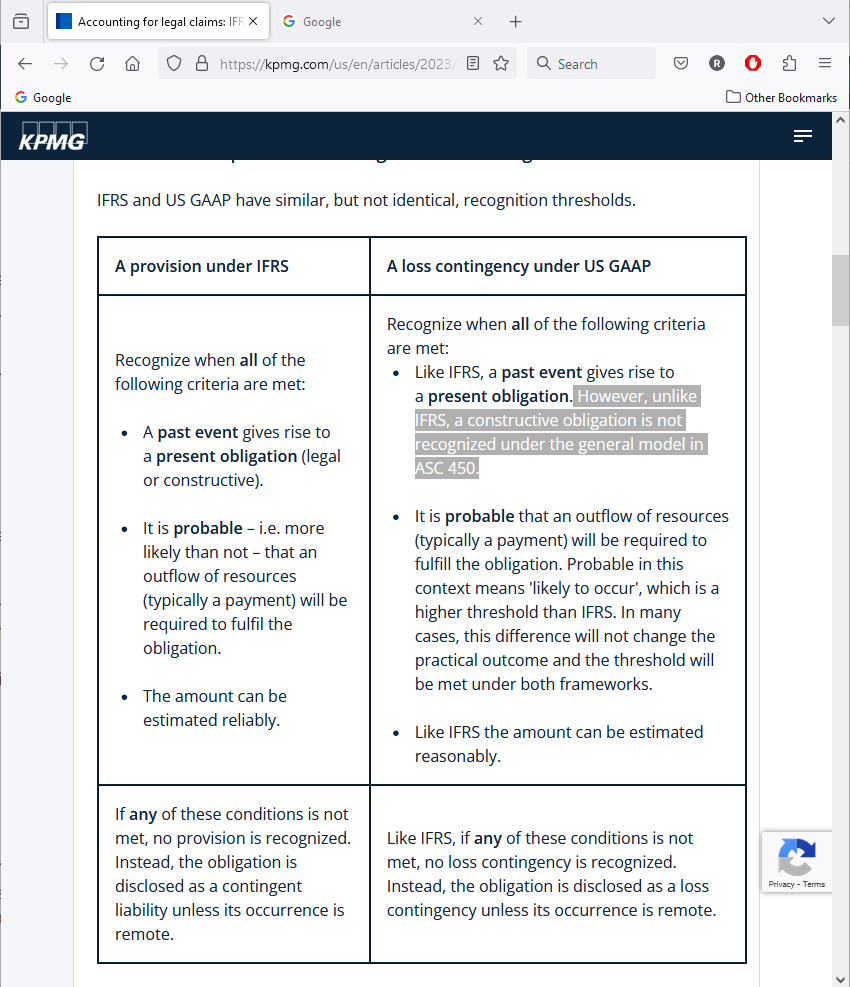
FAS 5 was adopted in 1975. It was codified, as ASC 450, without an update. As such, it pre-dates even the first conceptual framework by five years and, by today's standards, is, to put it mildly, archaic.
While a constructive obligation could be recognized by analogy, it should be recognizable on judgment alone.
ASC 710-10-25-2 states (edited):...The definition [of a liability] also encompasses a constructive obligation for reasonably estimable compensation for past services that, based on the employer's past practices, probably shall be paid and can be reasonably estimated.
While it may be theoretically possible to take this guidance into consideration, going from something as focused as compensated absences to something as broad as contingent liabilities is not only a stretch, but unnecessary.
Reading ASC 450 (carefully), one comes across ASC 450-20-55-14 which states (edited, emphasis added): With respect to unasserted claims and assessments, an entity must determine the degree of probability that a suit may be filed or a claim or assessment may be asserted and the possibility of an unfavorable outcome. If an unfavorable outcome is probable and the amount of loss can be reasonably estimated, accrual of a loss is required by paragraph 450-20-25-2. ...
Not only does the guidance suggest an obligation should be recognized if the entity expects a suit to be filed, a claim may also merely be asserted.
Given the litigious nature of the US business environment and the uncertainty inherent in common law jury trials, claims are often settled well before they are formally filed.
Similarly, for issues such as environmental harm, aggressive labor practices or product liability, it is often in a company’s best interest to settle and avoid the bad publicity well before a formal court filing catches the attention of the press, or social media.
From this perspective, that ASC 450 does not use the term "constructive obligations" for obligations that have not yet, and perhaps never will, begun their journey through the legal process, does not mean these obligations should not be recognized.
In forming that judgment, one should consider CON 8.Ch4.E50 (edited) where the FASB explains: ...A constructive obligation is created, inferred, or construed from the facts in a particular situation rather than contracted by agreement with another entity or imposed by government. An entity may become constructively obligated through customary business practice. In the normal course of business, an entity conducting certain activities may not create a clear contractual obligation but may nonetheless cause the entity to become presently obligated...
While this, in and of itself, does not justify recognizing a constructive obligation, CON 8.Ch4.E52 continues: Determining whether an entity is bound by an obligation to a third party in the absence of a clear determination of legal enforceability is often extremely difficult. Thus, the concept of constructive obligations must be applied with great care. Overly narrow interpretations tend to exclude significant actual obligations of an entity, while too-broad interpretations effectively nullify the definition of liabilities.
The key phrase: "must be applied with great care," which does not mean cannot be applied ever.
Another important phrase: "exclude significant actual obligations" something financial statement users, and even the SEC, hate almost as much as overstated revenue.
Finally, whether it is extremely difficult or merely somewhat challenging, is a matter of opinion.
Specifically, ASC 105-10-05-2 states (edited, emphasis added): If the guidance for a transaction or event is not specified within a source of authoritative GAAP for that entity, an entity shall first consider accounting principles for similar transactions or events within a source of authoritative GAAP for that entity and then consider nonauthoritative guidance from other sources...
According to ASC 105-10-05-3.d, nonauthoritative guidance from other sources includes International Financial Reporting Standards.
Thus, considering CON 8.Ch4, ASC 105-10-05-2 and ASC 105-10-05-3.d, one could conclude that applying IAS 37.17 to 21, guidance under which recognizing constructive obligations is not that difficult, to fill in the gaps of an outdated topic like ASC 450 would be reasonable, even in the absence of a clear determination of legal enforceability.
While US GAAP devotes a sub-topic to environmental liabilities, IFRS does not.
Even though it does not break environmental obligations out into a separate sub-standard comparable to ASC 410-30, IAS 37 does not ignore them, mentioning the issue in both IAS 37.19 and IAS 37.21. While this lack of specificity does lead to some differences, they are too minor to make any real difference.
As it is a stand-alone topic, ASC 410-30 provides more detailed and more prescriptive guidance. This can result in somewhat different results.
Even when the guidance is comparable, it can be subtly different.
For example, ASC 410-30-35-8 states (edited): ...The amount of an environmental remediation liability should be determined independently from any potential claim for recovery, and an asset relating to the recovery shall be recognized only when realization of the claim for recovery is deemed probable...
This implies, under ASC 410, a contingent gain, if associated with a potential recovery of amounts expended for environmental remediation, may be recognized before it is realized even though this is not consistent with the general, contingent gain guidance provided by ASC 450-30-25-1.
While a reversal of the loss/expense would be more appropriate, in practice these recoveries are generally recognized as gains.
However, as ASC 410-30-35-8 fails to specify which approach should be used, the appropriate accounting treatment should be decided by the entity, after confirming its acceptability with its independent auditor.
IAS 37 also addresses reimbursement, but IAS 37.53 states (edited):...the reimbursement shall be recognised when, and only when, it is virtually certain that reimbursement will be received if the entity settles the obligation...
So both US GAAP and IFRS recognize reimbursements before they are realized but, since probable in US GAAP is around 75%-80% while virtually certain is generally 90%-95%, US GAAP will probably recognize them sooner.
Somewhat more pronounced, IAS 37.5 states: In the statement of comprehensive income, the expense relating to a provision may be presented net of the amount recognised for a reimbursement. This implies that it would not be appropriate to present the item as a gain as is common, US GAAP practice.
Again, a difference, but whether it is major or minor, is a matter of opinion.
Similarly, IFRS does not provide stand-alone guidance for commitments, guarantees or warrantees.
IFRS does not provide stand-alone guidance for commitments comparable to ASC 440. However, as a commitment generally leads to a liability of uncertain timing or amount (a.k.a. provision), IAS 37's general guidance generally leads to generally comparable results.
One minor complication, IFRS scatters specific guidance throughout rather than putting it all in one place.
The disclosure of commitment is discussed, for example, in IAS 10.22.i, IAS 16.74.c, IAS 24.18.b and 21.i, IAS 38.122.e, IAS 41.49.b, IFRS 12.19D.b and 23.a, IFRS 7.14, 35B.c and B48, or IFRS 17.55.
ASC 440-10-50-1 requires disclosure of:
- Unused letters of credit
- Leases
- Assets mortgaged, pledged, or otherwise subject to lien; the approximate amounts of those assets; and the related obligations collateralized
- Pension plans
- The existence of cumulative preferred stock dividends in arrears
- Commitments, including:
- A commitment for plant acquisition
- An obligation to reduce debts
- An obligation to maintain working capital
- An obligation to restrict dividends.
Unfortunately, this list is not exhaustive. Additional guidance is provided at the topic (particularly industry specific) level. For example: ASC 920-440-50-1, ASC 928-440-50-1 or ASC 952-440-50-1.
Also, ASC 440-10-50-2 to 7 provide additional guidance on unconditional purchase obligations. However, as outlined in ASC 440-10-25-1 to 4, an unconditional purchase obligation should first be evaluated to see if it is subject to ASC 842, ASC 815 or ASC 330. Only if not, would it be subject to ASC 440.
Note: while the illustration in ASC 440-10-55 ("an integral part of the requirements of [the] Subtopic") suggests commitments should be disclosed in some detail, in practice, that much detail practically never appears in any published, financial report. The issue of information overload is also discussed in the last illustration on this page.
IAS 37.2 states: This Standard does not apply to financial instruments (including guarantees) that are within the scope of IFRS 9 Financial Instruments. This implies, IAS 37 does apply to guarantees not within the scope of IFRS 9 or, by implication, other specific standards, such as IFRS 15 or IFRS 17.
In contrast, as US GAAP is fond of lists, ASC 460 is fairly specific as to the guarantees that fall into its scope and those that do not.
- Contracts that contingently require a guarantor to make payments ... to a guaranteed party based on changes in an underlying that is related to an asset, a liability, or an equity security of the guaranteed party. For related implementation guidance, see paragraph 460-10-55-2.
- Contracts that contingently require a guarantor to make payments ... to a guaranteed party based on another entity's failure to perform under an obligating agreement (performance guarantees). For related implementation guidance, see paragraph 460-10-55-12.
- Indemnification agreements (contracts) that contingently require an indemnifying party (guarantor) to make payments to an indemnified party (guaranteed party) based on changes in an underlying that is related to an asset, a liability, or an equity security of the indemnified party.
- Indirect guarantees of the indebtedness of others, even though the payment to the guaranteed party may not be based on changes in an underlying that is related to an asset, a liability, or an equity security of the guaranteed party.
- A guarantee or an indemnification that is excluded from the scope of Topic 450 (see paragraph 450-20-15-2—primarily employment-related guarantees)
- A lessee's guarantee of the residual value of the underlying asset at the expiration of the lease term under Topic 842
- A contract that meets the characteristics in paragraph 460-10-15-4(a) but is accounted for as variable lease payments under Topic 842
- A guarantee (or an indemnification) that is issued by either an insurance entity or a reinsurance entity and accounted for under Topic 944 (including guarantees embedded in either insurance contracts or investment contracts)
- A contract that meets the characteristics in paragraph 460-10-15-4(a) but provides for payments that constitute a vendor rebate (by the guarantor) based on either the sales revenues of, or the number of units sold by, the guaranteed party
- A contract that provides for payments that constitute a vendor rebate (by the guarantor) based on the volume of purchases by the buyer (because the underlying relates to an asset of the seller, not the buyer who receives the rebates)
- A guarantee or an indemnification whose existence prevents the guarantor from being able to either account for a transaction as the sale of an asset that is related to the guarantee's underlying or recognize in earnings the profit from that sale transaction
- A registration payment arrangement within the scope of Subtopic 825-20 (see Section 825-20-15)
- A guarantee or an indemnification of an entity's own future performance (for example, a guarantee that the guarantor will not take a certain future action)
- A guarantee that is accounted for as a credit derivative at fair value under Topic 815.
- A sales incentive program in which a manufacturer contractually guarantees to reacquire the equipment at a guaranteed price or guaranteed prices at a specified time, or at specified time periods (for example, the entity is obligated to reacquire the equipment or the entity is obligated at the customer's request to reacquire the equipment). That program shall be evaluated in accordance with Topic 606 on revenue from contracts with customers, specifically the implementation guidance on repurchase agreements in paragraphs 606-10-55-66 through 55-78.
While not minor per se, guarantees are niche issue, generally dealt with by experts who do not really need any illustrations.
Warrantees are not a minor issue. In the ASC, they are even given their own, stand-alone sub-topic.
However the difference, ASC 460 includes specific warrantee guidance while IAS 37 does not, is minor.
The reason? The primary guidance for warrantees is IFRS 15 and ASC 606, not IAS 37 or ASC 460. As IFRS 15 and ASC 606 are converged, IFRS and US GAAP approach the issue the same way. For the same reason, this page only addresses warrantees in passing, while the receivables and revenue page goes into more detail.
Unlike IFRS, US GAAP does not allow a liability associated with a change in legislation to be recognized until enactment.
While IAS 37.22 states (edited, emphasis added): Where details of a proposed new law have yet to be finalized, an obligation arises only when the legislation is virtually certain to be enacted as drafted..., under US GAAP one needs to wait until the law is enacted.
While US GAAP does provide overall, general guidance to this effect like IFRS, ASC 740-10-25-47 does states (emphasis added): The effect of a change in tax laws or rates shall be recognized at the date of enactment. Thus, by analogy, all changes in law are recognized when the law is enacted not when it is virtually certain to be enacted.
In a nutshell, the difference between IFRS provisions and US GAAP contingencies liabilities is one of semantics.
IAS 37 defines provision (edited): A provision is a liability [a present obligation of the entity to transfer an economic resource as a result of past events] of uncertain timing or amount.
ASC 450-20 defines contingency: An existing condition, situation, or set of circumstances involving uncertainty as to possible gain (gain contingency) or loss (loss contingency) to an entity that will ultimately be resolved when one or more future events occur or fail to occur.
While ASC 450-20 refers to loss contingencies, the conceptual framework discusses contingent liabilities.
The reason, FAS 5 (1975) used terminology reflecting the then prevalent income/expense view of accounting. In 1980, Con 3 shifted views to asset/liability. As FAS 5 was codified without an update, ASC 450's language continues to reflect this older view.
Note: while a discussion of the implication of this change in view is beyond the scope of this web site, this dissertation includes a deeper analysis of some of its implications (link / local link).
So, provisions and contingent liabilities, if interpreted correctly, are comparable even if the amounts recognized and the timing of that recognition may differ.
FAS 5 (now ASC 450) was adopted in 1975. As it pre-dates the conceptual framework, its guidance is a bit dated. So, while its definition of a contingency fits with the conceptual framework, its recognition guidance less so.
The ASC 450-20 definition (quoted above) specifies that the condition, situation, or set of circumstances leading to the loss contingency be existing which means it must be present at the balance sheet date.
It is thus consistent with CON 8.Ch4.
CON 8.Ch4.E37 states: A liability is a present obligation of an entity to transfer an economic benefit.
CON 8.Ch4.E38 states: A liability has the following two essential characteristics:
- It is a present obligation.
- The obligation requires an entity to transfer or otherwise provide economic benefits to others.
ASC 450-20-25-2 (emphasis added) states: An estimated loss from a loss contingency shall be accrued by a charge to income if both of the following conditions are met:
- Information available before the financial statements are issued or are available to be issued (as discussed in Section 855-10-25) indicates that it is probable that an asset had been impaired or a liability had been incurred at the date of the financial statements. Date of the financial statements means the end of the most recent accounting period for which financial statements are being presented. It is implicit in this condition that it must be probable that one or more future events will occur confirming the fact of the loss.
- The amount of loss can be reasonably estimated.
Specifically, the phrase "information... indicates that it is probable that ... a liability had been incurred at the date of the financial statements" if taken literally, indicates that what is contingent is the liability itself, not just the timing or amount of the liability. Adding to the confusion, this phrase is also consistent with the dictionary definition of contingent leading many people to interpret it literally.
Merriam-Webster (link) defines contingent: dependent on or conditioned by something else.
Applied to an accounting context: if we lose a pending lawsuit, then we will pay a fine, making fine, hence the liability, dependent on or conditioned by the lawsuit.
One result, this interpretation is reflected in US GAAP educational material, and has been for some time.
For example, Intermediate Accounting, Kieso & Weygandt, 5th edition, page 661, states: What must be known is whether it is probable that a liability has been incurred.
While it has been updated over the years, page 674 of the 18th edition continues to state (emphasis added): Contingent liabilities depend on the occurrence of one or more future events to confirm either the payable, the payee, the date payable or its existence. That is these factors depend on a contingency.
When the author of this web page was still at school and the discussion turned to the meaning of the word probable on page 661, our professor explained contingent liabilities were not like regular liabilities. They were special.
As the liability was not based on a past transaction or event, but something that has yet to occur, the probability could not be the standard 75% to 80%, but a higher, 95% plus.
Being young and impressionable, none of us thought to point out the logical inconsistency between the definition and the guidance, nor the non-conceptual nature of that guidance.
Well, no one except Johny, who intended to become an actuary, and enjoyed giving teachers a hard time.
In any event, this "misinterpretation" of the guidance caught the attention of the FASB which, in the latest iteration of the conceptual framework, clarified:...contingent liabilities satisfy the definition of a liability because the contingency does not relate to whether a present obligation exists but instead relates to one or more uncertain future events that affect the amount that will be required to settle the present obligation. For those obligations, the fact that the outcome is unknown affects the measurement but not the existence of the liability...
CON 4.8.E60 (edited, emphasis added): Sometimes present obligations with uncertain amounts and timing are referred to as contingent liabilities. The term contingent liability has been a source of confusion because it is often thought to refer to circumstances in which the existence of an obligation depends on the occurrence or nonoccurrence of a future event. Absent a present obligation, the occurrence or nonoccurrence of a future event does not by itself give rise to a liability...
Looking back, even CON 3 indicated an update to the guidance was in order.
Specifically, CON 3.28 (issued in 1980) stated: Liabilities are probable future sacrifices of economic benefits arising from present obligations of a particular entity to transfer assets or provide services to other entities in the future as a result of past transactions or events. This definition was carried forward to CON 6.35.
While this original definition did not explicitly state the obligation must be a present obligation like CON 8.Ch4.E37. It did, specify it had to be the result of a past event. So obviously, if the obligating event was in the past and the sacrifice is in the future, it goes without saying that the obligation must exist in the present.
Interestingly, instead of the past, CON 8.Ch4 now discusses the present. As the FASB explains (CON 8.Ch4.E28): The existence of a present right at the financial statement date means that the right and therefore the asset have arisen from past transactions or other past events or circumstances. Even though E28 refers to a present right (an asset), the same logic would apply to a present obligation (a liability).
The FASB does not explain why it has never gotten around to doing so, even though this old, outdated guidance has been the source of confusion for over 40 years. Perhaps it had bigger fish to fry.
Such as the project to update the disclosure of contingent liabilities, which it abandoned after two exposure drafts (below).
Consequently, provided ASC 450-20-25-2.a is interpreted the way the FASB says it should be interpreted (not literally), provisions and contingent liabilities are comparable.
Both an IFRS provision and a US GAAP contingent liability:
- is an obligation that exists at the balance sheet date.
- was caused by a transaction or event that occurred before the balance sheet date.
- needs to be estimated because its amount (or timing) will only become known after the balance sheet date.
Another thing they have in common, the accounting for provisions | contingent liabilities can be challenging.
Warrantees, refund obligations, bad debt allowances, restructurings, asset retirement obligations, environmental obligations, commitments, guarantees, unfavorable contracts, litigation all have one thing in common: they need to be estimated.
As discussed above, IFRS addresses related issues in a single standard, while US GAAP prefers to spread its guidance out.
Why this particular order?
As a rule, warrantees, refund obligations and uncollectible accounts: smooth sailing.
The starting point is generally historical experience, which may not even need to be adjusted to reflect current conditions. This makes estimating warrantees, refunds and bad debts fairly straightforward.
Note: refund obligations and bad debt allowances are not governed IAS 37 | ASC 4XX, but rather IFRS 15 | ASC 606. They are included in this list because, like warrantee obligations, they need to be estimated. However, as they are related to revenue, they are illustrated on the Receivables and revenue page.
As receivables are linked to revenue, IFRS 15 | ASC 606 provides the primary guidance. However, as they are also financial assets, IFRS 15.108 | ASC 606-10-45-4 points to IFRS 9 | ASC 310 and ASC 326-20 for guidance on how to deal with uncollectible accounts.
Restructurings, asset retirement and environmental obligations: choppy seas.
Unlike the warrantees, refund obligations or uncollectible accounts, restructurings, asset retirement and environmental obligations need to be estimated using forward looking data.
In making the estimates, the accountant takes into account management's plans, forecasts and assumptions, which may require some effort to process into a reasonable quantification. Nevertheless, the uncertainties associated with these obligations tend to be more manageable than those associated with unfavorable contracts, commitments, guarantees and especially pending or threated litigation.
Also, as restructurings generally occur over fairly short time frames and have costs that lend themselves to accurate estimation, they pose less of a challenge than retirement or environmental obligations, which may take years to settle and can be influenced by factors such as changes in technology or legislation. As they are related to PP&E, retirement obligations are illustrated on of this page.
Commitments, guarantees or unfavorable contracts: dimenhydrinate.
Not only do commitments, guarantees and onerous | disadvantageous contracts need to be found and identified but, having legal form, evaluated by experts who, in addition to IFRS | US GAAP, are well versed in the nuances of the contract law applicable in the jurisdiction, if such experts can be found.
As noted above, US GAAP does not specifically mention "onerous contracts." Nevertheless, ASC 420-10-25-11.b does mention costs that will continue to be incurred under the contract for its remaining term without economic benefit to the entity.
Is this different from a contract in which the unavoidable costs of meeting the obligations under the contract exceed the economic benefits expected to be received under it (IAS 37.68)?
Maybe, but not by much.
This somewhat cavalier dismissal bellies the fact that, while comparable, IFRS | US GAAP guidance is not identical, especially since, instead of putting it all in one place, US GAAP spreads its guidance around.
For example, some contracts can fall into the guidance on commitments (ASC 440-10-25-4 addresses purchase commitments associated with inventory, although it points to ASC 330-10-35-17 and 18 for the details).
Some contracts may also fall into industry specific guidance, for example ASC 954-440, ASC 954-450, or ASC 980-350.
Also, ASC 420-10-25-13 discusses details, such as specifying a cease-use date, which IAS 37.66 to 69 do not address.
So, depending on the entity and the exact contracts it has, differences could result.
So, the only palpable difference, IAS 37 does not mind estimates, while ASC 420 prefers more precision.
While IAS 37 does not specifically state an entity may recognize an approximate cost associated with onerous contracts, in IAS 37.83.a.iii it does allow a provision comprising the approximate number of employees to be terminated. This suggests, since one approximation is acceptable, another approximation would probably be OK as well.
ASC 420-10-25-12 states: A liability for costs to terminate a contract before the end of its term shall be recognized when the entity terminates the contract in accordance with the contract terms (for example, when the entity gives written notice to the counterparty within the notification period specified by the contract or has otherwise negotiated a termination with the counterparty).
Thus the entity has to not only identify each individual disadvantageous contract, but inform the counterparty of its intention to terminate that contract. This implies a considerably higher level of precision than a mere approximation.
Note: to avoid confusing them with "onerous" contracts, this page refers the US GAAP version as disadvantageous, though both onerous and disadvantageous contracts could be labeled as unfavorable.
International companies applying US GAAP face the additional challenge that, unlike IFRS, which assumes it will be applied in various jurisdictions with various legal traditions, US GAAP is geared toward the particular flavor of common law used in the USA.
This can make applying its guidance to commitments, guarantees and contracts entered into outside the USA somewhat more challenging.
As accounting and law are separate disciplines, accountants quickly become accustomed to consulting their legal colleges and incorporating their views into IFRS | US GAAP recognition and measurement guidance.
For this reason, IAS 37 allows experts to assist with the recognition (IAS 37.16) and especially measurement (IAS 37.38) of provisions.
US GAAP gives similar guidance in ASC 450-20-55-12.c.
Lawsuits pending, threatened or unasserted: gruesome.
On paper, IFRS guidance is formidable. While not as challenging, US GAAP guidance, as written, is still far from straightforward especially as it includes a bonus requirement.
As outlined in IAS 37.36 and 37, a provision is measured at the expenditure required to settle the obligation, or what the entity would rationally pay to transfer the obligation to a third party.
As the only third parties generally interested in assuming such obligations are insurance companies, these seemingly innocuous paragraphs point to perhaps the most challenging guidance of all: IFRS 17.
In other words, to apply the guidance as written, one needs estimate what an insurance company, or similar third party, would rationally charge to assume the liability. One way to do so is to ask, assuming can find an insurance company, or similar third party, willing and able to make an offer.
The other is to pretend to be an insurance company apply IFRS 17.
Fortunately, IFRS 17 does provide detailed guidance on how to calculate insurance obligations.
Unfortunately, this guidance is not particularly straight-forward.
For example, it instructs entities to measure potential insurance claims with the:
- unbiased use of all reasonable and supportable information available without undue cost or effort (see paragraphs B37–B41);
- market variables and non-market variables (see paragraphs B42–B53);
- using current estimates (see paragraphs B54–B60); and
- cash flows within the contract boundary (see paragraphs B61–B71).
It also, for example, explains what it means by "without undue cost or effort."
IFRS 17.B41: An entity shall estimate the probabilities and amounts of future payments under existing contracts on the basis of information obtained including:
- information about claims already reported by policyholders.
- other information about the known or estimated characteristics of the insurance contracts.
- using current estimates (see paragraphs B54–B60); and
- historical data about the entity’s own experience, supplemented when necessary with historical data from other sources. Historical data is adjusted to reflect current conditions, for example, if:
- the characteristics of the insured population differ (or will differ, for example, because of adverse selection) from those of the population that has been used as a basis for the historical data;
- there are indications that historical trends will not continue, that new trends will emerge or that economic, demographic and other changes may affect the cash flows that arise from the existing insurance contracts; or
- there have been changes in items such as underwriting procedures and claims management procedures that may affect the relevance of historical data to the insurance contracts.
Perhaps, for an insurance companies, this information is available "without undue cost or effort."
For a company merely pretending to be an insurance company?
Some undue cost or effort will probably be necessary.
Note: unlike ASC 450, IAS 37 does not explicitly discuss unasserted claims and assessments. This does not, however, mean they will never be recognized.
The closest IFRS came to dealing with this issue is a staff paper (link) and IASB discussion (link).
The likely reason no action was ever taken, IAS 37.14 states: A provision shall be recognised when:
- an entity has a present obligation (legal or constructive) as a result of a past event;
- it is probable that an outflow of resources embodying economic benefits will be required to settle the obligation; and
- a reliable estimate can be made of the amount of the obligation.
IAS 37 defines: a legal obligation is an obligation that derives from:
- a contract (through its explicit or implicit terms);
- legislation; or
- other operation of law.
Other operation of law can be interpreted to mean: if the entity has committed an act that will probably result in a lawsuit being threatened or initiated, through the operation of law it will be compelled to recompense the counterparty(ies) adversely impacted by that act.
One way to deal with this: send all managers a form asking them to detail any situation where they think the company may have done something that could lead to a lawsuit being filed or threatened. And, while they are at it, if they could throw in an estimate, that would be great. And, adding probability quantifications would also be a nice touch. Oh, by the way, this needs to be submitted at least a month before year end so it can be reviewed and any additional questions posed.
While it's not a company, the DOJ has a great form that can be easily adapted (link / local link).
No wonder no one wants to sit with the accountants at lunch, they're worse than science hippies (but just as useful).
ASC 450-20-30-1 states (edited): If some amount within a range of loss appears at the time to be a better estimate than any other amount within the range, that amount shall be accrued...
It does not, however, provide any clue as to how this, or any amount, should be determined.
Even the illustrations, often a hidey-hole for useful guidance, are not particularly informative.
For example, ASC 450-20-55-18 (edited) states: ... Another aspect of the litigation may, however, be open to considerable interpretation, and depending on the interpretation by the court the entity may have to pay an additional $8 million over and above the $2 million.
Interesting, but not a word on how to calculate the $2 million, or the $8 million.
Fortunately, ASC 420-20-30-1 states (edited, emphasis added): A liability for a cost associated with an exit or disposal activity shall be measured initially at its fair value...
As noted above, ASC 450 is one in a series of related topics.
Consequently, it would be permissible to apply the guidance in ASC 420, by analogy, to fill in ASC 450's gaps.
ASC 420-10-30-2 continues (edited): Quoted market prices are the best representation of fair value. However, for many of the liabilities covered by this Subtopic, quoted market prices will not be available. Consequently, in those circumstances, fair value will be estimated using some other valuation technique...
Consequently, similarly to IAS 37, an entity could solicit an offer (quoted market price) from, for example, an insurance company. However, unlike IAS 37, it would not need to pretend it is an insurance company.
As discussed above, IAS 37.36 points to IFRS 17. In contrast, ASC 420-10-30-2 merely points to ASC 820.
While the guidance on valuation techniques (ASC 820-10-55-3A to 20) is not particularly straightforward, it is less daunting than if ASC 420 were to point to ASC 944.
Fortunately, as the contingent liabilities covered by ASC 450 are not discounted, at least an entity does not need to determine an appropriate discount rate.
Unasserted claims and assessments are discussed in ASC 450-20-55-1, ASC 450-20-50-6 and ASC 450-20-S99-1. While they are comparable to asserted claims and assessments in that they are accrued if probable and estimable, as they are unasserted, the accounting department may not know they exist.
One way to deal with this: send all managers a form asking them to detail any situation where they think the company may have done something that could lead to a lawsuit being filed or threatened. And, while they are at it, if they could throw in an estimate, that would be great. And, adding probability quantifications would also be a nice touch. Oh, by the way, this needs to be submitted at least a month before year end so it can be reviewed and any additional questions posed.
While it's not a company, the DOJ has a great form that can be easily adapted (link / local link).
No wonder no one wants to sit with the accountants at lunch, they're worse than science hippies (but just as useful).
However, once clear of the rocks and shoals, back to smooth sailing.
As this silly metaphor implies, recognizing and measuring ongoing litigation is above any sailor’s paygrade.
To put it plainly, accountants have no business estimating obligations best left to experts.
For this reason, IAS 37 allows experts to assist with the recognition (IAS 37.16) and especially measurement (IAS 37.38) of provisions.
Beyond plain vanilla issues like product warrantees or bad debts, or even challenging but manageable situations like retirement obligations, accountants should not try estimating the costs expected to be incurred to resolve pending litigation or meet legislative obligations or, in some cases, determine post-employment benefits that only an actuary can calculate.
In some jurisdictions, particularly those with a legalistic national GAAP, the opinions of court appointed appraisers are accepted at face value.
However, from an IFRS | US GAAP perspective, whether an appraiser is court appointed or not is beyond the point. The appraiser must be demonstrably qualified and independent instead.
IAS 40.32 provides the most pertinent discussion (edited):...an independent valuer who holds a recognised and relevant professional qualification and has recent experience in the location and category of the investment property being valued.
For its part, US GAAP does not specify what an independent valuer must be, but ASC 805-10-55-27 does suggest that the opinion from such a valuer is sufficient evidence to warrant remeasuring a previously recognized item of property, plant, and equipment.
This issue is also addressed by the SEC.
In ASC 310-10-S99-4.3.a (edited, emphasis added) it states: ... the staff normally would expect to find that Registrant B had documented how it determined the fair value, including the use of appraisals, valuation assumptions and calculations, the supporting rationale for adjustments to appraised values, if any, and the determination of costs to sell, if applicable, appraisal quality, and the expertise and independence of the appraiser.
US GAAP gives similar guidance in ASC 450-20-55-12.c.
However, once the amounts have been recognized and measured by qualified experts, the remaining task, reporting and disclosure, is something any experienced accountant can handle.
Warranties
XYZ is a retailer. By law it must provide a 2-year repair/replace warranty for defects. From 1/1/X1 to 3/31/X1, it sold goods for 1,000,000. In its experience, nonrecoverable costs associated with repairing or replacing defective goods are 3% of sales.
The accounting for warrantees is primarily governed by IFRS 15 | ASC 606. Consequently, additional illustrations are provided on the Receivables and revenue page.
As outlined in IFRS 15.B30 | ASC 606-10-55-32, if a warranty is not sold separately and does not provide a service in additional to assurance, it is accounted for as a provision (IAS 37) | guarantee (ASC 460-10).
As outlined in IFRS 15.B29 & B32 | ASC 606-10-55-31 & 34, if a warranty is sold separately or provides a service in additional to assurance, it is accounted for as a separate performance obligation, which generally means the portion of revenue associated with the warranty is deferred.
IFRS 15.B31 | ASC 606-10-55-33 gives guidance on how to determine if a warranty provides a service in addition to assurance, but fails to explicitly state what assurance is. However, sub-paragraph c provides a clue by mentioning the cost of shipping defective products.
IFRS 15.B31 | ASC 606-10-55-33: In assessing whether a warranty provides a customer with a service in addition to the assurance that the product complies with agreed-upon specifications, an entity shall consider factors such as:
- Whether the warranty is required by law—if the entity is required by law to provide a warranty, the existence of that law indicates that the promised warranty is not a performance obligation because such requirements typically exist to protect customers from the risk of purchasing defective products.
- The length of the warranty coverage period—the longer the coverage period, the more likely it is that the promised warranty is a performance obligation because it is more likely to provide a service in addition to the assurance that the product complies with agreed-upon specifications.
- The nature of the tasks that the entity promises to perform—if it is necessary for an entity to perform specified tasks to provide the assurance that a product complies with agreed-upon specifications (for example, a return shipping service for a defective product), then those tasks likely do not give rise to a performance obligation.
Reading between the lines, an assurance warranty is a promise by the seller (manufacturer) to repair defective merchandise (products) or replace them if they cannot be repaired for a term not exceeding one year (common practice) unless a term of longer than one year is mandated by law (in jurisdictions that have such mandates).
The same logic applies to services except, instead or replace/repair, the service would be reperformed.
Note: if, instead of repair/replace/reperform, the promise involves a refund, the guidance on warranties no longer applies.
Instead, the transaction(s) should be accounted for as a right to return.
Dr/Cr
|
1/1/ - 3/31/X1 / 1.1. - 31.3.X1 |
|
|
|
|
Cash, Payment card receivables, etc. |
1,000,000 |
|
|
|
Selling (distribution) expenses: Warranties |
30,000 |
|
|
|
|
Revenue |
|
1,000,000 |
|
|
Provision (contingent liability): Assurance warranty: Q1/X1 |
|
30,000 |
The cost associated with providing assurance type warranties should be classified as a selling expense regardless of whether it is required by law or not.
If required by law, it is a condition the seller must meet to be allowed to sell its goods.
If not required by law, it is a non-monetary incentive to the customer which helps facilitate the sale.
IFRS prefers the term Distribution (DistributionCosts), while US GAAP uses Selling (SellingExpense).
The advantage of using Selling instead of Distribution is that Selling can combined with General and Administrative expenses to make SG&A. An acronym like DG&A would, on the other hand, not mean anything to anyone.
As noted above, that IFRS recognizes provisions and US GAAP contingent liabilities is an actual difference.
As outlined in ASC 606-10-55-32, product warranties should be accounted for as guarantees (ASC 460). However, 460-10-25-1 states it does not apply to product warranties ¯\_(ツ)_/¯. Fortunately, ASC 460-10-25-5 does point to ASC 450-20-25-2 leads to ASC 606-10-55-32 which is comparable to IFRS 15.B30.
ASC 460-10-25-1 (emphasis added): The following types of guarantees are not subject to the recognition provisions of this Subsection: ... b. A product warranty or other guarantee for which the underlying is related to the performance (regarding function, not price) of nonfinancial assets that are owned by the guaranteed party ...
Thus, the only palpable difference, IFRS may require these items to be discounted while US GAAP does not.
However, since often "the effect of discounting is not material" (IAS 37.Example 1 Warranties), discounting warranty obligations is rare in practice.
As outlined in IAS 37.61, a provision may only be used only for expenditures associated with that provision.
XYZ interpreted this guidance by setting up a separate provision account for each quarter's sales.
Note: while ASC 450-20 does not provide similarly explicit guidance, cookie jar reserves are seriously frowned upon by the SEC and should be avoided at all cost.
As outlined in ASC 835-30-15-3.g, "contractual or other obligations assumed in connection with sales of property, goods, or service, for example, a warranty for product performance" need not be discounted. This is consistent with the guidance in ASC 450, which also does not require contingent liabilities to be discounted.
Unfortunately, IFRS does not include a similar, blanket exception and, as outlined in IAS 37.45, provisions do need to be discounted if the time value of money is material.
Nevertheless, in both examples C 1 and D 1 (where the warrantee term is three and two years respectively) the provision is not discounted because, as specified in example D 1, the amounts involved are not material. As a result, discounting warrantee obligation is not common practice in IFRS either.
5/1/X1, a customer returned defective merchandise that was repaired at a cost of 10 (XYZ outsourcers its repairs to DEF). 5/15/X1, a customer returned defective merchandise that XYZ replaced. XYZ’s cost was 30. 9/30/X2, a customer returned defective merchandise that would have been too expensive to repair, was no longer in stock and could not be purchased. The merchandise was originally sold for 50.
|
5/1/X1 / 1.5.X1 |
|
|
|
|
Provision: Assurance warranty: Q1/X1 |
10 |
|
|
|
|
Account payable: DEF |
|
10 |
|
5/15/X1 / 15.5.X1 |
|
|
|
|
Provision: Assurance warranty: Q1/X1 |
30 |
|
|
|
|
Inventory: Merchandise |
|
30 |
|
9/30/X2 / 30.9.X2 |
|
|
|
|
Provision: Assurance warranty: Q1/X1 |
50 |
|
|
|
|
Cash |
|
50 |
Although the standards do not specifically address this issue, as the provision was originally recognized to cover the costs of repair or replacement, it was recognized correctly. Provided the reasons for the cash refund are substantive, it would not need to be reevaluated as a right to return.
From 4/1/X1 to 3/31/X3, XYZ incurred costs of 29,000 related to X1.Q1 warrantees leaving a 1,000 balance.
|
3/31/X3 / 31.3.X3 |
|
|
|
|
Provision: Assurance warranty: Q1/X1 |
1,000 |
|
|
|
|
Selling expenses: Warranties |
|
1,000 |
While it does not give explicit guidance on the action to take when the provision term ends, IAS 37.59 does state (emphasis added) "Provisions shall be reviewed at the end of each reporting period and adjusted to reflect the current best estimate. If it is no longer probable that an outflow of resources embodying economic benefits will be required to settle the obligation, the provision shall be reversed."
In this example, XYZ deemed it to be "no longer probable that an outflow of resources embodying economic benefits will be required to settle the obligation" day the warrantee term ended.
Note: while ASC 450-20 does not provide similarly explicit guidance, the same approach would be consistent with the guidance it does provide.
Restructuring
11/15/X1, XYZ, an online broadcaster, publicly announced it was shutting down one of its platforms on 12/31/X1. It estimated | calculated the following costs:
As outlined in IAS 37.80, restructuring provision includes expenditures necessarily entailed by the restructuring not associated with the ongoing activities. The guidance does not specify whether these expenditures need to be calculated exactly or merely estimated approximately.
However, IAS 37.72.a.iii does state (emphasis added): the location, function, and approximate number of employees who will be compensated for terminating their services... This guidance strongly suggests an estimate, rather than rigorous calculation, is sufficient.
Nevertheless, entities should strive to make as accurate an estimate as possible because, if the estimate and the finally recognized expenditures differ substantially, this difference could be construed as a material error, subject to the guidance in IAS 8.41 to 48.
As stated in ASC 420-10-30-1 (edited): A liability for a cost associated with an exit or disposal activity shall be measured initially at its fair value... suggesting the need for a high degree of accuracy.
This guidance is reinforced by 420-10-25-4.b which states: The plan identifies the number of employees to be terminated, their job classifications or functions and their locations, and the expected completion date.
Similarly in example 1, ASC 420-10-55-2 shows the entity determining the exact number of employees to be terminated, the exact cost of each termination and calculating the obligation by multiplying the two.
With respect to contract termination costs, ASC 420-10-25-12 states (edited): ... when the entity terminates the contract in accordance with the contract terms (for example, when the entity gives written notice to the counterparty within the notification period specified by the contract or has otherwise negotiated a termination with the counterparty). This guidance, as it assumes notice has been given, also indicates an exact number, not a mere estimate.
- Employee termination: 500,000 | 511,250.
- Contract termination: 150,000 | 148,750.
- Onerous | disadvantageous contracts: 125,000 | 116,250.
- Relocation: 100,000.
- Retraining: 40,000.
- Consulting fees: 60,000.
As outlined in IAS 37.68, a contract is onerous if the unavoidable costs of meeting it exceed the economic benefits expected to be received from it. As a general rule, onerous contracts are recognized as separate, stand-alone obligations.
However, as outlined in IAS 37.82, they would be included in restructuring provision if they lead to future operating losses.
As noted in the introduction to this section, US GAAP does not specifically mention "onerous contracts." Nevertheless, ASC 420-10-25-11.b does mention costs that will continue to be incurred under the contract for its remaining term without economic benefit to the entity.
Is this different from a contract in which the unavoidable costs of meeting the obligations under the contract exceed the economic benefits expected to be received under it (IAS 37.68)?
Maybe, but not by much.
This somewhat cavalier dismissal bellies the fact that, while comparable, IFRS | US GAAP guidance is not identical, especially since, instead of putting it all in one place, US GAAP spreads it out.
For example, some contracts can fall into the guidance on commitments (ASC 440-10-25-4 addresses purchase commitments associated with inventory, although it points to ASC 330-10-35-17 and 18 for the details).
Some contracts may also fall into industry specific guidance, for example ASC 954-440, ASC 954-450, or ASC 980-350.
Also, ASC 420-10-25-13 discusses details, such as specifying a cease-use date, which IAS 37.66 to 69 do not address.
So, depending on the entity and the exact contracts it has, differences could result.
So, the only palpable difference, IAS 37 does not mind estimates, while ASC 420 prefers more precision.
While IAS 37 does not specifically state an entity may recognize an approximate cost associated with onerous contracts, in IAS 37.83.a.iii it does allow a provision comprising the approximate number of employees to be terminated. This suggests, since one approximation is acceptable, another approximation would probably be OK as well.
ASC 420-10-25-12 states: A liability for costs to terminate a contract before the end of its term shall be recognized when the entity terminates the contract in accordance with the contract terms (for example, when the entity gives written notice to the counterparty within the notification period specified by the contract or has otherwise negotiated a termination with the counterparty).
Thus the entity has to not only identify each individual disadvantageous contract, but inform the counterparty of its intention to terminate that contract. This implies a considerably higher level of precision than a mere approximation.
Note: to avoid confusing them with "onerous" contracts, this page refers the US GAAP version as disadvantageous, though both onerous and disadvantageous contracts could be labeled as unfavorable.
On 12/31/X1, it communicated details of the plan to employees, 1/1/X2, it sent contract termination notices to the effected counterparties and 1/2/X2, it ceased to use the disadvantageous contracts. By 6/30/X2, it incurred relocation costs, retraining costs and consulting fees of 112,250, 51,500, 65,000 and completed the restructuring.
IFRS | US GAAP
|
15.11.X1 |
|
|
|
|
Restructuring expense |
835,000 |
|
|
|
|
Restructuring provision |
|
835,000 |
As outlined in IAS 37.72, a provision is recognized when the entity has a constructive obligation to complete the restructuring. It has this obligation when it has a plan (detailed and formal) and has announced the plan (or started implementing it).
|
Cost |
Estimate |
Provision |
|
A |
B |
C |
|
Employee termination |
500,000 |
500,000 |
|
Contract termination |
150,000 |
150,000 |
|
Onerous contracts |
125,000 |
125,000 |
|
Staff retraining |
50,000 |
|
|
Relocation |
100,000 |
|
|
Consulting fees |
60,000 |
60,000 |
|
|
975,000 |
835,000 |
As outlined in IAS 37.81, a restructuring provision does not include retraining or relocating continuing staff, marketing, investment in new systems and distribution networks or any other cost associated with the ongoing activities of the entity.
|
By 30.6.X2 |
|
|
|
|
Restructuring provision |
776,250 |
|
|
|
Retraining expense |
112,250 |
|
|
|
Relocating expense |
51,500 |
|
|
|
Restructuring provision |
65,000 |
|
|
|
Restructuring expense |
5,000 |
|
|
|
|
Cash, Payables, etc. |
|
1,005,000 |
|
Cost |
Estimate |
Final cost |
|
A |
B |
C |
|
Employee termination |
500,000 |
511,250 |
|
Contract termination |
150,000 |
148,750 |
|
Onerous contracts |
125,000 |
116,250 |
|
Staff retraining |
50,000 |
112,250 |
|
Relocation |
100,000 |
51,500 |
|
Consulting fees |
60,000 |
65,000 |
|
|
975,000 |
1,005,000 |
|
12/31/X1 |
|
|
|
|
Restructuring expense |
511,250 |
|
|
|
|
Accrued restructuring obligation |
|
511,250 |
In contrast to IFRS, under US GAAP, having a plan is not enough.
As outlined in IAS 37.72, provision is recognized when the entity has a constructive obligation to complete the restructuring, which it has when the plan is announced.
As outlined in ASC 420-10-25-4, the obligation is recognized on "the communication date," the date it announces (b) the exact number of employees to be terminated, their job classifications or functions and their locations and provides (c) sufficient details to enable employees to determine the type and amount of benefits they will receive if they are involuntarily terminated.
Note: this guidance is sometimes interpreted as requiring termination notices to be sent to the individual employees being terminated. However, this is not strictly required.
|
1/1/X1 |
|
|
|
|
Restructuring expense |
148,750 |
|
|
|
|
Accrued restructuring obligation |
|
148,750 |
In contrast to IFRS, under US GAAP, having a plan is not enough.
As outlined in IAS 37.72, provision is recognized when the entity has a constructive obligation to complete the restructuring, which it has when the plan is announced.
As stated in ASC 420-10-25-12: a liability for costs to terminate a contract before the end of its term shall be recognized when the entity terminates the contract in accordance with the contract terms (for example, when the entity gives written notice to the counterparty within the notification period specified by the contract or has otherwise negotiated a termination with the counterparty).
Note: unlike employee termination benefits where termination notices need not be sent to individual employees, with contracts, the guidance is explicit.
|
2/1/X1 |
|
|
|
|
Restructuring expense |
116,250 |
|
|
|
|
Accrued restructuring obligation |
|
116,250 |
In contrast to IFRS, under US GAAP, having a plan is not enough.
As outlined in IAS 37.72, provision is recognized when the entity has a constructive obligation to complete the restructuring, which it has when the plan is announced.
ASC 420-10-25-13 states: A liability for costs that will continue to be incurred under a contract for its remaining term without economic benefit to the entity shall be recognized at the cease-use date. The date the entity ceases using the right conveyed by the contract, for example, to receive future goods or services.
|
By 6/30/X2 |
|
|
|
|
Accrued restructuring obligation |
776,250 |
|
|
|
Relocation expense |
112,250 |
|
|
|
Retraining expense |
51,500 |
|
|
|
Consulting fees |
65,000 |
|
|
|
|
Cash, Payables, etc. |
|
1,005,000 |
IAS 37 allows direct expenditures necessarily entailed by the restructuring to be included in the provision.
In contrast ASC 420-10-25-15 states (besides employee and contract termination): The liability shall not be recognized before it is incurred, even if the costs are incremental to other operating costs and will be incurred as a direct result of a plan. A liability for other costs associated with an exit or disposal activity shall be recognized in the period in which the liability is incurred (generally, when goods or services associated with the activity are received).
Thus, like IFRS, the obligation would exclude costs like retraining or relocating continuing staff.
Unlike IFRS, it would also exclude costs such as due diligence, consulting or labor mediation.
Legal obligation
XYZ sold vehicles in various jurisdictions. To meet emissions standards of one jurisdiction, engine control software was programmed to activate emissions controls only during emissions testing. 1/1/X1, this workaround was discovered during on-road testing. XYZ determined it would be liable for both criminal and civil penalties, as well as vehicle recall and repair costs. During Q1/X1, it estimated the litigation related costs of between 10B and 15B (criminal) and 5B to 10B (civil). It also estimated recall and repair costs between 10B and 20B. 3/31/X1, it recognized the provisions | contingent liabilities.
As there was no question a past event, emissions cheating, gave rise to a present obligation, XYZ did not need an expert's opinion to recognize the obligation. It did, however, need help with its measurement.
While expert advice is occasionally necessary to help determine whether an obligation exists, as stated in IAS 37.16 (edited): in almost all cases it will be clear whether a past event has given rise to a present obligation. In rare cases, for example in a lawsuit, it may be disputed either whether certain events have occurred or whether those events result in a present obligation. In such a case, an entity determines whether a present obligation exists at the end of the reporting period by taking account of all available evidence, including, for example, the opinion of experts...
As ASC 450-20-25 does not mention experts, it (implicitly) also considers their use necessary.
In contrast to IAS 37.16 (above), which suggest experts are not necessary to recognize an obligation, IAS 36.38 states (edited): The estimates of outcome and financial effect are determined by the judgement of the management of the entity, supplemented by experience of similar transactions and, in some cases, reports from independent experts...
Experts are especially needed in situations, such as pending litigation, where management experience is limited.
In addition to making the same point in ASC 450-20-55-12.c, ASC 450-20-55-12 provides guidance on the methodology that should be used.
ASC 450-20-55-12 (edited):... Among the factors that should be considered are the following:
- The nature of the litigation, claim, or assessment
- The progress of the case (including progress after the date of the financial statements but before those statements are issued or are available to be issued...
- They are able to enter into a transaction for the asset or liability
- The opinions or views of legal counsel and other advisers, although, the fact that legal counsel is unable to express an opinion that the outcome will be favorable to the entity should not necessarily be interpreted to mean that the condition in paragraph 450-20-25-2(a) is met
- The experience of the entity in similar cases
- The experience of other entities
- Any decision of the entity's management as to how the entity intends to respond to the lawsuit, claim, or assessment (for example, a decision to contest the case vigorously or a decision to seek an out-of-court settlement).
Schedules with the results are presented in the illustrations.
In contrast to the legal liabilities, XYZ's accounting department had experience estimating recall and repair costs. As such, it did not need to solicit any expert opinions to make this estimate.
The method it used is discussed in the illustration.
IFRS | US GAAP | IFRS and US GAAP
|
31.2.X1 |
|
|
|
|
Fines and penalties |
20.45 B |
|
|
|
|
Legal provision A |
|
12.95 B |
|
|
Legal provision B |
|
7.50 B |
As outlined in IAS 37.39, if it is possible to assign probabilities to the individual outcomes in a range, the probability weighted expected amount is recognized. To compare apples to apples, the time value of money is not illustrated.
As outlined in IAS 37.45, if the time value is material, the provision is discounted to present value.
In contrast, ASC 450 does not require contingent liabilities to be discounted.
Not discounting for IFRS purposes makes this illustration more comparable.
|
Outcome |
Estimate |
Probability |
Probability weighted outcome |
|
A |
B |
C |
D = B x C |
|
1 |
10 B |
5% |
0.50 B |
|
2 |
11 B |
10% |
1.10 B |
|
3 |
12 B |
20% |
2.40 B |
|
4 |
13 B |
25% |
3.25 B |
|
5 |
14 B |
30% |
4.20 B |
|
6 |
15 B |
10% |
1.5 B |
|
|
|
|
12.95 B |
As noted in the introduction to this section, as rule, accountants do not have the necessary qualifications to estimate the expected expenditures associated with many provisions | contingent liabilities, nor their probability, nor their timing, nor the probability of that timing. Instead, this should be left to experts, such as actuaries, that do have those qualifications.
Put simply, beyond plain vanilla situations like product warrants or repair obligations, accountants have no business estimating provisions | contingent liabilities associated with, for example, pending litigation, legislative obligations or, in many cases, corporate restructurings, especially if these involve post-employment benefits only an actuary can calculate.
For this reason, IAS 37 allows experts to assist with the recognition (IAS 37.16) and especially measurement (IAS 37.38) of provisions.
US GAAP gives similar guidance in ASC 450-20-55-12.c.
In some jurisdictions, particularly those with a legalistic national GAAP, the opinions of court appointed appraisers are accepted at face value.
However, from an IFRS | US GAAP perspective, whether an appraiser is court appointed or not is beyond the point. The appraiser must be demonstrably qualified and independent instead.
IAS 40.32 provides the most pertinent discussion (edited):...an independent valuer who holds a recognised and relevant professional qualification and has recent experience in the location and category of the investment property being valued.
For its part, US GAAP does not specify what an independent valuer must be, but ASC 805-10-55-27 does suggest that the opinion from such a valuer is sufficient evidence to warrant remeasuring a previously recognized item of property, plant, and equipment.
This issue is also addressed by the SEC.
In ASC 310-10-S99-4.3.a (edited, emphasis added) it states: ... the staff normally would expect to find that Registrant B had documented how it determined the fair value, including the use of appraisals, valuation assumptions and calculations, the supporting rationale for adjustments to appraised values, if any, and the determination of costs to sell, if applicable, appraisal quality, and the expertise and independence of the appraiser.
As outlined in IAS 37.39, if all outcomes are equally likely, the midpoint of the range is recognized. To compare apples to apples, the time value of money is not illustrated.
The same approach would be used if the probability of the individual outcomes could not be reasonably determined.
As outlined in IAS 37.45, if the time value is material, the provision is discounted to present value.
In contrast, ASC 450 does not require contingent liabilities to be discounted.
Not discounting for IFRS purposes makes this illustration more comparable.
|
Outcome |
Estimate |
Probability |
Probability weighted outcome |
|
A |
B |
C |
D = B x C |
|
1 |
5 B |
16.67% |
0.83 B |
|
2 |
6 B |
16.67% |
1.00 B |
|
3 |
7 B |
16.67% |
1.17 B |
|
4 |
8 B |
16.67% |
1.33 B |
|
5 |
9 B |
16.67% |
1.50 B |
|
6 |
10 B |
16.67% |
1.67 B |
|
|
|
|
7.50 B |
|
|
|
|
|
As noted in the introduction to this section, as rule, accountants do not have the necessary qualifications to estimate the expected expenditures associated with many provisions | contingent liabilities, nor their probability, nor their timing, nor the probability of that timing. Instead, this should be left to experts, such as actuaries, that do have those qualifications.
Put simply, beyond plain vanilla situations like product warrants or repair obligations, accountants have no business estimating provisions | contingent liabilities associated with, for example, pending litigation, legislative obligations or, in many cases, corporate restructurings, especially if these involve post-employment benefits only an actuary can calculate.
For this reason, IAS 37 allows experts to assist with the recognition (IAS 37.16) and especially measurement (IAS 37.38) of provisions.
US GAAP gives similar guidance in ASC 450-20-55-12.c.
In some jurisdictions, particularly those with a legalistic national GAAP, the opinions of court appointed appraisers are accepted at face value.
However, from an IFRS | US GAAP perspective, whether an appraiser is court appointed or not is beyond the point. The appraiser must be demonstrably qualified and independent instead.
IAS 40.32 provides the most pertinent discussion (edited):...an independent valuer who holds a recognised and relevant professional qualification and has recent experience in the location and category of the investment property being valued.
For its part, US GAAP does not specify what an independent valuer must be, but ASC 805-10-55-27 does suggest that the opinion from such a valuer is sufficient evidence to warrant remeasuring a previously recognized item of property, plant, and equipment.
This issue is also addressed by the SEC.
In ASC 310-10-S99-4.3.a (edited, emphasis added) it states: ... the staff normally would expect to find that Registrant B had documented how it determined the fair value, including the use of appraisals, valuation assumptions and calculations, the supporting rationale for adjustments to appraised values, if any, and the determination of costs to sell, if applicable, appraisal quality, and the expertise and independence of the appraiser.
|
3/31/X1 |
|
|
|
|
Fines and penalties |
19.0 B |
|
|
|
|
Contingent legal liability A |
|
14.0 B |
|
|
Contingent legal liability B |
|
5.0 B |
As outlined in ASC 450-20-30-1 if one amount appears to be a better estimate, it is accrued. While the guidance does not specify how quantify the better result, using probability will generally yield a good result.
|
Outcome |
Estimate |
Probability |
|
A |
B |
C |
|
1 |
10 B |
5% |
|
2 |
11 B |
10% |
|
3 |
12 B |
20% |
|
4 |
13 B |
25% |
|
5 |
14 B |
30% |
|
6 |
15 B |
10% |
|
|
|
|
As noted in the introduction to this section, as rule, accountants do not have the necessary qualifications to estimate the expected expenditures associated with many provisions | contingent liabilities, nor their probability, nor their timing, nor the probability of that timing. Instead, this should be left to experts, such as actuaries, that do have those qualifications.
Put simply, beyond plain vanilla situations like product warrants or repair obligations, accountants have no business estimating provisions | contingent liabilities associated with, for example, pending litigation, legislative obligations or, in many cases, corporate restructurings, especially if these involve post-employment benefits only an actuary can calculate.
For this reason, IAS 37 allows experts to assist with the recognition (IAS 37.16) and especially measurement (IAS 37.38) of provisions.
US GAAP gives similar guidance in ASC 450-20-55-12.c.
In some jurisdictions, particularly those with a legalistic national GAAP, the opinions of court appointed appraisers are accepted at face value.
However, from an IFRS | US GAAP perspective, whether an appraiser is court appointed or not is beyond the point. The appraiser must be demonstrably qualified and independent instead.
IAS 40.32 provides the most pertinent discussion (edited):...an independent valuer who holds a recognised and relevant professional qualification and has recent experience in the location and category of the investment property being valued.
For its part, US GAAP does not specify what an independent valuer must be, but ASC 805-10-55-27 does suggest that the opinion from such a valuer is sufficient evidence to warrant remeasuring a previously recognized item of property, plant, and equipment.
This issue is also addressed by the SEC.
In ASC 310-10-S99-4.3.a (edited, emphasis added) it states: ... the staff normally would expect to find that Registrant B had documented how it determined the fair value, including the use of appraisals, valuation assumptions and calculations, the supporting rationale for adjustments to appraised values, if any, and the determination of costs to sell, if applicable, appraisal quality, and the expertise and independence of the appraiser.
As outlined in ASC 450-20-30-1 if no amount appears to be a better estimate than any other amount, the minimum amount is accrued.
|
Outcome |
Estimate |
Probability |
|
A |
B |
C |
|
1 |
5 B |
16.67% |
|
2 |
6 B |
16.67% |
|
3 |
7 B |
16.67% |
|
4 |
8 B |
16.67% |
|
5 |
9 B |
16.67% |
|
6 |
10 B |
16.67% |
|
|
|
|
As noted in the introduction to this section, as rule, accountants do not have the necessary qualifications to estimate the expected expenditures associated with many provisions | contingent liabilities, nor their probability, nor their timing, nor the probability of that timing. Instead, this should be left to experts, such as actuaries, that do have those qualifications.
Put simply, beyond plain vanilla situations like product warrants or repair obligations, accountants have no business estimating provisions | contingent liabilities associated with, for example, pending litigation, legislative obligations or, in many cases, corporate restructurings, especially if these involve post-employment benefits only an actuary can calculate.
For this reason, IAS 37 allows experts to assist with the recognition (IAS 37.16) and especially measurement (IAS 37.38) of provisions.
US GAAP gives similar guidance in ASC 450-20-55-12.c.
In some jurisdictions, particularly those with a legalistic national GAAP, the opinions of court appointed appraisers are accepted at face value.
However, from an IFRS | US GAAP perspective, whether an appraiser is court appointed or not is beyond the point. The appraiser must be demonstrably qualified and independent instead.
IAS 40.32 provides the most pertinent discussion (edited):...an independent valuer who holds a recognised and relevant professional qualification and has recent experience in the location and category of the investment property being valued.
For its part, US GAAP does not specify what an independent valuer must be, but ASC 805-10-55-27 does suggest that the opinion from such a valuer is sufficient evidence to warrant remeasuring a previously recognized item of property, plant, and equipment.
This issue is also addressed by the SEC.
In ASC 310-10-S99-4.3.a (edited, emphasis added) it states: ... the staff normally would expect to find that Registrant B had documented how it determined the fair value, including the use of appraisals, valuation assumptions and calculations, the supporting rationale for adjustments to appraised values, if any, and the determination of costs to sell, if applicable, appraisal quality, and the expertise and independence of the appraiser.
|
3/31/X1 | 31.3.X1 |
|
|
|
|
Recall expense |
14.14 B |
|
|
|
|
Recall provision | Contingent recall liability |
|
14.14 B |
To estimate the cost of the recall, XYZ considered its own experience as well as experience of other entities in similar situations. As the cost of each individual repair could be estimated with relative accuracy, the primary uncertainty revolved around the number of customers that would submit their vehicle for repair.
Based on experience, XYZ was able to estimate a 5% or less likelihood that fewer than half of entitled customers would submit their vehicle. Likewise it was able to estimate a 5% or less likelihood all entitled customers would do so. Between the two extremes, it made estimates of recall costs at 10% return probability increments:
|
Outcome |
Estimated recall % The percent of all customers expected to submit a recall.
|
Absolute probability The likelihood this percentage of customers will submit a recall.
|
Cost of outcome |
|
A |
B |
C |
D = B x 20 B |
|
1 |
50.0% |
5% |
10.00 |
|
2 |
53.6% |
15% |
10.72 |
|
3 |
57.4% |
25% |
11.49 |
|
4 |
61.6% |
35% |
12.31 |
|
5 |
66.0% |
45% |
13.19 |
|
6 |
70.7% |
55% |
14.14 |
|
7 |
75.8% |
45% |
15.16 |
|
8 |
81.2% |
35% |
16.24 |
|
9 |
87.1% |
25% |
17.41 |
|
10 |
93.3% |
15% |
18.66 |
|
11 |
100.0% |
5% |
20.00 |
It recognized 14.14 B as this was the mid-point in the range, as well as the most likely (best) estimate.
Technically, as outlined in IAS 37.39, the midpoint should be recognized if each outcome in the range is as likely as the next, which is not the case in this illustration. Nevertheless, as the difference between that midpoint (14.14 B) and weighted average (14.32 B) was insignificant, XYZ decided, so it could recognize the same amount for both IFRS and US GAAP purposes, to recognize the midpoint.
To determine a probability weighted average, XYZ could have used a schedule such as:
|
Outcome |
Estimated recall % |
Relative probability |
Probability weighted cost |
|
A |
B |
C |
D = B x 20 B |
|
1 |
50.0% |
1.64% |
0.16 |
|
2 |
53.6% |
4.92% |
0.53 |
|
3 |
57.4% |
8.20% |
0.94 |
|
4 |
61.6% |
11.48% |
1.41 |
|
5 |
66.0% |
14.75% |
1.95 |
|
6 |
70.7% |
18.03% |
2.55 |
|
7 |
75.8% |
14.75% |
2.24 |
|
8 |
81.2% |
11.48% |
1.86 |
|
9 |
87.1% |
8.20% |
1.43 |
|
10 |
93.3% |
4.92% |
0.92 |
|
11 |
100.0% |
1.64% |
0.33 |
|
100.00% |
14.32 B |
As stated in 450-20-30-1 (edited): If some amount within a range of loss appears at the time to be a better estimate than any other amount within the range, that amount shall be accrued...
As the guidance fails to specify the criterion to be used to determine "better", XYZ used probability.
31/12/X1, it settled the criminal litigation for 16 B.
Dr / Cr
|
12/31/X1 | 31.12.X1 |
|
|
|
|
Fines and penalties |
3.05 B | 2 B |
|
|
|
Legal provision A | Contingent legal liability A |
12.95 B | 14 B |
|
|
|
|
Cash (or Fines and penalties payable) |
|
16 B |
30/6/X2, it was found liable in the civil litigation and ordered to pay 7 B.
Dr / Cr
|
30.6.X2 |
|
|
|
|
Legal provision B |
7.5 B |
|
|
|
|
Fines and penalties |
|
0.5 B |
|
|
Fines and penalties payable |
|
7.0 B |
As outlined in IAS 37.59, if an expenditure is no longer probable, the provision is reversed.
IAS 37.59 also requires provisions to be reviewed, and adjusted if necessary, each period. However, in the situation illustrated here, the probability assessment did not change until the uncertainty was resolved so the reversal was recognized at that time.
|
6/30/X2 |
|
|
|
|
Fines and penalties |
2.0 B |
|
|
|
Contingent legal liability B |
5.0 B |
|
|
|
|
Fines and penalties payable |
|
7.0 B |
As ASC 450-20-30-1 requires the minimum amount to be accrued, a reversal should never be necessary.
If the final amount were to be lower than the recognized amount, the applicable guidance would thus not be not be ASC 450, but ASC 250-10-45-22 to 27.
4/15/X1, it incurred a 2,000 repair cost. By 12/1/X4, it had incurred recall and repair costs of 11.14 B. However, as the recall was to end 12/31/X4, it deemed it unnecessary to adjust the provision | contingent liability. Instead, it simply expensed the remaining costs as they were incurred.
While the recall ended on 12/31/X4, 1/15/X5 a customer submitted a vehicle. For the sake to good relations, XYZ repaired it at a cost of 2,500.
Dr / Cr
|
4/15/X1 | 15.4.X1 |
|
|
|
|
Recall provision | Contingent recall liability |
2,000 |
|
|
|
|
Cash, Payroll, Payables, etc. |
|
2,000 |
|
1/15/X5 | 15.1.X5 |
|
|
|
|
Recall expense |
2,500 |
|
|
|
|
Cash, Payroll, Payables, etc. |
|
2,500 |
Constructive obligation
As in the previous illustration, XYZ sold vehicles in various jurisdictions. To meet emissions standards of jurisdiction A, engine control software was programmed to activate emissions controls only during emissions testing. XYZ also sold vehicles in jurisdiction B where, due to week legislation, it did not violate any statute or regulation. As such, it had no legal or regulatory obligation to recall or repair any effected vehicles.
Nevertheless, for the sake of its corporate reputation, XYZ decided to offer repairs on vehicles sold in all jurisdictions, including jurisdictions like jurisdiction B. Once this policy was communicated to XYZ-B's management, XYZ-B's management estimated XYZ-B's obligation.
To make its estimate, XYZ-B's management evaluated two scenarios:
- It would make no announcement, only providing repairs to customers returning vehicles at their own initiative.
- It would make an explicit announcement informing the public of its intent to provide repairs to its customers.
As the estimated costs of the two scenarios were 0.5 B and 1 B respectively, it decided on scenario one.
To make the estimate, XYZ use the approach shown in the previous illustration.
7/15/X1, XYZ-B put out a press release and recognized the provision | contingency.
As stated in IAS 37.20 (edited): ... Because an obligation always involves a commitment to another party, it follows that a management or board decision does not give rise to a constructive obligation at the end of the reporting period unless the decision has been communicated before the end of the reporting period to those affected by it in a sufficiently specific manner to raise a valid expectation in them that the entity will discharge its responsibilities.
As part of its quarterly review, XYZ-B's independent auditor informed XYZ-B's management that, under scenario one, it would not have the right to recognize a provision. Thus, instead of a onetime charge to earnings, it would need to recognize the cost of each individual repair as that repair was made.
As XYZ-B's management decided a one-time change was preferable, it changed its plan to scenario two and made the public announcement on 7/15/X1.
While the statement "a constructive obligation is not recognized under the general model in ASC 450" is technically correct, it belies the fact that ASC 450 is well past its best before date and should not be interpreted literally.
FAS 5 was adopted in 1975. It was codified, as ASC 450, without an update.
Consequently, its guidance pre-dates even the first conceptual framework by five years and, by today's standards, is archaic.
While a constructive obligation could be recognized by analogy, it should be recognizable on judgment alone.
ASC 710-10-25-2 states (edited):...The definition [of a liability] also encompasses a constructive obligation for reasonably estimable compensation for past services that, based on the employer's past practices, probably shall be paid and can be reasonably estimated.
While it may be theoretically possible to take this guidance into consideration, going from something as focused as compensated absences to something as broad as contingent liabilities is not only a stretch, but unnecessary.
Reading ASC 450 carefully, one also comes across ASC 450-20-55-14 which states (edited, emphasis added): With respect to unasserted claims and assessments, an entity must determine the degree of probability that a suit may be filed or a claim or assessment may be asserted and the possibility of an unfavorable outcome. If an unfavorable outcome is probable and the amount of loss can be reasonably estimated, accrual of a loss is required by paragraph 450-20-25-2. ...
Not only does the guidance suggest an obligation should be recognized if the entity expects a suit to be filed, a claim may also merely be asserted.
Given the litigious nature of the US business environment and the uncertainty inherent in common law, jury trials, claims are often settled well before they are formally filed.
Similarly, for issues such as environmental harm, aggressive labor practices or product liability, it is often in a company’s best interest to settle and avoid the bad publicity well before a formal court filing catches the attention of the press, or social media.
From this perspective, that ASC 450 does not use the term "constructive obligations" for obligations that have not yet, and perhaps never will, begun their journey through the legal process, does not mean these obligations should not be recognized.
In forming that judgment, one should consider CON 8.Ch4.E50 (edited) where the FASB explains: ...A constructive obligation is created, inferred, or construed from the facts in a particular situation rather than contracted by agreement with another entity or imposed by government. An entity may become constructively obligated through customary business practice. In the normal course of business, an entity conducting certain activities may not create a clear contractual obligation but may nonetheless cause the entity to become presently obligated...
While this, in and of itself, does not justify recognizing a constructive obligation, CON 8.Ch4.E52 continues: Determining whether an entity is bound by an obligation to a third party in the absence of a clear determination of legal enforceability is often extremely difficult. Thus, the concept of constructive obligations must be applied with great care. Overly narrow interpretations tend to exclude significant actual obligations of an entity, while too-broad interpretations effectively nullify the definition of liabilities.
The key phrase: "must be applied with great care," which does not mean cannot be applied ever.
Another important phrase: "exclude significant actual obligations" something financial statement users, and even the SEC, hate almost as much as overstated revenue.
Finally, whether it is extremely difficult or merely somewhat challenging, is a matter of opinion.
Specifically, ASC 105-10-05-2 states (edited, emphasis added): If the guidance for a transaction or event is not specified within a source of authoritative GAAP for that entity, an entity shall first consider accounting principles for similar transactions or events within a source of authoritative GAAP for that entity and then consider nonauthoritative guidance from other sources...
According to ASC 105-10-05-3.d, nonauthoritative guidance from other sources includes International Financial Reporting Standards.
Thus, considering CON 8.Ch4, ASC 105-10-05-2 and ASC 105-10-05-3.d, one could conclude that applying IAS 37.17 to 21, guidance under which recognizing constructive obligations is not that difficult, to fill in the gaps of an outdated topic like ASC 450 would be reasonable even in the absence of a clear determination of legal enforceability.
Dr / Cr
|
6/30/X1 | 30.6.X1 |
|
|
|
|
Recall expense |
1 B |
|
|
|
|
Recall provision | Contingent recall liability |
|
1 B |
XYZ-B made the announcement on 7/15/X1, so the constructive obligation became technically recognizable, as outlined in IAS 37.20, on 7/15/X1.
Nevertheless, as the obligation did factually exist on 6/30/X1, not recognizing it would be inconsistent with the guidance provided by IAS 10.9.a which states (edited) ... the settlement after the reporting period of a court case that confirms that the entity had a present obligation...
While an announcement is not a settlement, XYZ's auditor concluded that not reporting the obligation in the Q2 interim report would be inconsistent with the logic behind this guidance.
ASC 855-10-25-1 provides comparable guidance.
XYZ used the same methodology for making the estimate as shown in the previous illustration.
Reporting and disclosure
XYZ's X1 annual report included the following footnote:
XYZ is involved in some generic legal actions (management would rather not specify how many) related to generic legal issues (management would rather not specify their nature) which may or may not result in some generic damages (management would rather not provide even an inaccurate estimate, but has no choice ) to be paid to some generic counterparties (who management would rather not identify) at a time, you guessed it, management would rather not say. If any stakeholder has any question, please hesitate to ask.
Both IFRS and US GAAP require companies to report provisions | contingencies on their balance sheets. However, not every company adds a quantification to this line item.
For example, in its 10K, Pfizer just presents the line item with no value attached. Also, while its Note 16. Contingencies and Certain Commitments stretches over 5 pages, it does not actually include any estimates. The only quantification it includes relates to contingent consideration for acquisitions, not any pending litigation.
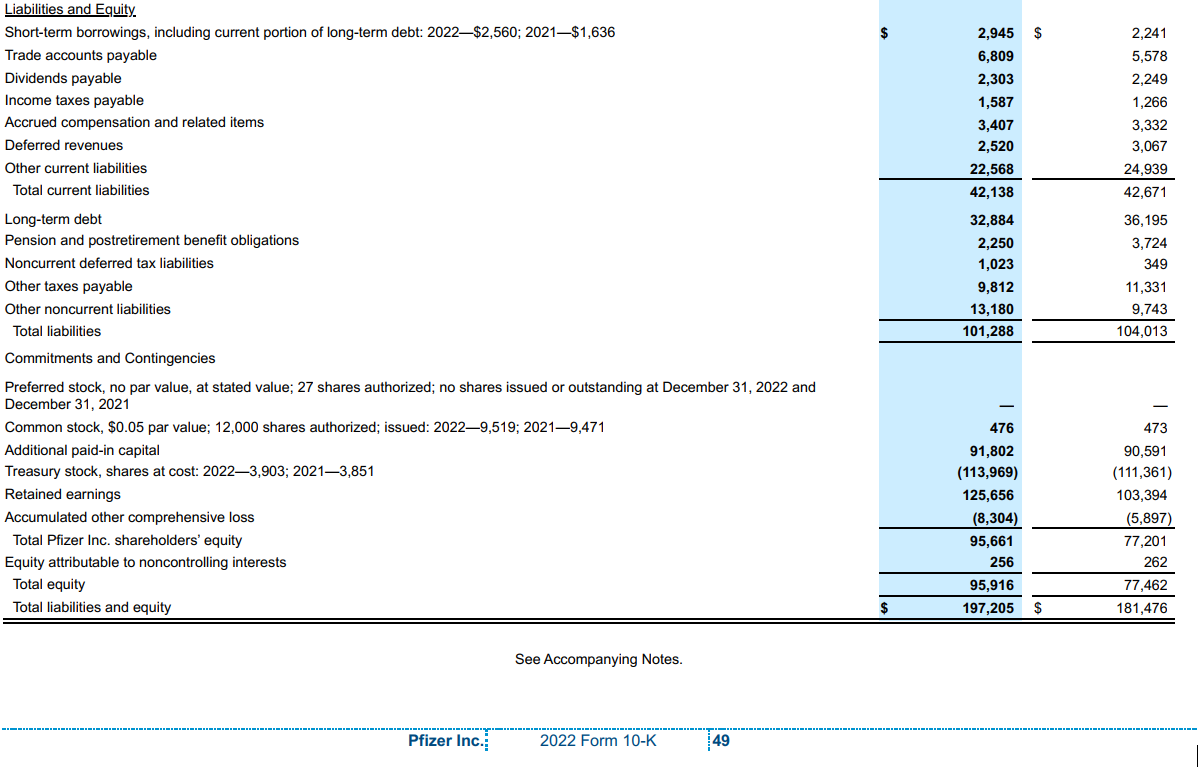
Source: Pfizer, 2022 Form 10-K.
Obviously we jest, but not by much.
Industry practices are a key consideration when formulating a provisions | contingencies disclosure. In preparing this illustration, we examined annual reports | 10-Ks from a range of companies in a range of industries. In comparing the reports | 10-Ks, we strived to compare apples to apples, for example Oracle with SAP, Pfizer with Novo Nordisk, Siemens with GE and ABB, etc.
Note: as ABB is a Swiss company that publishes a US GAAP financial report, it provides a useful window into how US GAAP is perceived and applied by a non-US entity.
For example, Apple's 2022 FORM 10-K: The Company is subject to various legal proceedings and claims that have arisen in the ordinary course of business and that have not been fully resolved. The outcome of litigation is inherently uncertain. In the opinion of management, there was not at least a reasonable possibility the Company may have incurred a material loss, or a material loss greater than a recorded accrual, concerning loss contingencies for asserted legal and other claims.
While Apple may have recorded an accrual, their balance sheet only shows:
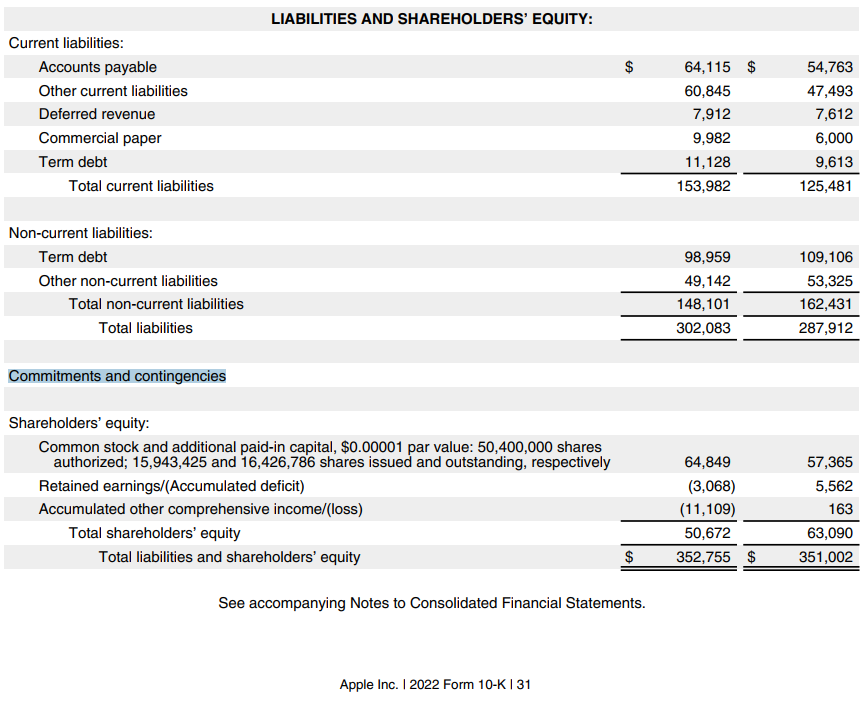
In this, it is comparable to Pfizer's balance sheet .
The difference, while Apple only needs a paragraph to not saying anything, Pfizer's Note 16 with over 5 pages of information that has already been reported in the media, is a master class of what David Byrne might call talking a lot without saying anything.
Since IAS 37.84 to 92 require somewhat more disclosure, companies applying IFRS do go into a bit more detail. However, as a rule, their disclosures are not substantively different. Nevertheless, as IAS 37.84 does require quantifications, companies usually include reconciliations such as this in their footnotes.
Novo Nordisk 2022 annual report:
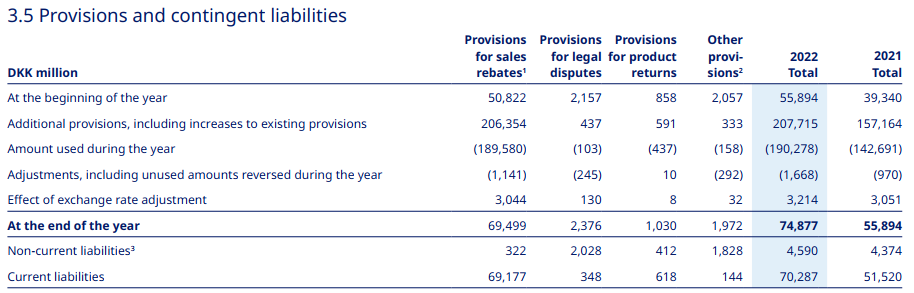
The reason companies avoid too much information: it benefits one stakeholder group at the expense of another.
If a company publishes information useful to plaintiffs and their legal representation, it is generally detrimental to all its other stakeholders.
Specifically, cash paid out as fines and penalties cannot also be used to for dividends, shares buybacks, interest, to pay down debt, to buy equipment, to perform R&D, to hire new employees, to acquire competitors, etc. If, as a result of legal costs, a company goes bankrupt, even the public, which will no longer be able to buy its goods and services, will suffer. The only stakeholder that is generally unaffected, as fines and penalties are usually not tax deductible, the government.
Obviously, we are not trying to suggest companies, or more accurately their management, should not be held accountable for their actions.
What we are trying to suggest, evaluating who's claim is greater: investors, employees, customers, suppliers or those harmed by a company’s actions, is not simple.
Balancing the interests of the various stakeholder groups is a key financial reporting consideration and one that will be picked apart not just by auditors or litigators but, since regulators have become more diligent, ESMA, the SEC, the FCA, the FSA, and so on.
In striking a balance, companies consider both written and (especially with US GAAP) unwritten guidance.
For example, as outlined in IAS 37.85.a | ASC 450-20-50-4, disclosure should include a description of the nature of the obligation | contingency. However IAS 37.85 also specifically states that this should be done by class of provision rather than for each individual provision. The reason, if it were done on a case by case basis, it would not only prejudice the defendant's position by giving plaintiffs too much information, but conflict with attorney-client privilege.
Among the issues raised in the reaction to the exposure draft discussed below is that an estimate of damages provided by an attorney to its client is privileged information. If accounting guidance required disclosing this information, explicitly or implicitly, it would violate that privilege.
More importantly, IAS 37.92 specifically states that disclosure of information that would prejudice the entity's position is not required. While ASC 450-20 does not provide similar, explicit guidance, it cannot be interpreted as requiring any more, or more detailed, disclosure than IFRS.
As discussed in the introduction to this section, ASC 450 (previously FAS 5) is an old standard that does not explicitly require the disclosure of practically any information. To address this deficit, the FASB published an exposure draft, Disclosure of Certain Loss Contingencies - an amendment of FASB Statements No. 5 and 141(R), in June 2008.
To strike a balance between too much and too little information, paragraph 11 had a prejudicial information exemption similar to IAS 37.92. The reason for this exemption was that paragraph 4 required entities to "provide disclosures to assist users of financial statements in assessing the likelihood, timing, and amount of future cash flows associated with loss contingencies that are (or would be) recognized as liabilities in a statement of financial position."
Stakeholder reaction, except the plaintiff’s bar, was not positive, with many commentors implying the ED was a solution looking for a problem.
Besides the breach of attorney-client privilege, another point that kept coming up: this was not a guidance issue. It was a regulatory issue.
Specifically, the existing guidance already gave the SEC the tools to deal with inadequate disclosure. That the SEC was lax in its use of the tools, was not the tools' fault.
Note: a similar point had been made with respect to "cookie jar" restructuring reserves. However, in this case, the FASB could not resist the urge to do the SEC's heavy lifting, so introduced FAS 146.
Surprised by the reaction, the FASB backtracked and published ED 2.0 (Contingencies (Topic 450) - Disclosure of Certain Loss Contingencies) in July 2010. This ED no longer included the prejudicial information exemption because, in the FASB's words, "the proposed amendments would eliminate many of the speculative or predictive disclosures that were proposed in [ED 1.0]."
Obviously, this minor tweak did nothing to appease the opposition. On the contrary, it became fiercer.
So the FASB, as quietly as possible, gave up (link).
How does this affect current GAAP?
Quite simply.
Taken together, the two EDs are an "unwritten" list of informational items that, unless explicitly required by ASC 450, should not be shared with the public.
To measure the obligation, XYZ prepared a schedule, which it (obviously) only shared with its independent auditor.
Legal actions closed or pending in FY X1:
|
Case |
Status |
Unfavorable outcome |
Estimate |
Actual |
|
|
A |
Trial completed; |
certain | |
|
20,000 |
15,000 |
|
B |
Trial completed; |
certain | |
|
15,000 |
25,000 |
|
|
|
|
|
35,000 |
40,000 |
|
|
|
|
Estimate |
||
|
|
|
|
Low |
Best |
High |
|
As discussed in the legal obligation example above, requires ASC 450-20-30-1 a "best" (a.k.a. better than any other) estimate, while IAS 37 specifies a probability weighted average. For the sake of readability, this illustration assumes the two are equal even though, in practice, this will rarely be the case. |
|||||
|
C |
Trial completed; |
virtually certain | |
20,000 |
24,000 |
25,000 |
|
D |
Trial ongoing; |
highly probable | |
23,000 |
40,000 |
45,000 |
|
As discussed in the introduction to this section, IFRS and US GAAP quantify "probable" differently. As a result, IFRS "highly probable" is comparable to US GAAP "probable" while IFRS "probable" is comparable to US GAAP "more likely than not". A more detailed discussion this issue is also available on this page. |
|||||
|
E |
Trial ongoing; |
probable | |
9,000 |
10,000 |
25,000 |
|
XYZ estimated a 50%/50% probability that damages would be assessed. As outlined in IAS 37.14.b, a provision is recognized (taken to the balance sheet) if probable. IAS 37.15 (edited, emphasis added) states: ...a past event is deemed to give rise to a present obligation if, taking account of all available evidence, it is more likely than not that a present obligation exists ... So, while IFRS does not include a conceptual definition of "probable," in the context of IAS 37, it is 50% or more (though it may be different elsewhere). In the past, the IASB used to hold staff days for teachers where academics from all over the world had the opportunity to interact with the IASB staff. During one such meeting in 2012, the topic of probability came up. As the information provided was not particularly satisfying, the attendees asked the staff member in charge "so what are we supposed to tell out students?"
Source: local link. Unfortunately, Google is no longer able to find a link to this file on the IASB's web site.
The staff member replied: "the conceptual framework does not quantify the term probable and it is not used consistently throughout the standards." Being academics, we had been able to read this for ourselves, so we requested a real answer. Eventually, the staff member relented and said "The conceptual farmwork does not quantify the term probable nor is it quantified the standard level. Nevertheless, in practice most practitioners interpret it as 50% or more, auditors interpret it as 50% or more, regulators interpret its 50% or more, at court it is generally interpreted as 50% or more and, when board members discusses probability, they also generally take it to mean 50% or more. However, and this is very important, you may never, ever tell your students that the IFRS conceptual framework, nor any standard, explicitly states that probable should be quantified as 50% or more. Satisfied with this answer, the discussion moved on to other issues. Consequently, XYZ accrued a provision. XYZ estimated a 50%/50% probability that damages would be assessed. ASC 450-20-25-1 establishes three probability thresholds: In practice there are actually 16 thresholds. A discussion of how probability is currently quantified is available on this page. However, for the purpose or recognizing contingencies, three are enough.
As outlined in 450-20-55-13, accrual requires an unfavorable outcome to be probable. As an unfavorable outcome only 50% likely, XYZ did not accrue a contingency. |
|||||
|
F |
Trial ongoing; |
not probable | |
0 |
0 |
40,000 |
|
XYZ estimated a probability of 20% to 30% that damages would be assessed. ASC 450-20-55-15.b, requires disclosure if the probability of an unfavorable outcome is reasonably possible. Per IAS 37.86 disclosure is required if the probability exceeds remote. Potatoes / potátoes. |
|||||
|
G |
Trial threatened; |
highly probable | |
15,000 |
15,000 |
15,000 |
|
H |
Trial threatened; |
probable | |
2,500 |
3,000 |
60,000 |
|
I |
Trial threatened; |
not probable | |
0 |
10,000 |
100,000 |
|
J |
Claim asserted; |
highly probable | |
10,000 |
12,000 |
40,000 |
|
K |
Claim asserted; |
probable | |
5,000 |
15,000 |
25,000 |
|
L |
Claim asserted; |
highly probable | |
5,000 |
8,000 |
10,000 |
|
M |
Claim asserted; |
remote | |
0 |
0 |
80,000 |
|
XYZ estimated a probability of 15% to 20% that damages would be assessed. IAS 37.86 requires disclosure if the probability of an unfavorable outcome exceeds remote. Per ASC 450-20-55-15.b, disclosure is required if it is reasonably possible. Potatoes / potátoes. |
|||||
|
N |
Claim unasserted; |
highly probable | |
2,500 |
5,000 |
80,000 |
|
ASC 450 also provides guidance for unasserted claims. Unasserted claims and assessments are discussed in ASC 450-20-55-1, ASC 450-20-50-6 and ASC 450-20-S99-1. While they are comparable to asserted claims and assessments in that they are accrued if probable and estimable, as they are unasserted, the accounting department may not know they exist. One way to deal with this: send all managers a form asking them to detail any situation where they think the company may have done something that could lead to a lawsuit being filed or threatened. And, while they are at it, if they could throw in an estimate, that would be great. And, adding probability quantifications would also be a nice touch. Oh, by the way, this needs to be submitted at least a month before year end so it can be reviewed and any additional questions posed. While it's not a company, the DOJ has a great form that can be easily adapted (link / local link). No wonder no one wants to sit with the accountants at lunch, they're worse than science hippies (but just as useful). While its example is a bit silly, this site (link) publishes a nice flow chart:
|
|||||
|
O |
Claim unasserted; |
not probable | |
3,000 |
3,000 |
20,000 |
|
P |
Claim unasserted; |
highly probable | |
5,000 |
5,000 |
5,000 |
|
Q |
Claim unasserted; |
remote | |
0 |
0 |
0 |
|
100,000 |
150,000 |
570,000 |
|||
IFRS | US GAAP
|
Before 1.1.X1 Cases A through F were recognized at or before 31.12.X0. |
|
|
|
|
Fines and penalties |
110,000 |
|
|
|
|
Provision A |
|
20,000 |
|
|
Provision B |
|
15,000 |
|
|
Provision C |
|
24,000 |
|
|
Provision D |
|
40,000 |
|
|
Provision E |
|
10,000 |
|
|
Provision F |
|
1,000 |
In the lawsuit, XYZ not only disputed the fact pattern of the events alleged by the plaintiffs but also whether the events themselves created a legal liability. However, after considering the inherent uncertainty associated with legal actions, it consulted legal experts. Unfortunately, these experts could not come to a consensus. Some were of the opinion that XYZ would probably be found liable simply because some juries find for plaintiffs when the defendants are corporation regardless of fact patterns. Some were of the opinion that XYZ’s case was strong enough that even a biased jury would find in its favor. Still others were of the opinion that while the jury could assess damages the verdict would almost certainly be overturned on appeal.
While generally more rational and less capricious than jury trials in common law jurisdictions, judge only trials in statutory law jurisdictions may also be unpredictable.
Another factor international companies need to consider in each particular jurisdiction:
- Are all persons, including the government, are accountable under the law
- Is system based on fair, publicized, broadly understood and stable laws
- Is the legal process fair, robust and accessible, and are the rights and responsibilities based in law evenly enforced
- Is the system populated by diverse, competent, and independent lawyers and judges
Link: rule-of-law .
After considering the opinions of experts, XYZ applied IAS 37.16 as rationally as possible. It assigned IAS 37.16.a to heads, IAS 37.16.b to tails and flipped the coin.
Just kidding.
To make its decision, XYZ considered not only IAS 37 but also the conceptual farmwork where CF 5.18 states (edited): Recognition of a particular asset or liability is appropriate if it provides not only relevant information, but also a faithful representation of that asset or liability and of any resulting income, expenses or changes in equity…
Given that the legal action could, with a greater than remote probability, result in an expense, XYZ concluded that recognizing a provision, as outlined in IAS 37.16.a, would lead to the more faithful representation.
However, before finalizing its decision, XYZ also considered CF 5.20 which explains (edited): the level of uncertainty involved in estimating a measure of an asset or liability may be so high that it may be questionable whether the estimate would provide a sufficiently faithful representation of that asset or liability...
Fortunately, this was not its situation, so XYZ recognized the provision.
As outlined in IAS 37.37, a provision should be measured at the amount an entity would rationally pay to transfer it to a third party. Fortunately DEF, XYZ’s insurance carrier was, as a customer service, willing to give XYZ a binding offer of 1,000 for indemnification in this particular legal proceeding.
An entity may also estimate the amount it would rationally pay to settle the obligation.
However, doing so would require it apply guidance, for example IFRS 17, designed for this purpose which, as discussed in the introduction to this section, most entities try to avoid.
While XYZ did not accept the offer, it did file it away in case its independent auditor decided to test the item.
|
After 1.1.X1 Cases G through Q were recognized between 1.1.X1 and 31.12.X1.
|
|
|
|
|
Fines and penalties |
63,000 |
|
|
|
|
Provision G |
|
15,000 |
|
|
Provision H |
|
3,000 |
|
|
Provision I (for disclosure purposes: 10,000) |
|
0 |
|
As outlined in IAS 37.14.b, if the expenditure is not probable, a provision is not accrued. However, as outlined in IAS 37.86, unless the probability of the expenditure is remote, the obligations is disclosed. As discussed above, companies keep their public disclosures to a minimum. Nevertheless, the adequacy of contingencies recognition is a key audit issue so auditors often review and/or test all contingencies, even if the amounts involved are not objectively material. |
|||
|
|
Provision J |
|
12,000 |
|
|
Provision K |
|
15,000 |
|
|
Provision L |
|
8,000 |
|
|
Provision M |
|
N/A |
|
As outlined in IAS 37.23, if it is not probable an obligation exists, a contingent liability is recognized unless the possibility of an outflow is remote. Similarly, IAS 37.28 specifies that a contingent liability is not disclosed if the possibility of an outflow is remote. |
|||
|
|
Provision N |
|
5,000 |
|
|
Provision O (for disclosure purposes: 3,000) |
|
0 |
|
|
Provision P |
|
5,000 |
|
|
Provision Q |
|
N/A |
|
30.6.X1 During Q2, case A was closed and provision derecognized.
|
|
|
|
|
Provision A |
20,000 |
||
| Fines and penalties |
5,000 |
||
|
|
Cash |
|
15,000 |
|
30.9.X1 During Q3, case B was closed and F dismissed.
|
|
|
|
|
Provision B |
15,000 |
||
|
Provision F |
1,000 |
||
|
Fines and penalties |
9,000 |
|
|
|
|
Cash |
|
25,000 |
|
Before 1/1/X1 Cases A through F were recognized at or before 12/31/X0.
|
|
|
|
|
Fines and penalties |
99,000 |
|
|
|
|
Contingency A |
|
20,000 |
|
|
Contingency B |
|
15,000 |
|
|
Contingency C |
|
24,000 |
|
|
Contingency D |
|
40,000 |
|
|
Contingency E (for disclosure purposes: 10,000) |
|
0 |
|
|
Provision F |
|
0 |
As the expenditure was not probable, the best estimate was not accrued. Nevertheless, an account was created so it could be disclosed.
As discussed above, companies keep their public disclosures to a minimum.
Nevertheless, the adequacy of contingencies recognition is a key audit issue so auditors often review and/or test all contingencies, even if the amounts involved are not objectively material.
In the lawsuit, XYZ not only disputed the fact pattern of the events alleged by the plaintiffs but also whether the events themselves created a legal liability. However, after considering the inherent uncertainty associated with legal actions, it consulted legal experts. Unfortunately, these experts could not come to a consensus. Some were of the opinion that XYZ would probably be found liable simply because some juries find for plaintiffs when the defendants are corporation regardless of fact patterns. Some were of the opinion that XYZ’s case was strong enough that even a biased jury would find in its favor. Still others were of the opinion that while the jury could assess damages the verdict would almost certainly be overturned on appeal.
While generally more rational and less capricious than jury trials in common law jurisdictions, judge only trials in statutory law jurisdictions may also be unpredictable.
Another factor international companies need to consider in each particular jurisdiction:
- Are all persons, including the government, are accountable under the law
- Is system based on fair, publicized, broadly understood and stable laws
- Is the legal process fair, robust and accessible, and are the rights and responsibilities based in law evenly enforced
- Is the system populated by diverse, competent, and independent lawyers and judges
Link: rule-of-law .
ASC 450-20-55-15.b, requires disclosure if the probability of an unfavorable outcome is reasonably possible. Since the probability of an unfavorable outcome was higher than remote, XYZ disclosed the obligation to its independent auditor as outlined in 450-20-50-4.
As discussed above, companies keep their public disclosures to a minimum.
Nevertheless, the adequacy of contingencies recognition is a key audit issue so auditors often review and/or test all contingencies, even if the amounts involved are not objectively material.
As stated in 450-20-30-1 (edited): If some amount within a range of loss appears at the time to be a better estimate than any other amount within the range, that amount shall be accrued. When no amount within the range is a better estimate than any other amount, however, the minimum amount in the range shall be accrued...
In this situation both the best and minimum estimates were zero, so XYZ accrued zero.
|
After 1/1/X1 Cases G through Q were recognized between 1/1/X1 and 31/12X1.
|
|
|
|
|
Fines and penalties |
45,000 |
|
|
|
|
Contingency G |
|
15,000 |
|
|
Contingency H (for disclosure purposes: 3,000) |
|
0 |
|
|
Contingency I (for disclosure purposes: 10,000) |
|
0 |
|
|
Contingency J |
|
12,000 |
|
|
Contingency K (for disclosure purposes: 15,000) |
|
0 |
|
|
Contingency L |
|
8,000 |
|
|
Contingency M |
|
N/A |
|
As outlined in ASC 450-20-55-15.b, disclosure is only required if an unfavorable outcome is reasonably possible. This implies, if is remote, disclosure is not necessary. |
|||
|
|
Contingency N |
|
5,000 |
|
|
Contingency O (for disclosure purposes: 3,000) |
|
0 |
|
|
Contingency P |
|
5,000 |
|
|
Contingency Q |
|
N/A |
|
6/30/X1 During Q2, case A was closed and provision derecognized.
|
|
|
|
|
Contingency A |
20,000 |
||
| Fines and penalties |
5,000 |
||
|
|
Cash |
|
15,000 |
|
9/30/X1 During Q3, case B was closed and F dismissed.
|
|
|
|
|
Contingency B |
15,000 |
||
|
Contingency F |
0 |
||
|
Fines and penalties |
10,000 |
|
|
|
|
Cash |
|
25,000 |
By the end of X1, developments in cases J and L led XYZ to revise damage estimates to 11,000 and 15,000 respectively. Developments in case N led it to revise its damage probability estimate to remote.
As outlined in IAS 37.59 provision are reviewed and, if necessary, adjusted to reflect the current best estimate at the end of each reporting period.
While ASC 450 does specifically not discuss either a review or an adjustment, estimates are, as a general rule, changed as outlined in ASC 250-10-50-4.
As outlined in IAS 37.59, if an outflow is no longer probable, the provision is reversed.
While ASC 450 does specifically not discuss either a review or reversal, estimates are, as a general rule, changed as outlined in ASC 250-10-50-4.
Dr / Cr
|
12/31/X1 | 31.12.X1 |
|
|
|
|
Fines and penalties |
1,000 |
||
|
Provision | Contingency J |
1,000 |
|
|
|
Provision | Contingency N |
5,000 |
|
|
|
|
Provision | Contingency L |
|
7,000 |