Your browser does not support JavaScript!

Basic GAAP Chart of Accounts

This basic GAAP chart of accounts reflects basic FASB guidance.

The advanced, expanded (multidimensional) and XBRL cross referenced COAs are suitable for entities that need to produce financial reports fully consistent with all FASB guidance.

Advanced COA Expanded COA With XBRL cross references

Each of the above COAs may downloaded in machine readable format in Pro view.

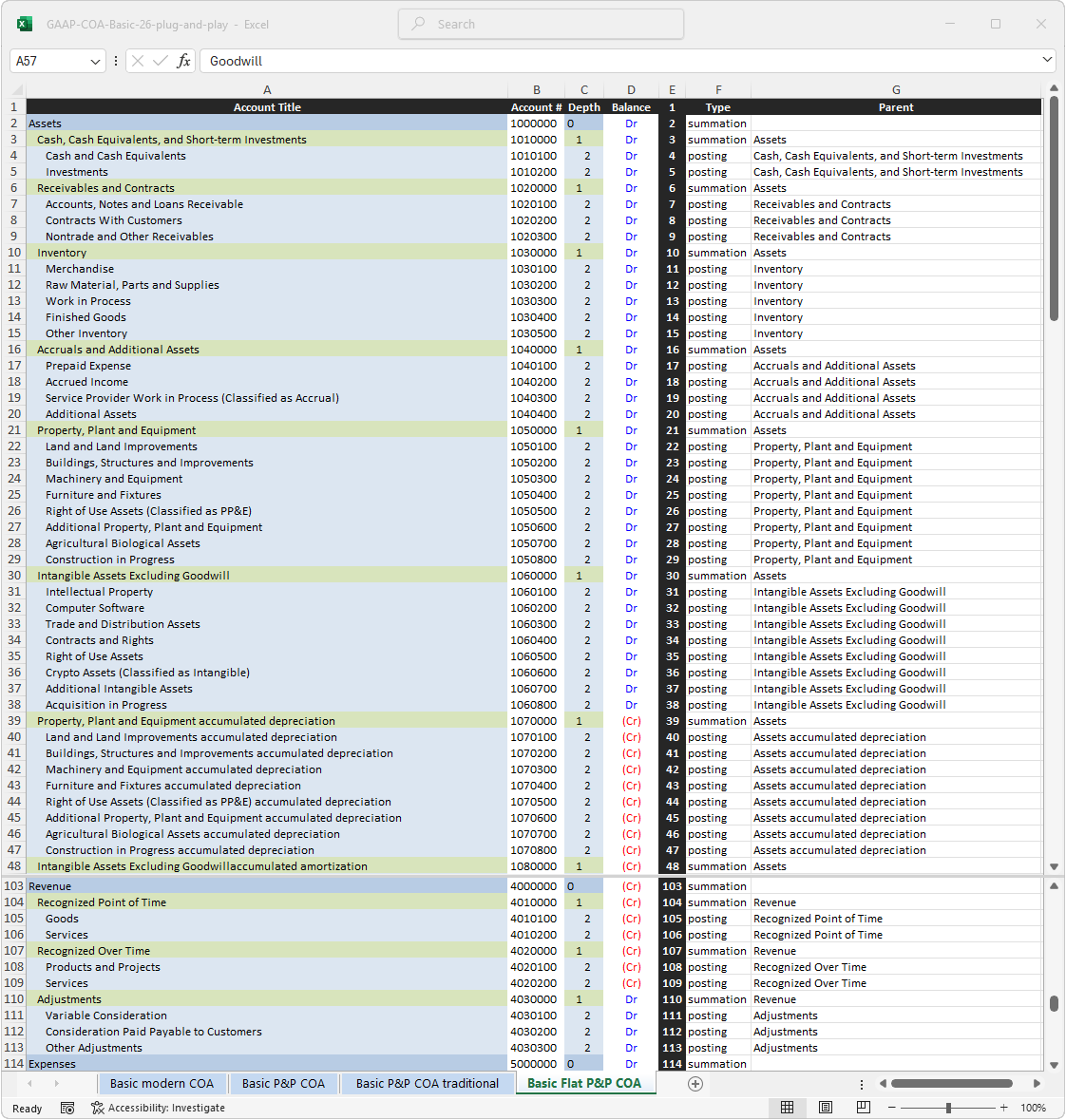
A COA may be incorporated into reporting structure in many ways. Nevertheless, Excel remains the lingua franca of accounting.

On the other hand, some ERP implantation professionals require data structured as CSV or TSV. To accommodate fulfill this requirement, read this.

First, ensure you have a functioning version of Python with the Pandas and Openpyxl libraries installed. Next, download the zip file that contains the script Excel-to-CSV.zip. Place both the COA and the script into the same folder. Rename the COA exactly Excel-TSV-Input.xlsx and run the script.

To convert the TSV back, simply copy Excel-TSV-Output.csv to Excel and use the Text to Columns function. Leave the delimiter set to the default Tab. Please be aware, this will strip all formatting, so the Depth column is critical for retaining COA's hierarchy.

Pro view includes additional scripts illustrating how to generate a dynamic hierarchical COA from an Excel source file. It also includes scripts to map the output to balance sheet and P&L in IFRS or US GAAP format (also in Excel).

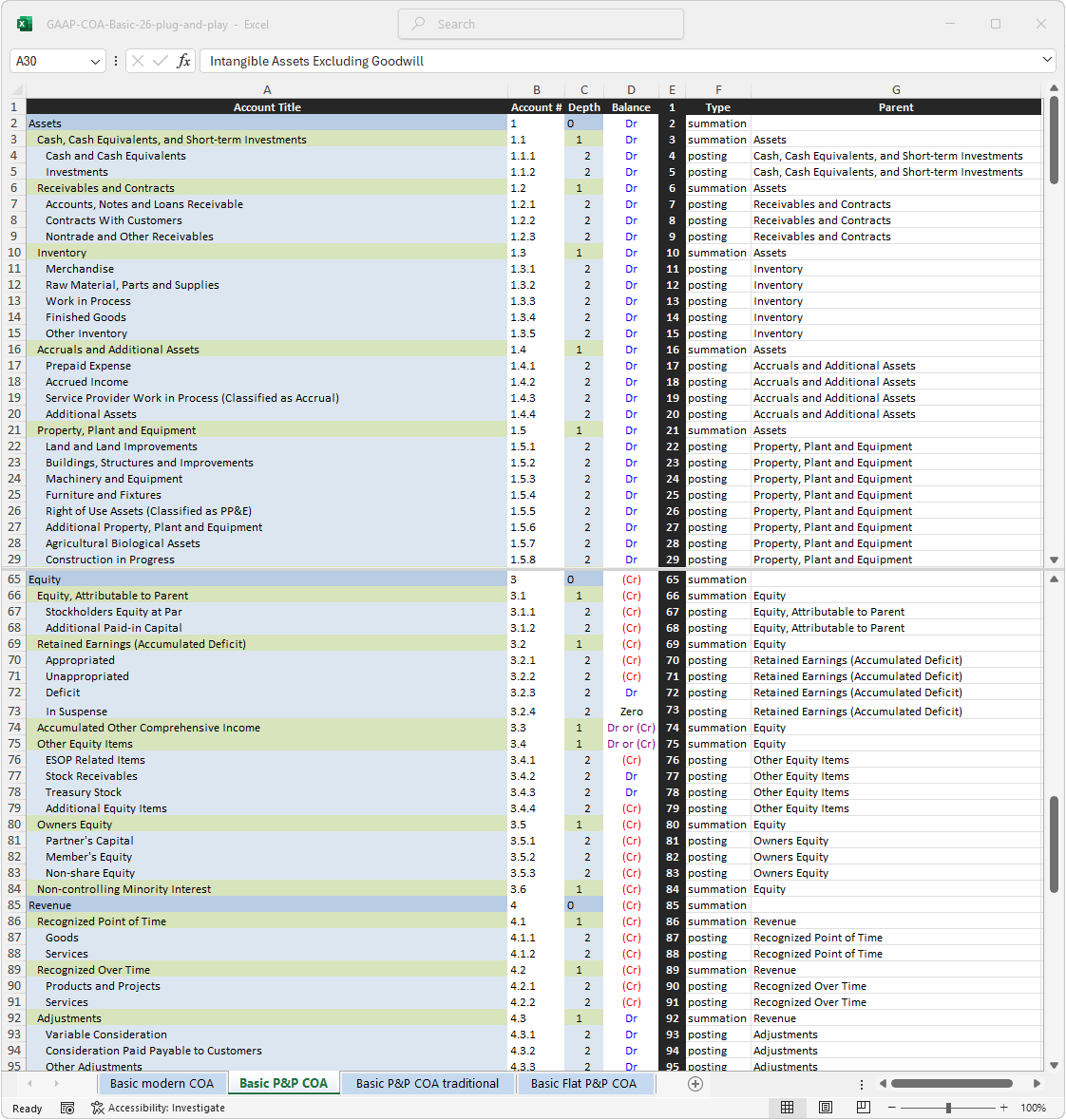
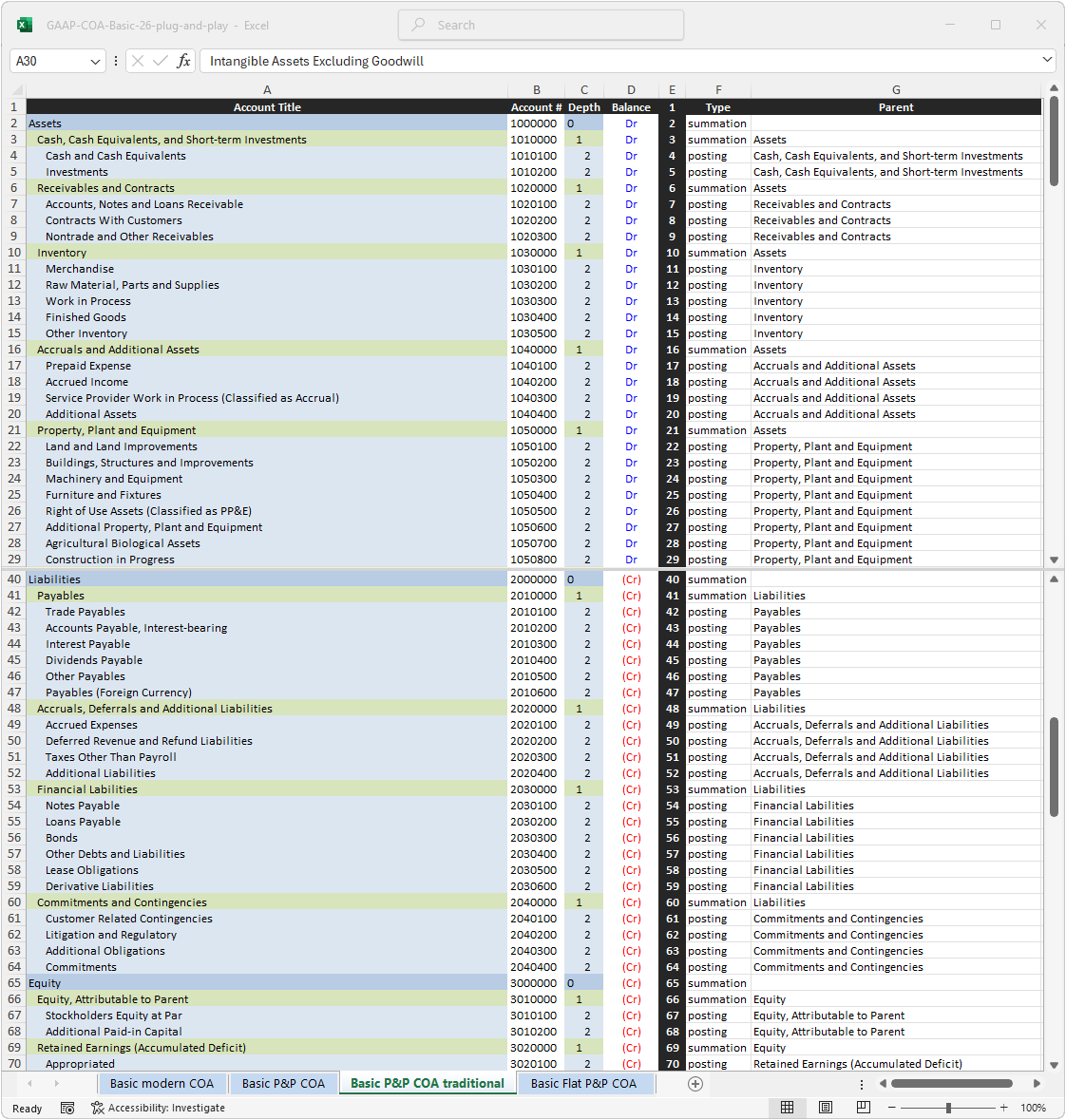
Account Title Account # Depth Balance 1
Assets 1 0 Dr 2
Cash, Cash Equivalents, and Short-term Investments 1.1 1 Dr 3
Cash and Cash Equivalents 1.1.1 2 Dr 4
Investments 1.1.2 2 Dr 5
Receivables and Contracts 1.2 1 Dr 6
Accounts, Notes and Loans Receivable 1.2.1 2 Dr 7
Contracts With Customers 1.2.2 2 Dr 8
Nontrade and Other Receivables 1.2.3 2 Dr 9
Inventory 1.3 1 Dr 10
Merchandise 1.3.1 2 Dr 11
Raw Material, Parts and Supplies 1.3.2 2 Dr 12
Work in Process 1.3.3 2 Dr 13
Finished Goods 1.3.4 2 Dr 14
Other Inventory 1.3.5 2 Dr 15
Accruals and Additional Assets 1.4 1 Dr 16
Prepaid Expense 1.4.1 2 Dr 17
Accrued Income 1.4.2 2 Dr 18
Additional Assets 1.4.3 2 Dr 19
Property, Plant and Equipment 1.5 1 Dr 20
Land and Land Improvements 1.5.1 2 Dr 21
Buildings, Structures and Improvements 1.5.2 2 Dr 22
Machinery and Equipment 1.5.3 2 Dr 23
Furniture and Fixtures 1.5.4 2 Dr 24
Right of Use Assets (Classified as PP&E) 1.5.5 2 Dr 25

A right to use an asset is a contractual right. Thus, the right-to-use asset (ROU) is, strictly speaking, always intangible. Nevertheless, the FASB-defined XBRL taxonomy includes: PropertyPlantAndEquipmentAndFinanceLeaseRightOfUseAssetAfterAccumulatedDepreciationAndAmortizationAbstract.

This implies that the right to use, for example, a building would comprise PP&E.

Note: provided the right-of-use asset is recognised on the balance sheet, the guidance (ASC 842-20-45-1 to 3) is flexible about how it is presented. For example, a leased building may be presented within the “Buildings” line item rather than on a separate “right-of-use asset” line, as long as the notes explain that the amount relates to a leased (right-of-use) building rather than an owned building. From an internal accounting perspective, the building could thus be posted either to the Buildings account with a metadata flag indicating that it is an ROU or to the ROU account with metadata describing the underlying asset as a building.

Additional Property, Plant and Equipment 1.5.6 2 Dr 26
Construction in Progress 1.5.7 2 Dr 27
Intangible Assets Excluding Goodwill 1.6 1 Dr 28
Intellectual Property 1.6.1 2 Dr 29
Computer Software 1.6.2 2 Dr 30
Trade and Distribution Assets 1.6.3 2 Dr 31
Contracts and Rights 1.6.4 2 Dr 32
Right of Use Assets 1.6.5 2 Dr 33

A right to use an asset is a contractual right. Thus, the right-to-use asset (ROU) is, strictly speaking, always intangible. Nevertheless, the FASB-defined XBRL taxonomy includes : PropertyPlantAndEquipmentAndFinanceLeaseRightOfUseAssetAfterAccumulatedDepreciationAndAmortizationAbstract.

This implies the right to use, for example, a building should be classified an ROU within PP&E (above) even though the right is clearly intangible.

With intangible assets, such issues do not arise.

However, while both are clearly intangible, a, for example, leased patent differs from an owned patent. Nevertheless, recognizing both owned and leased patents on the same "Patents" account would not be incorrect, and would actually be preferable, provided additional metadata (facilitating the required footnoted discloses) is associated with the leased patents.

Alternatively, while not particularly elegant, separate "Patent" and "Right-to-use Patent" accounts could be used. While it would lead to fragmented and counterintuitive accounting, it would not be inconsistent with the the guidance.

ASC 842-20-45-1 states (emphasis added): A lessee shall either present in the statement of financial position or disclose in the notes all of the following: a. Finance lease right-of-use assets and operating lease right-of-use assets separately from each other and from other assets ...

ASC 842-20-45-2 clarifies this guidance by stating: If a lessee does not present finance lease and operating lease right-of-use assets and lease liabilities separately in the statement of financial position, the lessee shall disclose which line items in the statement of financial position include those right-of-use assets and lease liabilities.

In practice, the preferred approach would be to recognize, for example, both owned and leased patents as "Patents" and simply provide additional discourse of the values of the leased versus owned patents.

It would not, however, be incorrect to recognize owned patents as "Patents" and leased patents as "Rights to Use Patents" in which case, assuming the values are clearly distinguished on the balance sheet, they would not need to be reiterated in the footnotes.

Crypto Assets 1.6.6 2 Dr 34

While crypto assets have more in common with financial assets than intangible assets, ASC 350-60-15-1.a defines: a. Meet the definition of intangible assets as defined in the Codification ... d. Are secured through cryptography... The 2026 FASB-approved XBRL taxonomy (link) likewise places CryptoAssetFairValue on the balance sheet as a separate line item directly below intangible assets and above right-of-use assets.

Additional Intangible Assets 1.6.7 2 Dr 35
Acquisition in Progress 1.6.8 2 Dr 36
Goodwill 1.7 1 Dr 37
Liabilities 2 0 (Cr) 38
Payables 2.1 1 (Cr) 39
Trade Payables 2.1.1 2 (Cr) 40
Interest Payable 2.1.2 2 (Cr) 41
Dividends Payable 2.1.3 2 (Cr) 42
Other Payables 2.1.4 2 (Cr) 43
Accruals, Deferrals and Additional Liabilities 2.2 1 (Cr) 44
Accrued Expenses 2.2.1 2 (Cr) 45
Deferred Revenue and Refund Liabilities 2.2.2 2 (Cr) 46
Taxes Other Than Payroll 2.2.3 2 (Cr) 47
Additional Liabilities 2.2.4 2 (Cr) 48
Financial Liabilities 2.3 1 (Cr) 49
Notes Payable 2.3.1 2 (Cr) 50
Loans Payable 2.3.2 2 (Cr) 51
Bonds 2.3.3 2 (Cr) 52
Other Debts and Liabilities 2.3.4 2 (Cr) 53
Lease Obligations 2.3.5 2 (Cr) 54
Derivative Liabilities 2.3.6 2 (Cr) 55
Commitments and Contingencies 2.4 1 (Cr) 56
Customer Related Contingencies 2.4.1 2 (Cr) 57
Litigation and Regulatory 2.4.2 2 (Cr) 58
Additional Obligations 2.4.3 2 (Cr) 59
Commitments 2.4.4 2 (Cr) 60
Equity 3 0 (Cr) 61
Equity, Attributable to Parent 3.1 1 (Cr) 62
Stockholders Equity at Par 3.1.1 2 (Cr) 63
Additional Paid-in Capital 3.1.2 2 (Cr) 64
Retained Earnings (Accumulated Deficit) 3.2 1 (Cr) 65
Appropriated 3.2.1 2 (Cr) 66
Unappropriated 3.2.2 2 (Cr) 67
Deficit 3.2.3 2 Dr 68
In Suspense 3.2.4 2 Zero 69
Accumulated Other Comprehensive Income 3.3 1 Dr or (Cr) 70
Other Equity Items 3.4 1 Dr or (Cr) 71
ESOP Related Items 3.4.1 2 (Cr) 72
Stock Receivables 3.4.2 2 Dr 73
Treasury Stock 3.4.3 2 Dr 74
Additional Equity Items 3.4.4 2 (Cr) 75
Owners Equity 3.5 1 (Cr) 76
Partner's Capital 3.5.1 2 (Cr) 77
Member's Equity 3.5.2 2 (Cr) 78
Non-share Equity 3.5.3 2 (Cr) 79
Non-controlling Minority Interest 3.6 1 (Cr) 80
Revenue 4 0 (Cr) 81
Recognized Point of Time 4.1 1 (Cr) 82
Goods 4.1.1 2 (Cr) 83
Services 4.1.2 2 (Cr) 84
Recognized Over Time 4.2 1 (Cr) 85
Products and Projects 4.2.1 2 (Cr) 86
Services 4.2.2 2 (Cr) 87
Adjustments 4.3 1 Dr 88
Variable Consideration 4.3.1 2 Dr 89
Consideration Paid Payable to Customers 4.3.2 2 Dr 90
Other Adjustments 4.3.3 2 Dr 91
Expenses 5 0 Dr 92
Expenses (Classified by Nature) 5.1 1 Dr 93
Material and Merchandise 5.1.1 2 Dr 94
Employee Benefits 5.1.2 2 Dr 95
Services 5.1.3 2 Dr 96
Rent, Depreciation, Amortization and Depletion 5.1.4 2 Dr 97
Expenses (Classified by Function) 5.2 1 Dr 98
Cost of Revenue 5.2.1 2 Dr 99
Selling, General and Administrative Expense 5.2.2 2 Dr 100
Other Non-operating Income and Expenses 6 0 Dr or (Cr) 101
Other Revenue and Expenses 6.1 1 Dr or (Cr) 102
Other Revenue 6.1.1 2 (Cr) 103
Other Expenses 6.1.2 2 Dr 104
Gains and Losses 6.2 1 Dr or (Cr) 105
Taxes Other Than Income and Payroll and Fees 6.3 1 Dr 106
Income Tax Expense or Benefit 6.4 1 Dr or (Cr) 107
Intercompany and related party accounts 7 0 Dr or (Cr) 108
Intercompany and related party assets 7.1 1 Dr 109
Intercompany balances eliminated in consolidation 7.1.1 2 Dr 110
Related party balances reported or disclosed 7.1.2 2 Dr 111
Intercompany investments 7.1.3 2 Dr 112
Intercompany and related party liabilities 7.2 1 (Cr) 113
Intercompany balances eliminated in consolidation 7.2.1 2 (Cr) 114
Related party balances reported or disclosed 7.2.2 2 (Cr) 115
Intercompany and related party income and expense 7.3 1 Dr or (Cr) 116
Intercompany and related party income 7.3.1 2 (Cr) 117
Intercompany and related party expenses 7.3.2 2 Dr 118
Income loss from equity method investments 7.3.3 2 Dr or (Cr) 119

Updated: January 2026.

The 2026 XBRL version has been updated with cross-references to the 2026 FASB issued XBRL taxonomy.

Copyright

The COA published on this page may be republished provided the following citation is provided:

Source: https://www.ifrs-gaap.com/chart-accounts.